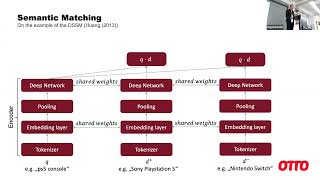
Unbiased Neural Ranking Model for Product Search
Explore an unbiased neural ranking model for product search, leveraging implicit customer feedback and addressing position bias to improve e-commerce search results.
The Era of 1-bit LLMs Explained - BitNet b1.58 and New Scaling Laws
Explore groundbreaking research on BitNet b1.58, a ternary parameter model matching full-precision Transformers while offering improved cost-effectiveness and defining new LLM scaling laws.
Foundation Models and the Transfer of Embodied Autonomy
Explore challenges in developing foundation models for sequential decision-making, including transfer learning, and discuss future research directions in embodied autonomy.

How to Finetune and Develop Your Own Large Language Model
Explore techniques for fine-tuning and developing custom large language models, enhancing your AI capabilities and understanding of advanced NLP concepts.
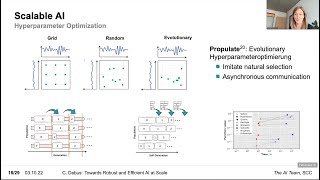
Towards Robust and Efficient AI at Scale
Explore robust, efficient AI for scientific time series forecasting. Learn scalable transformer architectures, energy optimization, and balancing performance with sustainability in large-scale AI applications.
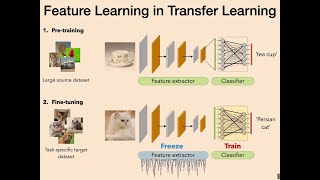
Foundations for Feature Learning via Gradient Descent
Explore the theoretical foundations of feature learning in modern machine learning models, focusing on gradient descent's role in extracting useful features and representations from data.
Very Few Parameter Fine-Tuning with ReFT and LoRA
Explore advanced fine-tuning techniques ReFT and LoRA for efficient parameter optimization in transformer models. Learn implementation, comparison, and practical tips for improved model performance.
Introduction to Language Models - LLMs, Prompt Engineering, and Architectures
Explore language models, covering generative AI, LLMs, encoders, prompt engineering, and transformer architecture. Gain insights into embeddings, attention mechanisms, and model limitations.
Vision Transformer - Lecture 16
Dive into Vision Transformers architecture and implementation, exploring their role in computer vision tasks through expert insights and practical applications in machine learning.
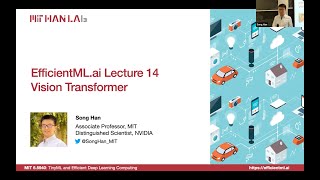
Vision Transformer - Lecture 14
Explore Vision Transformers in deep learning, covering architecture, training, and applications. Gain insights into this powerful model for computer vision tasks.
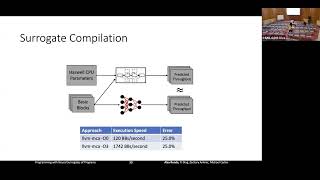
Programming with Neural Surrogates of Programs
Explore neural surrogates for program optimization, including case studies on CPU simulators and techniques like the Renamer and Turaco for constructing efficient program surrogates.

Generative Sequence Models for Sequential Decision Making
Explore generative sequence models for decision-making under uncertainty. Learn how Transformer architecture and language modeling advances can enhance offline learning, online exploration, and multi-task generalization in AI.
Reducing Hallucinations in Conversational Systems
Discover effective strategies for minimizing AI hallucinations through prompt engineering techniques, ethical considerations, and bias mitigation in large language models.

NVIDIA HYMBA: A Hybrid-Head Architecture for Small Language Models with MetaTokens
Explore NVIDIA's Hymba hybrid architecture combining transformer attention and state-space models, featuring innovative meta tokens and memory optimizations for enhanced language model performance and efficiency.
Mixture of Transformers for Multi-modal Foundation Models
Explore Meta's Mixture-of-Transformers (MoT) architecture, a revolutionary approach to handling multi-modal AI tasks combining text, speech, images, and videos with enhanced efficiency and performance.