Innovations in Theoretical Computer Science 2020 - Session 10
Explores cutting-edge research in theoretical computer science, covering topics like computational hardness, random strings, decision trees, and pseudorandomness. Features presentations from leading experts in the field.
The Power of Graph Learning - Richard M. Karp Distinguished Lecture
Explore graph learning's applications, methods, and theoretical foundations. Discover connections between graph learning and database theory for insights into expressive power potential.
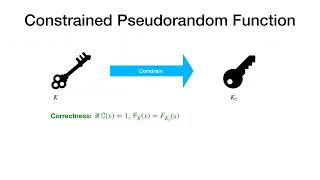
Pseudorandom Functions - Eurocrypt 2023 Session
Explore cutting-edge research on pseudorandom functions in cryptography, featuring presentations from leading experts at the prestigious Eurocrypt 2023 conference.
Zero-Knowledge Proofs - Advanced Concepts and Applications - Session 1 Continuation
Explore cutting-edge developments in zero-knowledge proofs and their applications in cryptography at this advanced Eurocrypt 2023 session.
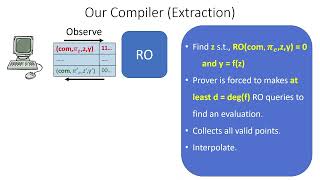
Zero-Knowledge Proofs - Session 1
Explore cutting-edge research on zero-knowledge proofs and cryptographic protocols in this advanced session from a leading cryptography conference.
Improving Oracle-Guided Inductive Synthesis by Efficient Question Selection
Explore efficient question selection in Oracle-Guided Inductive Synthesis. Learn about LearnSy, a novel selector improving OGIS solver performance through effective and efficient optimization techniques.
Combining Dependency, Grades, and Adjoint Logic in Type Systems
Explore new dependent type systems combining graded/linear types with modal operators and Adjoint Logic. Delve into meta-theoretic properties and graded substitution in advanced type theory.
Visualizing a Nondeterministic to Deterministic Finite-State Machine Transformation
Explore the visualization of transforming nondeterministic finite-state machines to deterministic ones in this insightful presentation.
Visualizing Why Nondeterministic Finite-State Automata Reject
Explore visual techniques for understanding rejection in nondeterministic finite-state automata, enhancing comprehension of complex computational concepts.
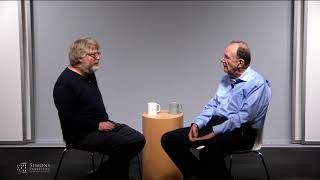
Oral History - Russell Impagliazzo in Conversation with Dick Karp
Explore key developments in theoretical computer science through an engaging conversation between Russell Impagliazzo and Dick Karp, covering topics from NP-completeness to computational biology.
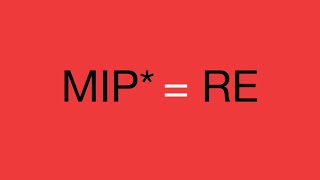
MIP* = RE
Explore the intersection of physics, mathematics, and computer science through a two-player game, delving into quantum mechanics, operator algebras, and interactive proofs.
Pseudorandomness: From Quantum States to Binary Strings
Explore quantum pseudorandom generators, their construction from logarithmic-output pseudorandom quantum states, and applications in cryptography beyond classical one-way functions.
Pseudopolynomial-Time Algorithms for Optimization Problems
Explore fine-grained complexity theory and best-possible algorithms for discrete optimization problems, focusing on Subset Sum and related challenges in theoretical computer science.
Recent Progress on the KLS Conjecture
Explore recent advancements in the KLS conjecture, its implications, and the stochastic localization technique used to achieve current best bounds for the Cheeger isoperimetric coefficient.
Matthias Mnich - Time- and Space-Optimal Algorithms for the Many-Visits TSP
Optimizing algorithms for the many-visits TSP problem, improving time and space complexity while maintaining logarithmic dependence on tour length. Discusses applications and compares with previous work.
Proof Mining in Bounded Arithmetic
Explore proof mining in bounded arithmetic, focusing on computational content, complexity classes, and applications in mathematical logic and theoretical computer science.
Leslie G. Valiant - Turing Award Lecture 2010
Explore computational learning theory, machine learning, and brain modeling with Leslie G. Valiant, 2010 ACM Turing Award winner, as he discusses his groundbreaking research and insights.
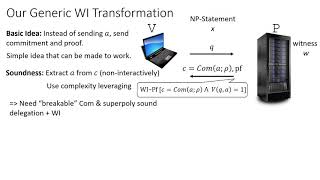
Witness Indistinguishability for Any Single-Round Argument with Applications to Access Control
Explore witness indistinguishability in single-round arguments and its applications to access control, presented by Brakerski and Kalai at PKC 2020.
What Computers Can't Do - With Kevin Buzzard
Explore the P vs NP problem in computer science with mathematician Kevin Buzzard, delving into computational complexity, security implications, and unsolved mathematical challenges.
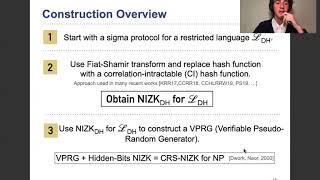
Non-Interactive Zero-Knowledge in Pairing-Free Groups from Weaker Assumptions
Explore advanced cryptographic techniques for non-interactive zero-knowledge proofs in pairing-free groups, focusing on improved constructions and weaker assumptions.
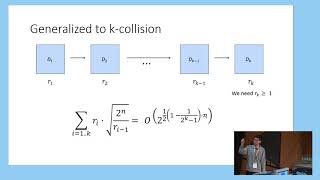
On Finding Quantum Multi-Collisions
Explore quantum multi-collision finding, its complexity, and comparison to classical methods. Learn about "The Reciprocal Plus 1" rule and quantum lazy sampling techniques.