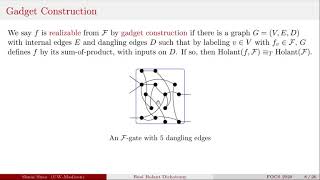
A Dichotomy for Real Boolean Holant Problems
Explore the complexity classification of real-valued Boolean Holant problems, focusing on tractable signatures, gadget construction, and induction proofs for a comprehensive dichotomy theorem.
How to Start Using Coroutines
Learn to implement and utilize C++20 coroutines with practical examples and a custom library, exploring their benefits and applications in modern programming.
How to Delegate Computations - The Power of No-Signaling Proofs
Explore the concept of delegating computations and the significance of no-signaling proofs in cryptography, presented by expert Yael Tauman Kalai at Crypto 2014.
Revisiting Trade-Offs and Impossibility Theorems
Explore trade-offs and impossibility theorems in computing, examining fundamental limitations and potential solutions in algorithmic design and system architecture.

Computer Science - A Guide for the Perplexed
Explore computer science through the lens of real-world problems, bridging the gap between academic theory and practical applications. Gain insights from Erlang's inventor on solving user challenges.
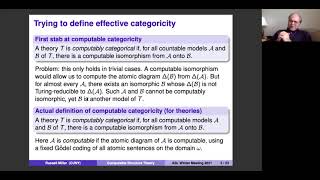
Computable Structure Theory with Noncomputable Structures
Explore computable structure theory, categoricity, and noncomputable structures in mathematics, focusing on fields and isomorphism types of subfields.
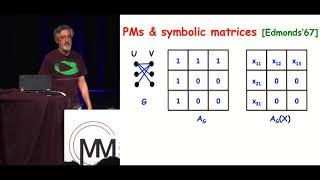
Alternate Minimization and Scaling Algorithms - Theory, Applications and Connections Across Mathematics and Computer Science
Explore alternate minimization and scaling algorithms, their applications, and connections across mathematics and computer science with Avi Wigderson's in-depth lecture.
Different Problems, Common Threads - Computing the Difficulty of Mathematical Problems
Explore mathematical problem complexity, computability, and reverse mathematics with Karen Lange's insightful analysis of theorems, algorithms, and foundational concepts.
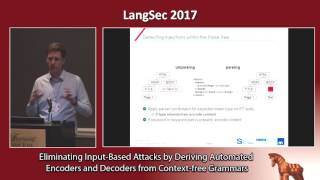
Eliminating Input-Based Attacks by Deriving Automated Encoders and Decoders from Context-Free Grammars
Learn to derive automated encoders and decoders from context-free grammars to eliminate input-based attacks, enhancing security in complex language communication systems.
A Simpler Variant of Universally Composable Security for Standard Multiparty Computation
Simplified approach to universal composability in multiparty computation, addressing complexity issues and offering a more accessible framework for secure protocols.
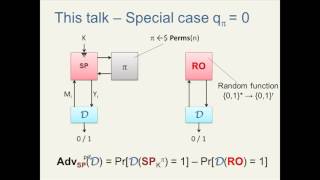
The Exact PRF Security of Truncation - Tight Bounds for Keyed Sponges and Truncated CBC
Explore pseudorandom functions, HMAC, sponge construction, and truncated CBC, examining security bounds and proof challenges in cryptographic primitives.
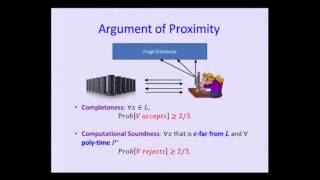
Arguments of Proximity
Explore sublinear-time verification, interactive proofs of proximity, and arguments of proximity in cryptography, focusing on bounded depth computation and recent advancements.
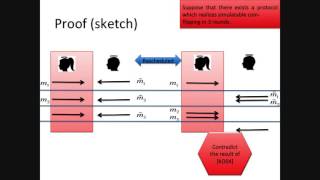
The Exact Round Complexity of Secure Computation
Explore the precise round complexity in secure computation, examining theoretical foundations and practical implications for cryptographic protocols.
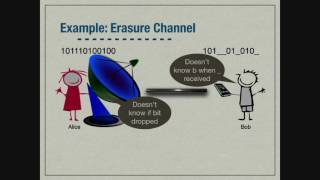
All Complete Functionalities are Reversible
Explore the concept of reversibility in complete functionalities, examining its implications and applications in cryptography and secure computation.
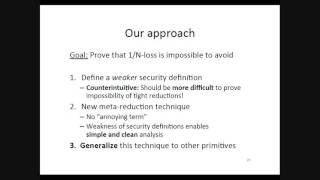
On the Impossibility of Tight Cryptographic Reductions
Explore the limitations of tight cryptographic reductions and their implications for security proofs in cryptography.
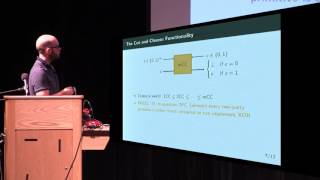
Adaptive Versus Non Adaptive Strategies in the Quantum Setting with Applications
Explore quantum strategies, comparing adaptive and non-adaptive approaches, and their applications in cryptography and information theory.
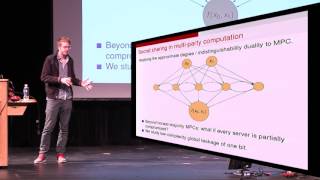
Bounded Indistinguishability and the Complexity of Recovering Secrets
Explore cryptographic concepts of bounded indistinguishability and secret recovery complexity, delving into advanced theoretical aspects of information security and computational theory.
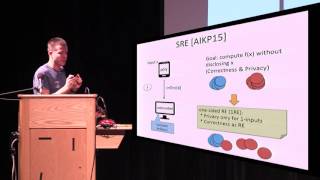
On the Relationship between Statistical Zero Knowledge and Statistical Randomized Encodings
Explore the connection between statistical zero knowledge and randomized encodings in cryptography, examining their similarities and differences.
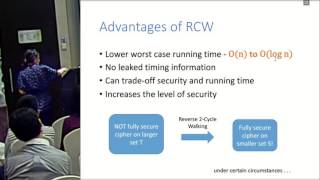
Reverse Cycle Walking and Its Applications
Explore reverse cycle walking in cryptography, its applications, and analysis of mixing time using path coupling. Learn about format-preserving encryption and matching exchange processes.
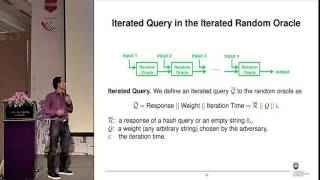
Iterated Random Oracle - A Universal Approach for Finding Loss in Security Reduction
Explore iterated random oracles as a universal approach for finding loss in security reductions, focusing on IND-computational hard problems and their applications in cryptography.
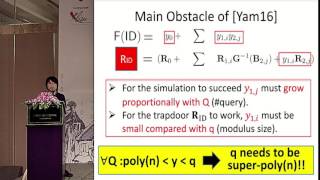
Partitioning via Non Linear Polynomial Functions - More Compact IBEs from Ideal Lattices
Explore advanced cryptography concepts including adaptive security, simulation trapdoors, and Fourier IBE in this technical talk on partitioning via non-linear polynomial functions for compact IBEs from ideal lattices.