Practical Uses of Program Analysis - Automatic Exploit Generation
Explore automatic exploit generation through program analysis techniques, including instrumentation and symbolic execution, with practical demonstrations and tool insights.
Cyber Grand Shellphish - Shellphish and the DARPA Cyber Grand Challenge
Explore autonomous hacking with Mechanical Phish, a system for automatic bug detection, exploit creation, and binary patching. Learn about its design, challenges, and implementation in the DARPA Cyber Grand Challenge.
Leveraging the Power of Automated Reasoning - USENIX Enigma Conference - 2017
Explores automated bug detection and security exploit generation using symbolic execution and SMT solvers, showcasing their application in Web security analysis and potential for broader automation.
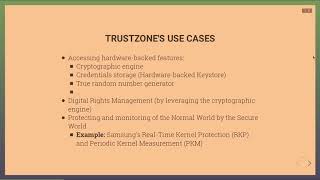
Breaking Samsung's ARM TrustZone
Explore Samsung's TrustZone vulnerabilities and learn techniques to exploit trusted components, execute high-privilege code, and bypass security measures in ARM-based systems.
Code Deobfuscation - Intertwining Dynamic, Static and Symbolic Approaches
Explore advanced code deobfuscation techniques combining dynamic, static, and symbolic approaches to enhance software analysis and reverse engineering capabilities.
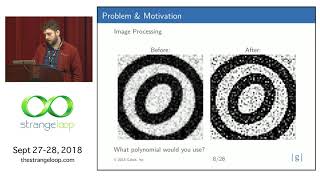
Your Secrets Are Safe with Julia - A Compiler for Secure Computation
Explore Ramparts, a compiler translating Julia code for homomorphic encryption, enabling secure computation on encrypted data without cryptography expertise.
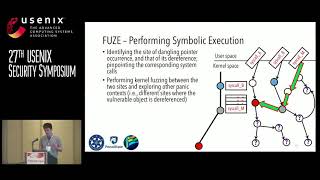
FUZE - Towards Facilitating Exploit Generation for Kernel Use-After-Free Vulnerabilities
Explore automated exploit generation for kernel Use-After-Free vulnerabilities using FUZE framework, enhancing security analysis efficiency and exploitability evaluation for complex OS kernels.
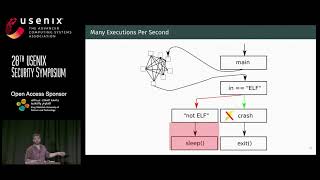
AntiFuzz - Impeding Fuzzing Audits of Binary Executables
Explore techniques to protect binary executables against automated bug-finding tools, focusing on impeding fuzzing, symbolic execution, and hybrid fuzzing approaches while maintaining performance.
Bringing the Power of Symbolic Execution to the Fight Against Malicious Excel 4 Macros
Explore Symbexcel, a tool using symbolic execution to analyze and detect malicious Excel 4.0 macros, enhancing cybersecurity against this common attack vector.
Assessing and Exploiting BigNum Vulnerabilities
Explore vulnerabilities in multi-precision integer arithmetic used in cryptography implementations. Learn bug patterns, exploitation techniques, and strategies for automated vulnerability detection.
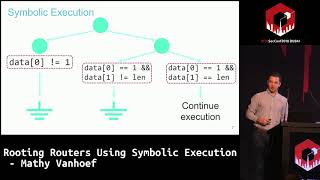
Rooting Routers Using Symbolic Execution
Explore advanced techniques for exploiting router vulnerabilities using symbolic execution, uncovering potential security flaws in network devices.
T-Fuzz - Fuzzing by Program Transformation
Innovative fuzzing technique that removes input checks to explore deeper code paths, improving bug discovery in software. Combines program transformation with symbolic execution for effective results.
How the BIOS Assures Its Handling of Inputs
Explore BIOS input handling, firmware interfaces, and analysis techniques for formal validation and vulnerability detection, including static, dynamic, and symbolic execution approaches.
SymCerts - Practical Symbolic Execution for Exposing Noncompliance in X.509 Certificate Validation
Explore practical symbolic execution techniques to uncover noncompliance in X.509 certificate validation implementations, enhancing security in SSL/TLS protocols and IoT systems.
Contemporary Automatic Program Analysis
Explore automatic program analysis techniques for vulnerability discovery, from historical context to cutting-edge methods, with practical examples and demos for effective security research.
How to Grow a TREE from CBASS
Innovative binary analysis toolset for cross-platform programs. Integrates with IDA Pro, enabling interactive visualization and on-demand analysis for efficient reverse engineering and vulnerability detection.
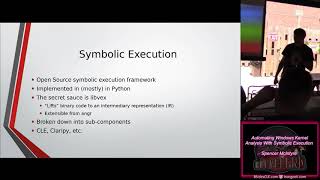
Automating Windows Kernel Analysis With Symbolic Execution
Explore automated Windows kernel analysis using symbolic execution techniques for enhanced security and vulnerability detection.
Symbolically Executing a Fuzzy Tyrant
Explore symbolic execution and fuzzing techniques for software security analysis, focusing on practical applications and advanced methodologies.
Compiling Your Story - Using Techniques from Compiler Design to Check Your Narrative
Explore compiler techniques applied to narrative design, enhancing dialogue error-checking and streamlining testing processes for branching stories in game development.
Hardware Is the New Software - Finding Exploitable Bugs in Hardware Designs
Explore techniques for identifying and exploiting security vulnerabilities in hardware designs, focusing on RISC-V and OR1k CPU architectures using innovative tools and symbolic execution.
Owi: An Interpreter and Toolkit for WebAssembly in OCaml
Explore Owi, an OCaml-based interpreter and toolkit for WebAssembly. Learn about its architecture, features, and advantages for experimentation and symbolic manipulations of Wasm code.