Shaving Logs by Weighing Coins - Extroverted Sublinear Algorithms
Explore innovative sublinear algorithms for efficient data analysis, focusing on log-shaving techniques and coin-weighing problems in computational complexity.
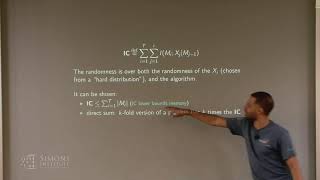
New Upper and Lower Bounds on Approximate Counting
Explores new upper and lower bounds for approximate counting, addressing amortized space complexity and memory optimization in maintaining arrays of approximate counters.

Sublinear Algorithms for Gap Edit Distance
Explore sublinear algorithms for efficiently computing gap edit distance, including dynamic programming, approximation techniques, and key theoretical results.
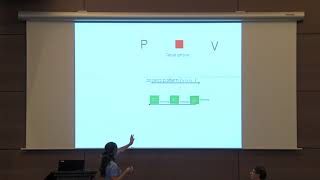
Sublinear Zero Knowledge Arguments for RAM Programs
Explore cutting-edge cryptographic techniques for efficient zero-knowledge proofs in RAM programs, enhancing privacy and security in computational systems.
Sublinear Algorithms and Complexity Theory Vignettes
Explore key concepts and applications of sublinear algorithms through practical vignettes, focusing on efficient computational methods and algorithmic complexity.
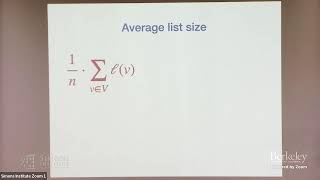
Simple Sublinear Algorithms for Vertex Coloring
Dive into advanced graph theory concepts and efficient vertex coloring algorithms, exploring sublinear approaches for optimizing computational complexity.
Sketching Algorithms: Making Sense of Big Data in a Single Stroke
Explore sketching algorithms for efficient big data processing, covering concepts, design principles, and practical applications using open-source tools like Apache DataSketches.
Agnostic Proper Learning of Monotone Functions: Beyond the Black-Box Correction Barrier
Explore efficient algorithms for agnostic, proper learning of monotone Boolean functions, overcoming previous limitations and achieving near-optimal runtime complexity.
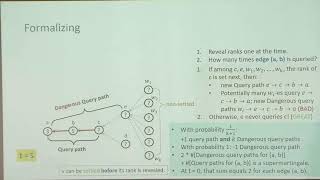
Sublinear Algorithms for Correlation Clustering
Explore sublinear algorithms for correlation clustering, focusing on a 3+eps approximation method using LCA probes, MPC rounds, and dynamic updates. Analyze technical results for maximal independent set computation.
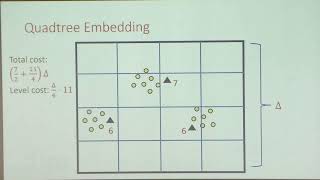
Fast Streaming Euclidean Clustering with Constant Space
Explore streaming algorithms for k-median and k-means clustering, achieving constant space complexity independent of data size and aspect ratio. Improve space and update time for approximate subspace embeddings.
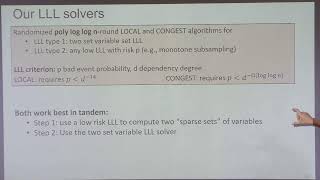
Sparsification for Communication-Efficient Distributed Symmetry-Breaking
Explore sparsification techniques for efficient distributed algorithms, focusing on local symmetry-breaking problems in graph theory and the CONGEST model.
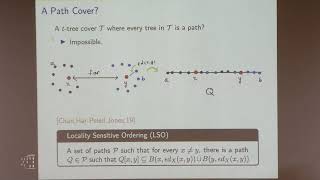
Recent Progress on Euclidean Spanners
Explore recent advancements in Euclidean spanners, including sparse, light, fault-tolerant, and dynamic variants, while discovering outstanding open problems in the field.
A Quasi-Monte Carlo Algorithm for Smooth Kernel Evaluation
Explore a novel data structure for density queries, combining discrepancy theory and LSH to build sparse coresets and enhance smooth kernel evaluation algorithms.
Parallel Algorithms for Local Problems in Sparse Graphs
Explore efficient parallel algorithms for locally checkable problems in sparse graphs, focusing on techniques beyond graph sparsification for improved performance in sublinear regimes.
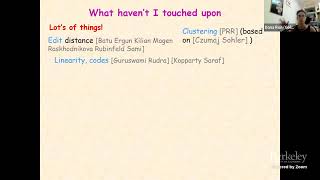
Tolerant Property Testing and Distance Approximation in Sublinear Algorithms
Explore tolerant property testing and distance approximation algorithms for various object types and properties. Gain insights into bipartiteness, monotonicity, uniformity, and subsequence-freeness.
Optimal Quantile Estimation for Streams
Explore optimal quantile estimation for data streams, focusing on space-efficient algorithms and recent advancements in deterministic sketching techniques for improved accuracy and memory usage.
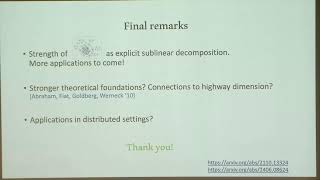
Sublinear Algorithms in Social Networks via Core-Periphery Decomposition
Explore sublinear algorithms for large networks using core-periphery structure and degree distribution. Learn about accelerating tasks like node sampling and shortest path computations.