Maximal Matching in Bounded-deletion Streams
Explore maximal matching in bounded-deletion graph streams, analyzing space complexity as a function of deletion parameter K. Gain insights into algorithmic techniques and lower bound results.
Hypothesis Selection with Computational Constraints
Explore optimal tradeoffs between memory, sample complexity, and time in hypothesis selection algorithms for distribution matching, with focus on achieving near-optimal accuracy efficiently.
Randomized Least Squares Optimization and its Incredible Utility for Large-Scale Tensor Decomposition
Explore randomized least squares optimization techniques for large-scale tensor decomposition, focusing on sublinear algorithms and their applications in data analysis.
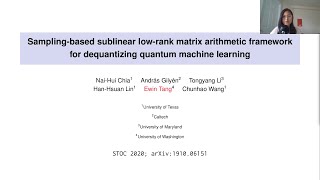
Sampling-Based Sublinear Low-Rank Matrix Arithmetic Framework for Dequantizing Quantum Machine Learning
Explore quantum-inspired classical algorithms for machine learning, focusing on sublinear low-rank matrix arithmetic and singular value transformation techniques.
Learning-Augmented Sketches for Frequency Estimation
Explore advanced techniques for frequency estimation using learning-augmented sketches, enhancing sublinear algorithms and nearest-neighbor search methodologies.
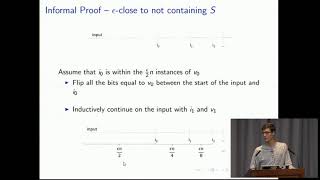
Sublinear Time Property Testers - Algorithms for Efficient Function Analysis
Explore sublinear time property testers for efficient algorithm design. Learn about relaxed decision problems, fast testers, and applications in graph theory and string processing.
Sublinear Time Algorithms for Estimating Edit Distance
Explore efficient methods for approximating edit distance between strings, focusing on sublinear time algorithms and their applications in computational biology and text processing.
New Advances on Multi-Pass Graph Streaming Lower Bounds
Explore cutting-edge developments in multi-pass graph streaming lower bounds, focusing on sublinear algorithms and their applications in data analysis and network theory.
Coresets and Their Applications to Design Sublinear Algorithms
Explore coresets and their role in designing efficient sublinear algorithms, enhancing computational performance for large-scale data analysis and machine learning tasks.
Adversarially Robust Streaming Algorithms
Explore techniques for designing streaming algorithms that maintain accuracy under adversarial data manipulation, enhancing resilience in data processing systems.
An Overview of Data Streams Algorithms
Explore efficient algorithms for processing massive data streams, focusing on space-saving techniques and approximation methods for real-time analysis and decision-making.
An Introduction to Distributed, Massively Parallel, and Local Computation Algorithms
Explore distributed, massively parallel, and local computation algorithms, focusing on their applications, challenges, and recent advancements in sublinear algorithmic techniques.
Testing Boolean Functions
Explore efficient algorithms for testing Boolean function properties, covering definitions, variants, and key analyses in sublinear complexity.
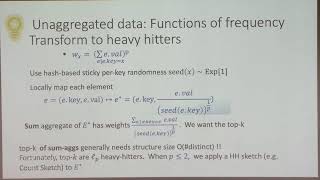
Sampling Big Ideas in Sublinear Algorithms
Explore random sampling techniques for enhancing data analysis scalability, focusing on weighted and coordinated sampling schemes for streamed or distributed data.
Extroverted Sublinear Algorithms
Explore extroverted sublinear algorithms with Google Brain researcher Ilya Mironov, delving into innovative computational techniques for efficient data processing and analysis.
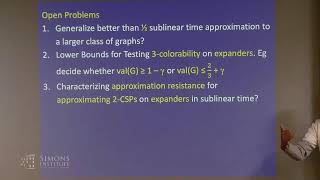
Sublinear Time Algorithms for Max-Cut Approximation on Expander Graphs
Explore random walks on graphs to achieve better-than-1/2 approximation for max-cut on expanding and clusterable graphs, using sublinear time algorithms.
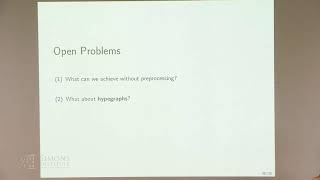
Linear and Sublinear Algorithms for Graphlet Sampling
Explore efficient algorithms for graphlet sampling, including linear and sublinear preprocessing techniques, with applications to semi-streaming and MPC settings.
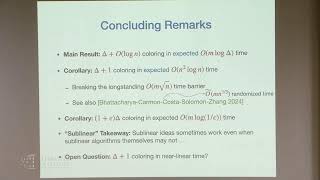
Sublinear Insights: A Faster Classical Algorithm for Edge Coloring
Explores a novel randomized algorithm for near-linear time graph edge coloring, improving on decades-old methods. Discusses implications for Vizing's theorem and dense graph coloring efficiency.
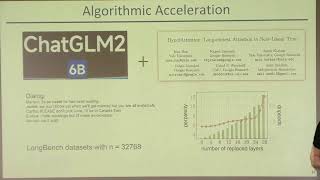
Long-context Attention in Near-Linear Time
Explores HyperAttention, an innovative approach to tackle computational challenges in long-context LLMs, offering significant speed improvements while maintaining performance across various datasets.
Efficiently Computing Similarities to Private Datasets
Explore advanced techniques for computing similarities to private datasets, focusing on extroverted sublinear algorithms and their applications in data privacy.
O(log s)-Approximate Nearest Neighbor Search for Earth Mover's Distance
Explore advancements in nearest neighbor search for Earth Mover's Distance, improving approximation to Õ(log s) with sublinear query time using data-dependent LSH functions and tree embedding techniques.