
Causal Abstractions Using Generalized Functions
Explore generalized functions and their applications in causal models, including nondeterministic structural models and novel types of model reduction, leading to new definitions of causal abstraction.

Meaningful Causal Aggregation and Paradoxical Confounding
Explore causal aggregation challenges, macro interventions, and micro-realism in statistical analysis. Gain insights into ill-defined causality and its impact on confounding in aggregated variables.

Weakly Supervised Causal Representation Learning
Explore weakly supervised causal representation learning, its theoretical foundations, and practical applications in disentangling causal variables from unstructured data like images for improved causal reasoning.
Linear Causal Representations from Interventions under General Nonlinear Mixing
Explore causal representation learning from latent interventions in nonlinear settings. Uncover geometric structures, analyze precision matrices, and evaluate a contrastive algorithm for identifying latent variables.
Causal Representation Learning via Soft Interventions
Explore causal representation learning through soft interventions, focusing on identifiability, prediction of intervention effects, and applications in single-cell biology using auto-encoding variational Bayes.
A Tutorial on Causal Representation Learning
Explore Causal Representation Learning: combining machine learning with causal assumptions to identify causal variables from low-level data. Gain insights into core problems and future directions in scientific discovery.
Identifiability of Causal Models and Applications to Perturb-Seq Data
Explore causal model identifiability, structure learning, and applications to Perturb-seq data. Delve into interventions, latent variables, and causal disentanglement for advancing AI in drug discovery.
Causal Inference in Retail: An M&S Case Study
Explore causal inference techniques for understanding consumer behavior and improving customer lifetime value in retail, using Marks & Spencer as a case study.
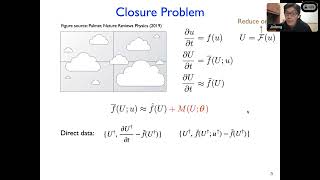
Data-Driven Closure Modeling Using Derivative-free Kalman Methods
Explore data-driven closure modeling for complex dynamical systems using derivative-free Kalman methods. Learn to improve predictions in turbulence and cloud dynamics with advanced machine learning techniques.
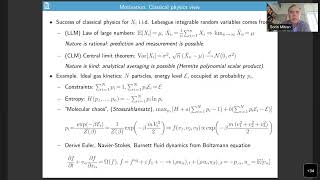
Data-Driven Information Geometry Approach to Stochastic Model Reduction
Explore data-driven information geometry for stochastic model reduction, extending least squares to curved statistical manifolds. Learn adaptive computation techniques for rapidly varying stochastic phenomena.
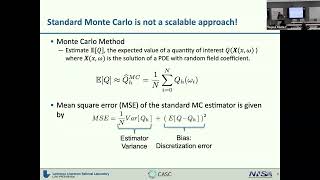
Uncertainty Quantification, Software Ecosystems, and Infrastructure Resilience - Technical Talk
Explore uncertainty quantification, exascale software ecosystems, and infrastructure resilience in this technical talk by Sarah Osborn at WiDS Livermore 2024.

Uncertainty Quantification and Deep Learning for Water-Hazard Prediction
Explore uncertainty quantification and deep learning techniques for predicting water hazards, focusing on storm surge impacts and urban infrastructure damage assessment.
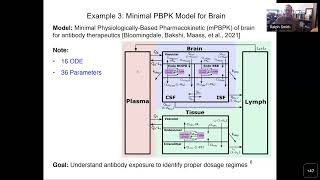
Parameter Subset Selection and Active Subspace Techniques for Engineering and Biological Models
Explore parameter subset selection and active subspace techniques for engineering and biological models, focusing on influential parameter isolation and uncertainty quantification in complex systems.

Expanders in Higher Dimensions: From Local to Global Properties and Applications
Explore high-dimensional expanders, their local-to-global properties, and applications in coding theory, networking, and computational complexity.
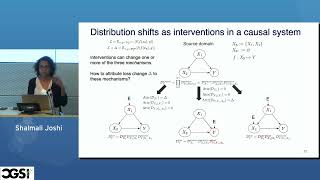
Observational Causal Inference for Improving and Auditing ML in Healthcare
Explore observational causal inference techniques to enhance and audit machine learning models in healthcare, focusing on distribution shifts, safe policy learning, and robust off-policy evaluation.
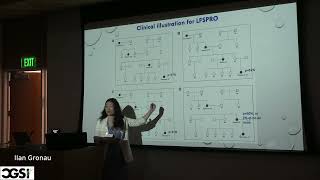
Statistical Methods for Cancer Risk Prediction Models - CGSI 2023
Explore statistical methods for cancer risk prediction models, focusing on Bayesian approaches and applications to Li-Fraumeni syndrome and personalized risk assessment for cancer survivors.
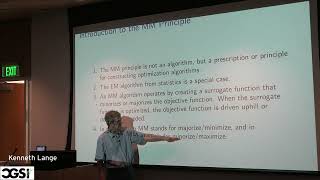
MM Principle of Optimization - CGSI 2023
Explore the MM Principle of Optimization in computational genomics, covering algorithms, applications in signal processing, and machine learning techniques.
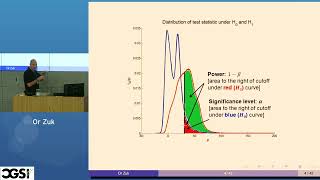
Independence Tests and Dependence Measures for Unbiased and Biased Samples
Explore independence tests and dependence measures for unbiased and biased samples. Learn statistical techniques to analyze relationships between variables in genomic data.
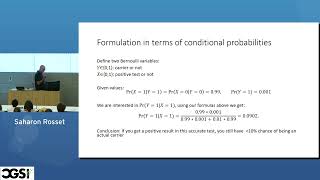
Intuition and Paradoxes in Probability and Statistics
Explore paradoxes and counterintuitive concepts in probability and statistics, enhancing understanding of complex statistical phenomena in computational genomics.
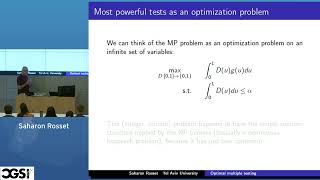
Multiple Testing Methods for Low and High-Dimensional Testing Problems in Biomedical Research
Explore multiple testing methods for biomedical problems, covering low and high-dimensional scenarios. Learn optimization techniques, hypothesis testing, and power analysis through practical examples.
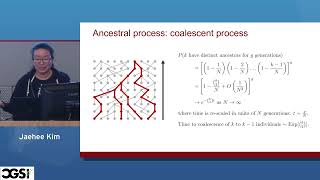
Bayesian Inference of Dependent Population Dynamics in Coalescent Models
Explore Bayesian inference techniques for analyzing dependent population dynamics in coalescent models, focusing on applications in genomics and evolutionary biology.