Introduction to Random Walks and Markov Processes - Preparatory Lecture 1
Comprehensive introduction to random walks and Markov processes, covering discrete and continuous cases, evolution equations, and master equations for advanced statistical physics students.
Soft and Biological Matter - Introduction to States and Structures in Living Systems - Lecture 1
Explore the intersection of biology and physics, covering topics from molecular evolution to ecology. Learn about physical constraints, evolutionary outcomes, and mathematical models in living systems.
Chemical Reaction Networks - Lecture 1
Explore stochastic chemical reaction networks, their examples, definitions, and the deficiency zero theorem in this comprehensive lecture on statistical physics of complex systems.
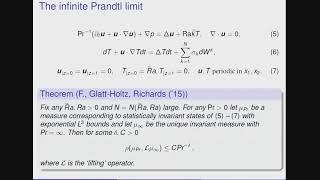
Invariants States in Stochastically Forced Boussinesq Equations
Explore stochastic forcing in Boussinesq equations, covering existence, uniqueness, stability, and numerical simulations for fluid dynamics and convection phenomena.
Rough Perturbations of the Navier Stokes System
Explore rough perturbations of Navier-Stokes equations, focusing on solution definitions, well-posedness, and physical relevance in terms of conserved quantities.
A Gradient Flow Approach to Kinetic Equations
Gradient flow approach to linear kinetic equations, exploring entropy dissipation inequality and large deviation principles. Discusses potential extensions to non-linear cases and connections to Markov chains.
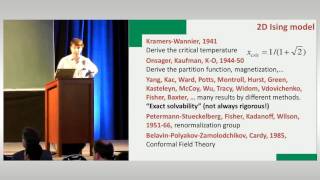
Panorama of Mathematics - Clusters, Loops and Trees in the Ising Model
Explore clusters, loops, and trees in the Ising model with Fields Medalist Stanislav Smirnov, covering topics from conformal field theory to discrete complex analysis and random cost representation.
Lambda-Coalescents Arising in a Population With Dormancy
Explore Lambda-coalescents in populations with dormancy, examining genealogy and multiple ancestral line mergers through a three-season model of spring awakening, summer reproduction, and winter dormancy.
The Cosmic Censorship Conjectures in General Relativity - Lecture 3
Explore cosmic censorship conjectures in general relativity, focusing on global high publicity, null infinity, and the Hawking pass, with expert Mihalis Dafermos.
Brownian Motion, Evolving Geometries and Entropy Formulas - A. Thalmaier
Explore Brownian motion, stochastic processes, and related mathematical concepts in this comprehensive lecture on evolving geometries and entropy formulas.
Inducing Schemes and Their Role in Thermodynamics - ICTP 2021
Explore inducing schemes in thermodynamics, focusing on Young diffeomorphisms, symbolic representations, and equilibrium measures. Gain insights into pressure analyticity and phase transitions.
Schrödinger Bridges - Classical and Quantum
Explore Schrödinger bridges in classical and quantum contexts, their applications to Markov chains and quantum channels, and their solutions for probability distributions and state evolutions.
Gravitational Wave Parameter Estimation with Compressed Likelihood Evaluations
Explore advanced techniques for efficient gravitational wave parameter estimation, focusing on Reduced Order Quadratures (ROQs) to accelerate likelihood evaluations and improve Bayesian inference in GW astronomy.
Black Hole Astrophysics With Gravitational-Wave Catalogs - IPAM at UCLA
Explore black hole astrophysics through gravitational-wave data, uncovering insights on mass distribution, spin, and redshift evolution. Learn about pair-instability mass gap and formation-to-merger time delays.
Cosmology with Dark Sirens - Attempting to Solve the Hubble Constant Tension
Explore gravitational waves for cosmology, focusing on dark sirens and galaxy catalogs to address Hubble constant tension. Learn challenges in GW-based cosmological parameter estimation.
Randomized Methods for Quantum Many-Body Problems - A Mathematical Primer
Explore randomized methods for quantum many-body problems, focusing on Monte Carlo techniques to approximate ground and excited states in large systems. Learn about VMC and FCIQMC algorithms.
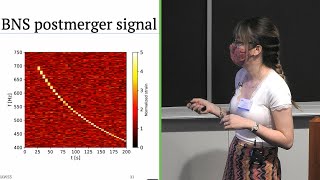
Power Spectral Density Uncertainty and Gravitational-Wave Parameter Estimation
Explore power spectral density uncertainty in gravitational-wave parameter estimation, its impact on Bayesian analysis, and methods to incorporate this uncertainty for more accurate results in compact binary coalescence detection.
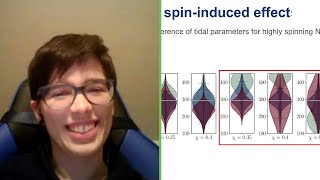
Waveform Systematics in the Gravitational-Wave Inference of Tidal Parameters
Exploración de sistemáticas en formas de onda para inferir parámetros de marea y ecuación de estado en señales de ondas gravitacionales de sistemas binarios de estrellas de neutrones.
Conditional Probability Density Functional Theory - IPAM at UCLA
Explore conditional probability density functional theory for electronic structure calculations, addressing challenges in DFT and offering insights into ground-state correlations and warm dense matter simulations.
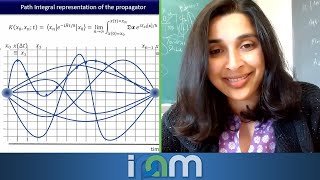
Quantum Dynamics from Classical Trajectories - IPAM at UCLA
Explore semiclassical approximations in quantum mechanics, focusing on a novel approach for complex chemical systems and addressing challenges in path space sampling and prefactor evaluation.
Introduction to Gene Genealogies and Coalescent Processes by John Wakeley
Explore gene genealogies and coalescent processes in population genetics, covering inference of human population history from genome sequences and SNP-difference data analysis.