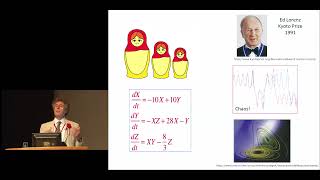
From Determinism to Probability: Development of the Ensemble Prediction Technique for Weather and Climate Forecasting
Discover how ensemble prediction revolutionized weather forecasting by transforming deterministic methods into probabilistic approaches, enhancing forecast reliability and decision-making in meteorology.
Random Walks in Physics - From Biopolymer Elasticity to Zero-Temperature Decoherence
Explore the fascinating applications of Brownian Motion and random walks in physics, from biopolymer elasticity to quantum decoherence, through expert insights and research perspectives.
Understanding Spacetime from Causality and Discreteness
Delve into the fundamental concepts of spacetime through the lens of causality and discreteness, exploring theoretical physics principles and their implications for our understanding of the universe.
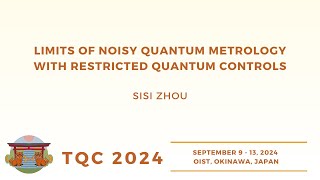
Limits of Noisy Quantum Metrology with Restricted Quantum Controls
Delve into quantum metrological limits, exploring how restricted quantum controls affect parameter estimation precision and the achievability of Heisenberg and standard quantum limits in noisy systems.
Debiasing Coarse-Scale Climate Models Using Statistically Consistent Neural Networks
Explores using neural networks to improve coarse-scale climate models, addressing unresolved scales and enhancing predictions. Discusses framework, wavelet analysis, and multi-model architecture for more accurate climate simulations.
Earth System Emulation - Duncan Watson-Parris #CLIMATE-C21
Explore Earth system emulation for climate projections, uncertainty analysis, and machine learning applications in weather and climate science. Gain insights into advanced modeling techniques and data-driven approaches.
Contained Chaos - Ensemble Consistency Testing for the Community Earth System Model
Explore ensemble consistency testing for climate models, focusing on the Community Earth System Model. Learn about statistical methods to evaluate model changes and ensure software quality in climate simulations.
Introduction to Lattice and Neutrino Cross Sections - Andre Walker Loud
Explore lattice QCD techniques for calculating neutrino cross sections, addressing challenges and future directions in this interdisciplinary field of particle physics.

Spacetime Atoms and the Unity of Physics - Perimeter Public Lecture
Explore black hole thermodynamics and the concept of spacetime atoms in this lecture by Fay Dowker. Discover how this theory unifies physics and suggests a granular structure of spacetime at microscopic scales.
Collapse and the Closure of the Physical
Explore quantum collapse theories and their implications for consciousness, examining physical closure and epistemic asymmetry in scientific theories of mind.
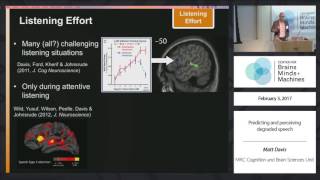
Predicting and Perceiving Degraded Speech
Explore speech perception challenges, cochlear implants, and predictive coding in this talk on improving speech understanding and perceptual learning for degraded speech signals.
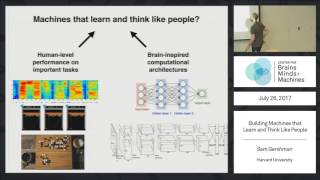
Building Machines that Learn and Think Like People
Explore computational neuroscience and AI inspired by human cognition, covering intuitive theories, compositionality, and learning to learn for more human-like artificial intelligence.
Statistical Physics and Computation in High Dimension
Explore high-dimensional statistical physics and computation, covering sampling, minimization, and replica methods with applications in finance and algorithms.
Linkage Disequilibrium - Introduction to Genomics Theory
Explore linkage disequilibrium in genomics, its importance, metrics, and applications. Learn about LD block structure, genetic distance, and how it reveals population history and selection pressures.

Toward Brain Computer Interface - Deep Generative Models for Brain Reading
Explore deep generative models for brain reading, covering GAN implementation, image reconstruction from brain signals, and evolving latent codes using genetic algorithms.
How Fast Is a Neural "Winner-Take-All" When Deciding Between Many Noisy Options?
Explore neural decision-making mechanisms, focusing on the speed and efficiency of "winner-take-all" processes in noisy environments. Gain insights into parallel strategies and canonical circuits.
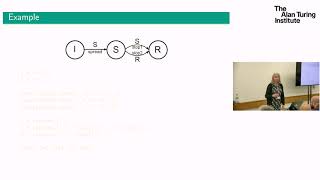
Integrating Inference with Stochastic Process Algebra Models - Jane Hillston, Edinburgh
Explore probabilistic programming for continuous-time systems using ProPPA, an extension of Bio-PEPA. Learn parameter inference methods and applications in biology, ecology, and urban transport.
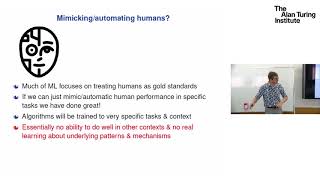
Beyond Tech - Machine Learning in Science & Policy - Professor David Dunson, Duke
Exploring machine learning applications beyond tech, highlighting challenges in science and policy. Discusses fair algorithms, interpretable models, and the need for targeted methods in complex domains.
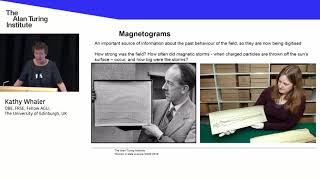
How Big Data Has Transformed and Is Transforming Geophysics
Exploring geophysical advancements: from analog instruments to digital data collection, satellite technology, and machine learning, revolutionizing Earth and planetary studies.
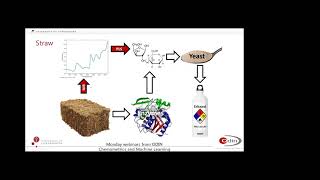
The Cage of Covariance
Explore strategies for handling correlated variables in data analysis, including orthogonalization techniques and predictive component methods.
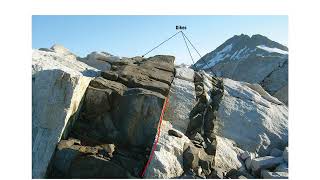
Geologic Time Lecture
Explore Earth's history through geologic principles, fossils, and dating methods. Uncover the secrets of our planet's past and learn to interpret the rock record.