Random Matrices and the Uses of Dyson-Schwinger Equations - Lecture 5
Explore advanced concepts in random matrix theory, focusing on Dyson-Schwinger equations and their applications in mathematical physics and probability theory.
Entropy Techniques for Nonlinear Partial Differential Equations - A Few Examples
Explore entropy techniques for nonlinear PDEs, focusing on Fokker-Planck equations. Learn applications in polymeric fluids, molecular dynamics, and high-dimensional algorithms.

Fundamentals of Heavy-tails: Properties and Emergence - Lecture 5
Explore heavy-tailed distributions: properties, emergence, and applications in probability theory. Gain insights into advanced stochastic processes and their mathematical foundations.
The Functional Volume Product Under Heat Flow
Explores monotonicity of functional volume product along Fokker-Planck heat flow, leading to improved Borell's hypercontractivity and Laplace transform quasi-norm lower bound.
Fluctuations of Linear Eigenvalue Statistics in Sample Covariance Matrices - Tensor Product Data
Explore fluctuations in linear eigenvalue statistics of sample covariance matrices with tensor product data, comparing normal and uniform distributions on unit sphere.
Spectrum of Sparse Inhomogeneous Random Graphs
Explore the spectrum of sparse inhomogeneous random graphs, examining structural properties and applications in network science, probability theory, and statistical physics.
Algorithms on Networks
Explore algorithms for network analysis, optimization, and control. Learn techniques for solving complex problems on graphs and networks, with applications in various fields.
Spin Systems on Spatial Random Graphs
Explore spin systems on spatial random graphs, examining their properties, dynamics, and applications in network science and statistical physics.
Asymptotics of Invariant Measures of Mean-field Markov Models on Countable State Spaces
Explore asymptotics of invariant measures in mean-field Markov models on countable spaces. Gain insights into network science, probability theory, and applications in complex systems and data analysis.
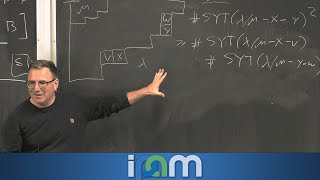
Correlation Inequalities for Schur Functions and Young Tableaux
Explore correlation inequalities in mathematics, focusing on Schur functions and Young tableaux. Discover connections to probability, statistical physics, and algebraic combinatorics in this advanced lecture.
Limit Shapes for Random Young Tableaux via Determinantal Point Processes
Explore limit shapes for random Young tableaux using determinantal point processes. Discover new insights on limiting surfaces for multirectangular shapes, including potential discontinuities.
Conservative Adaptive Rank Integrators for Nonlinear Kinetic Models
Explore low-rank time integrators for PDEs, including explicit and implicit schemes, with applications to Vlasov, heat, Fokker-Planck, and advection-diffusion equations.

Dynamics of Biological Systems - Lecture 5
Explore biological dynamics using physics tools to model and predict complex living systems, from predator-prey oscillations to bacterial motility and collective behavior in fluids.

Dynamics of Biological Systems - Lecture 8
Explore biological dynamics using physics tools to model and predict complex living systems, from predator-prey oscillations to bacterial motility and collective behavior in fluids.

Dynamics of Biological Systems - Lecture 7
Explore biological dynamics using physics principles. Learn to model predator-prey oscillations, ecosystem chaos, and microbial swimming. Gain insights into species competition, population changes, and collective behavior in fluids.
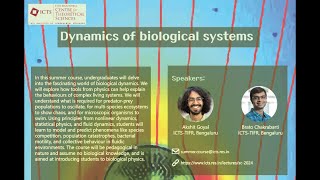
Dynamics of Biological Systems - Lecture 6
Explore biological dynamics using physics tools to model and predict complex living systems, from predator-prey oscillations to bacterial motility and collective behavior in fluids.
Generalized Law of Iterated Logarithm in the Infinite Horizon Lorentz Gas
Explore the behavior of infinite horizon Lorentz gas, focusing on chaotic dynamics, long flights, and non-standard scaling in limit theorems for billiard particle positions.
Multilevel Monte Carlo Methods for the Dean-Kawasaki Equation from Fluctuating Hydrodynamics
Explore Multilevel Monte Carlo methods for Dean–Kawasaki equation, analyzing efficiency and convergence in stochastic PDEs of Fluctuating Hydrodynamics for many-particle systems.
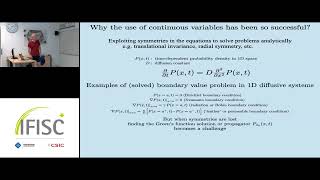
Resolution of a Hundred Year Old Problem on Lattice Random Walks and Its Application to Study Inelastic Collisions
Explore a century-old lattice random walk problem and its implications for inefficient diffusion in complex systems.
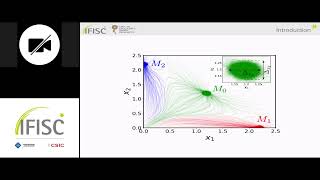
Generation of Stochastic Trajectories - Applications to Complex Systems
Explore stochastic trajectory generation and its applications in complex systems, focusing on interdisciplinary physics concepts and advanced modeling techniques.
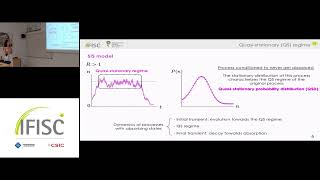
Numerical Methods for Quasi-Stationary Distributions
Explore numerical techniques for calculating quasi-stationary distributions in complex systems, enhancing understanding of long-term behavior in stochastic processes.