Physics - Nonequilibrium Statistical Mechanics
Explore advanced concepts in nonequilibrium statistical mechanics, including Langevin models, linear response theory, Fokker-Planck equations, and critical phenomena, with practical applications and quizzes.
Sensitivity, Spatial Models, and Fokker-Planck Equations in Mathematical Oncology - Graduate Course
Dive into advanced mathematical concepts in oncology, exploring sensitivity analysis, spatial modeling, and Fokker-Planck equations with Dr. Thomas Hillen.
The Regularity Problem for the Landau Equation
Explore the intricacies of the Landau equation's regularity problem with François Golse, delving into advanced mathematical concepts and their applications.
Variational Formulations of Fokker-Planck Equations: Theory and Applications to Stability - Lecture 1
Explore variational formulations of Fokker-Planck equations, focusing on theory and applications to stability. Gain insights into advanced mathematical concepts at the doctorate level.
Mean-Field Games Through Monotone Methods
Explore mean-field games using monotonicity techniques. Discover unified approaches for solving various MFG classes, including stationary, time-dependent, and planning problems with congestion.
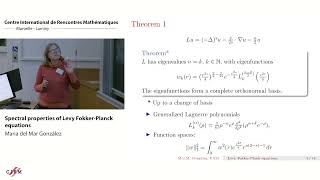
Spectral Properties of Levy Fokker-Planck Equations
Explore spectral properties of Levy Fokker-Planck equations in this mathematical conference talk by Maria del Mar González at CIRM.
Entropy Method for Hypocoercive BGK and Fokker-Planck Equations
Explore entropy methods for hypocoercive equations, focusing on BGK and Fokker-Planck models. Learn about decay rates, auxiliary functionals, and regularization techniques in non-symmetric systems.
Entropy Techniques for Nonlinear Partial Differential Equations - A Few Examples
Explore entropy techniques for nonlinear PDEs, focusing on Fokker-Planck equations. Learn applications in polymeric fluids, molecular dynamics, and high-dimensional algorithms.
The Functional Volume Product Under Heat Flow
Explores monotonicity of functional volume product along Fokker-Planck heat flow, leading to improved Borell's hypercontractivity and Laplace transform quasi-norm lower bound.
Conservative Adaptive Rank Integrators for Nonlinear Kinetic Models
Explore low-rank time integrators for PDEs, including explicit and implicit schemes, with applications to Vlasov, heat, Fokker-Planck, and advection-diffusion equations.
Introduction to Stochastic Modeling in Evolution - Lecture 1
Explore stochastic modeling in evolution, covering heritability, Mendel's experiments, neutral evolution, random genetic drift, and fixation probability through lectures and experiments.
Kinetic Theory of Social Phenomena I
Explore statistical mechanics of multi-agent systems to explain distributions in human activities, focusing on skewed distributions in economics and social sciences.
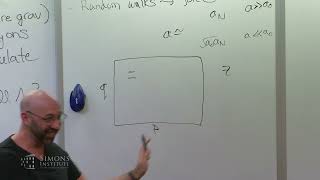
Is It Dark Matter, or Is Spacetime Undergoing a Random Walk?
Explore a theory combining classical and quantum systems, applying it to general relativity to explain galactic rotation curves without dark matter through stochastic spacetime processes.
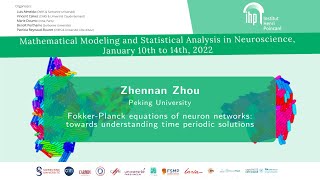
Fokker-Planck Equations of Neuron Networks: Understanding Time Periodic Solutions
Explore Fokker-Planck equations in neuron networks, focusing on time periodic solutions and their implications for neural dynamics.
Introduction to the Dynamics of Disordered Systems - Equilibrium and Gradient Descent - Part 3
Explore equilibrium dynamics and gradient descent in disordered systems, focusing on theoretical concepts and practical applications in statistical physics and optimization.
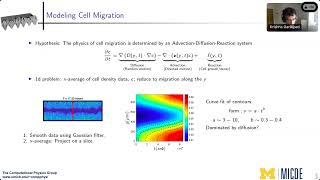
Fokker-Planck-Inverse Reinforcement Learning
Explore Fokker-Planck-Inverse Reinforcement Learning for revealing agent behavior rationale. Learn about a novel physics-aware algorithm inferring transition and reward functions from observed trajectories.
An Optimal Control Perspective on Diffusion-Based Generative Modeling
Explore optimal control theory's connection to diffusion-based generative modeling. Gain insights into stochastic differential equations, Hamilton-Jacobi-Bellman equations, and novel sampling methods for unnormalized densities.
Stochastic Interpolants: A Unifying Framework for Flows and Diffusions - Lecture
Explore a unified framework for generative models, bridging flow-based and diffusion-based methods using stochastic interpolants. Learn about probability flow equations, likelihood estimation, and applications in AI for drug discovery.