
Stochastic Interpolants: A Unifying Framework for Flows and Diffusions - Lecture
Explore a unified framework for generative models, bridging flow-based and diffusion-based methods using stochastic interpolants. Learn about probability flow equations, likelihood estimation, and applications in AI for drug discovery.
Deterministic Annealing for Clustering, Classification and Speech Recognition
Explore deterministic annealing for improved clustering and classification, avoiding local optima and optimizing various structures in machine learning applications.
KPZ Universality and Iterates of Random Monotone Maps
Explore KPZ universality and random monotone map iterations with insights from Konstantin Khanin's mathematical research.
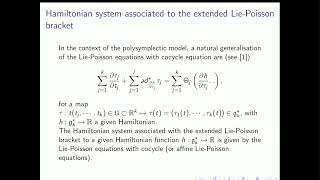
Polysymplectic Souriau Lie Group Thermodynamics and Entropy Geometric Structure as Casimir Invariant
Explore advanced concepts in Lie group thermodynamics, focusing on polysymplectic Souriau theory and entropy's geometric structure as a Casimir invariant.
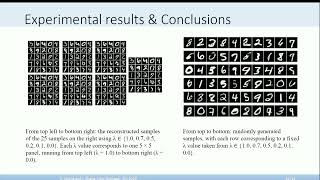
Deformed Evidence Lower Bound (λ-ELBO) Using Rényi and Tsallis Divergence
Explore advanced variational inference techniques using Rényi and Tsallis divergences to optimize the Deformed Evidence Lower Bound (λ-ELBO) for improved probabilistic modeling.
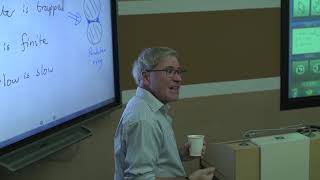
Invasion Percolation - Part II
Explore advanced concepts of invasion percolation, building on fundamental principles to deepen understanding of fluid flow in porous media.
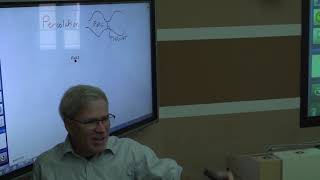
Percolation Theory
Explore percolation theory, its applications, and fundamental concepts in complex systems and network analysis.

Invasion Percolation - Part I
Explore invasion percolation concepts and applications in porous media flow modeling, focusing on fundamental principles and computational techniques.
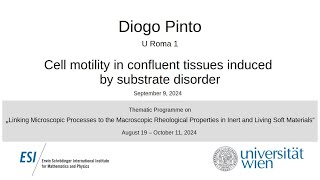
Cell Motility in Confluent Tissues Induced by Substrate Disorder
Explore cell motility in confluent tissues and the impact of substrate disorder on tissue mechanics, rigidity, and cell dynamics using the Self-Propelled Voronoi model.
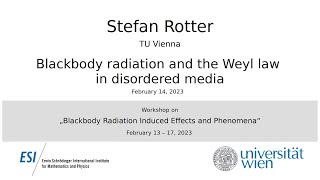
Blackbody Radiation and the Weyl Law in Disordered Media
Explore blackbody radiation in complex media, focusing on path length invariance, Weyl law, and connections to information theory and quantum vacuum forces.
The Long-Run Distribution of Stochastic Gradient Descent: A Large Deviations Approach
Explore the long-run behavior of stochastic gradient descent in non-convex problems, analyzing state space visitation patterns and energy level distributions.
Cell Shape Variability and Its Implications in Epithelial Monolayers
Explore cell shape variability in epithelial monolayers, its universal distribution, origins, and implications for tissue dynamics and biological functions.
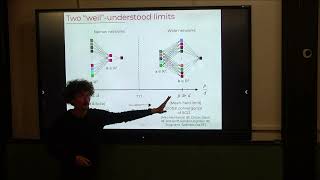
Phase Diagram of Stochastic Gradient Descent in High-Dimensional Two-Layer Neural Networks
Explore the phase diagram of Stochastic Gradient Descent in high-dimensional two-layer neural networks, focusing on its behavior and implications.
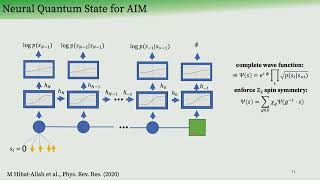
Is the Ground State of Anderson's Impurity Model a Recurrent Neural Network?
Explore the connection between Anderson's impurity model ground state and recurrent neural networks in condensed matter physics.
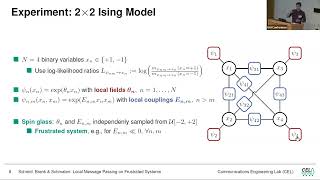
Local Message Passing on Frustrated Systems - UAI Oral Session 6
Explore an alternative message passing algorithm for cyclic graphs, challenging SPA's extrinsic principle and optimizing factor node updates for improved performance on complex networks.
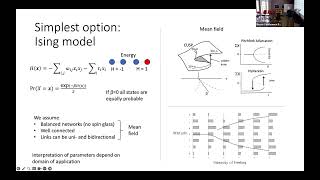
Modeling Psychological Systems with Ternary Spin Models
Explore how ternary spin models enhance psychological research by extending binary network models to include neutral states, offering richer dynamics for analyzing depression, intelligence, and attitude changes.
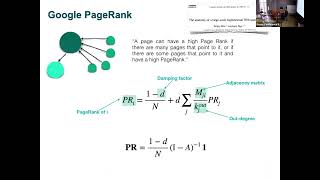
From Centrality Measures to Nanowire Networks - Disordered Systems Methods to the Rescue
Explore advanced network analysis techniques, from centrality measures to nanowire networks, using disordered systems methods to understand complex network dynamics and neuromorphic computing applications.
Current Fluctuations in Noninteracting Run-and-Tumble Particles in One Dimension
Explore current fluctuations in noninteracting run-and-tumble particles, focusing on flux distribution through origin and anomalous large-deviation form in active particles.
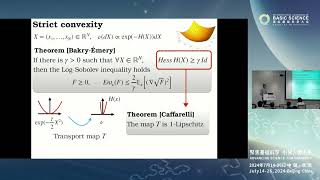
A Renormalisation Group Perspective on Functional Inequalities - ICBS 2024
Explore multiscale analysis for decomposing high-dimensional measures, deriving functional inequalities using renormalization group methods in statistical physics.
1D Statistical Mechanics and Resurgence
Explore advanced concepts in one-dimensional statistical mechanics and resurgence theory through mathematical physics principles and analytical techniques.
Random Local Hamiltonians - Glassiness and Optimization
Explore the mathematical complexities of random local Hamiltonians, focusing on glassiness phenomena and optimization techniques in quantum systems and algorithms.