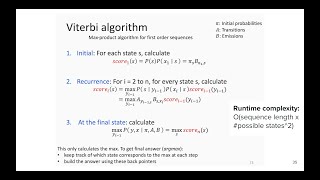
Hidden Markov Models - Parameter Estimation and Efficient Inference
Master parameter estimation and efficient inference techniques for Hidden Markov Models, exploring key algorithms and mathematical foundations for probabilistic sequence modeling and pattern recognition.

Probabilistic Inference - Session Preview at POPL 2023
Explore probabilistic inference concepts with expert Alexandra Silva in this POPL 2023 session preview, enhancing accessibility of advanced programming language topics.
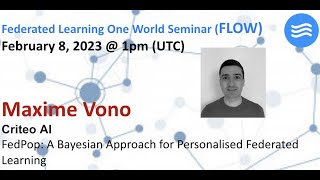
A Bayesian Approach for Personalized Federated Learning - Seminar 93
Discover how Bayesian approaches enhance personalized federated learning through innovative statistical methods and practical applications in distributed machine learning environments.
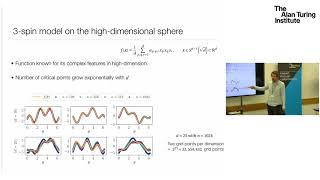
Neural Networks as Interacting Particle Systems
Explore neural networks as interacting particle systems, examining their mathematical foundations and applications in complex systems modeling across various scientific disciplines.
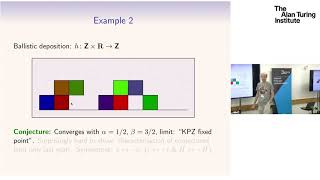
Universality Classes for 1+1 Dimensional Systems
Explore universality classes in 1+1 dimensional systems, focusing on weak universality conjecture, graphical construction, and links to Brownian web. Gain insights into complex systems modeling.
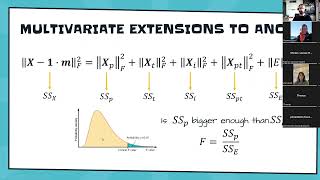
Statistical Inference of Omics Data with Variable-Selection
Learn statistical inference techniques for omics data analysis, focusing on variable selection methods to enhance spectral matching and predict molecular structures from LC-MS/MS spectra using chemometrics and deep learning approaches.
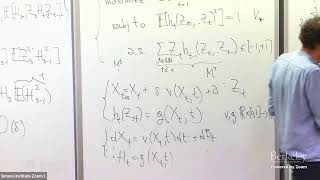
Optimal Iterative Algorithms for Problems With Random Data
Explore advanced iterative algorithms for solving problems with random data, focusing on computational complexity in statistical inference.
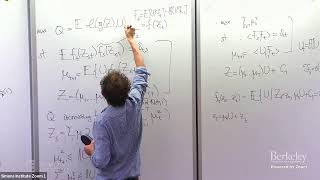
Optimal Iterative Algorithms for Problems With Random Data
Explore optimal iterative algorithms for statistical problems with random data, focusing on computational complexity and efficient solutions in statistical inference.
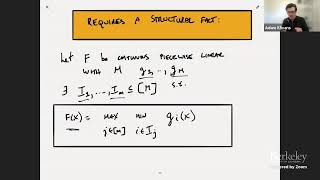
In Search of New Algorithms Part I - Neural Networks
Explore neural networks and their role in developing new algorithms, focusing on computational complexity and statistical inference challenges.
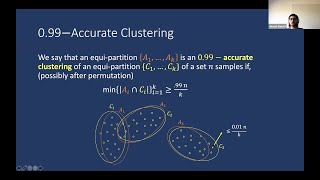
Learning Algorithms and Techniques - Session 1C
Explore cutting-edge research in machine learning and computational theory at FOCS 2020's Session 1C, featuring presentations on innovative algorithms and theoretical advancements.
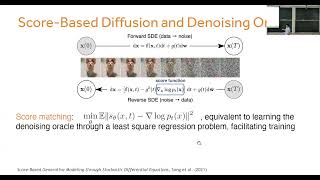
Provable Posterior Sampling with Score-Based Diffusion through Tilted Transport
Explore score-based diffusion methods for posterior sampling, focusing on tilted transport techniques and their applications in machine learning and dynamical systems.
Learning from Aggregate Responses
Explore aggregate learning techniques for privacy-protected data, including loss construction, bagging schemes, and iterative boosting algorithms to improve model accuracy while maintaining data privacy.
Dynamic Denoising for AMP Applied to Sparse Regression Inner Codes with Outer Codes
Explores dynamic denoising in AMP for sparse regression codes with outer codes, discussing performance improvements, state evolution approximations, and extensions to multi-user scenarios and multiple measurement vectors.
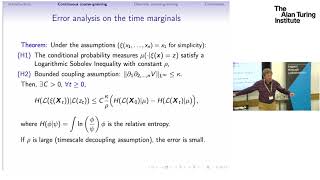
Coarse-Graining Stochastic Dynamics
Explore techniques for simplifying complex stochastic systems through coarse-graining, enabling practical computation and accurate prediction in various scientific fields.
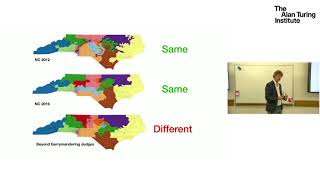
Understanding the Geopolitical Structure of the USA
Explore statistical approaches for analyzing geopolitical structures in the USA, combining data analysis with complex systems modeling to uncover crucial features and patterns.
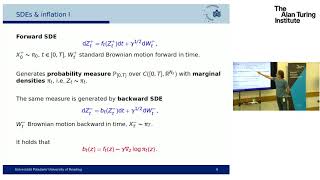
Learning Models by Making Them Interact
Explore new approaches to data-driven modeling of complex systems, combining statistical inference, high-throughput computation, and physical laws for more accurate predictions in various scientific fields.
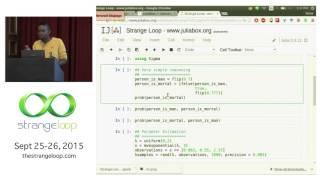
Probabilistic Programs Which Make Common Sense
Explore probabilistic programming as a step towards machines with common sense. Learn about Sigma, a language for functional probabilistic models, and its applications in automated reasoning and inference.
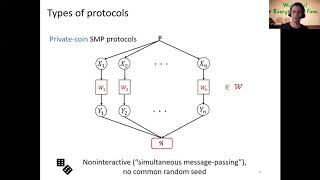
Cookbook Lower Bounds for Statistical Inference in Distributed and Constrained Settings - Part 1
Explore statistical inference in distributed and constrained settings, focusing on lower bounds, protocols, and models for discrete distributions and high-dimensional domains.
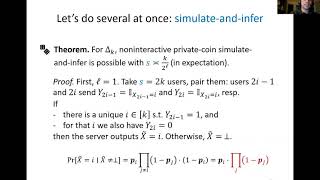
Cookbook - Lower Bounds for Statistical Inference in Distributed and Constrained Settings - Part 4
Explore statistical inference in distributed and constrained settings, focusing on lower bounds, simulation techniques, and non-interactive inference methods.
F Test and Hypothesis Testing in Applied Statistics
Master the F-test concept in statistics through practical numerical examples and hypothesis testing applications, perfect for understanding statistical analysis in engineering and business contexts.
T-Test Numerical Problems in Applied Statistics and Hypothesis Testing
Master the step-by-step procedure for solving t-test problems in statistics, focusing on practical applications and hypothesis testing methods for engineering and business analysis.