
Network Regression and Its Inference
Explore network regression and inference techniques for analyzing complex network data, focusing on estimating regression coefficients with network effects and addressing observational errors.

Statistical Inference
Comprehensive exploration of statistical inference, covering likelihood, hypothesis testing, Bayesian statistics, and non-parametric methods for robust data analysis and decision-making.
Statistical Inference Concept Statistics for Beginners
Comprehensive introduction to statistical inference concepts, covering sampling distributions, confidence intervals, hypothesis testing, and more. Ideal for beginners seeking a solid foundation in statistical analysis.

Inference for Two Population Means
Learn statistical inference techniques for comparing two population means, including pooled-variance and Welch t-tests, confidence intervals, and paired-difference procedures.
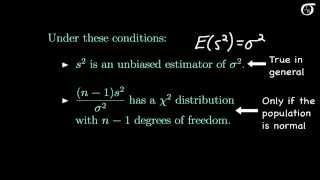
Inference for Variances
Explore statistical methods for analyzing variances, including confidence intervals and hypothesis tests for one and two variances, with a focus on normally distributed populations and robustness considerations.

Workshop on Probabilistic Numerical Methods - Panel Discussion
Panel discussion exploring probabilistic numerical methods, covering topics like reference priors, robust uncertainty quantification, and Bayesian inversion methods for improved statistical inference and error quantification.
Recent Development in Selective Inference II
Explore advanced selective inference techniques, including randomized approaches, computational challenges, and approximate methods for statistical analysis in adaptive data settings.
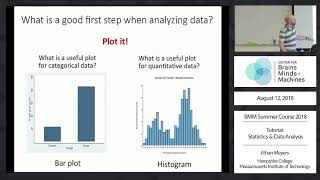
Statistics and Data Analysis
Learn essential statistics and data analysis concepts, including distributions, visualization techniques, correlation, regression, and hypothesis testing, to enhance your data interpretation skills.
Approximate Message Passing Algorithms
Explore Approximate Message Passing algorithms, their applications in statistical inference, and theoretical foundations including state evolution, convergence, and joint distribution analysis.
Statistics Tutorial - T Distribution and Hypothesis Testing
Learn to calculate and interpret T distributions, use T tables, understand degrees of freedom, and perform hypothesis testing with independent and dependent samples in this comprehensive statistics tutorial.
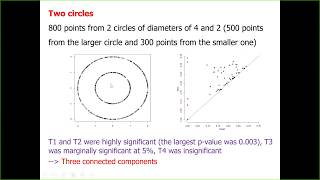
Modeling and Replicating Persistence Diagrams
Explore modeling and replicating persistence diagrams for statistical inference in topological data analysis. Learn about RST approach, parametric modeling, and improvements for clustered data.

Larry Wasserman - Robust Topological Inference
Explore robust topological inference with Larry Wasserman, covering persistence, confidence bands, bootstrap methods, and optimal tuning for data analysis and statistical modeling.
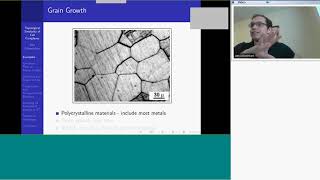
Benjamin Schweinhart - Statistical Topology of Random Cell Complexes, and Applications
Explore statistical topology of random cell complexes, covering curvature flow, grain growth, graph limits, and computational evidence for steady state hypothesis.
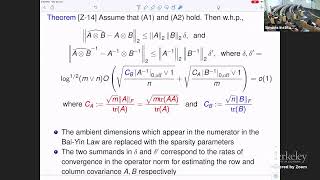
Tensor Graphical Models for Complex and High Dimensional Data
Explore advanced statistical methods for analyzing complex, high-dimensional data using tensor graphical models, with applications in algorithmic inference and combinatorial structures.
Approximate Message Passing for Statistical Inference and Estimation by Cynthia Rush
Explore approximate message passing techniques for statistical inference and estimation, focusing on applications in machine learning and data analysis.

Deep Learning of Dynamical Systems for Mechanistic Insight and Prediction in Psychiatry
Explore deep learning techniques for analyzing dynamical systems in psychiatry, uncovering mechanisms, and predicting outcomes using neural and behavioral data from various sources.
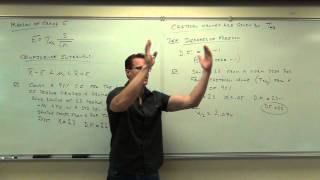
Confidence Interval for the Sample Mean, Population Std Dev - Unknown
Learn to estimate population mean using sample data when population standard deviation is unknown, including t-distribution and confidence intervals.

Statistical Inference
Comprehensive exploration of statistical inference, covering estimation techniques, hypothesis testing, and advanced concepts for in-depth understanding of statistical analysis methods.
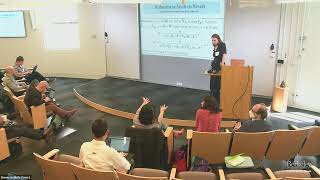
On the Robustness to Misspecification of α-Posteriors and Their Variational Approximations
Explore α-posteriors and variational approximations, examining their robustness to misspecification in machine learning contexts.

Graph Alignment: Informational and Computational Limits - Lecture 2
Explore graph alignment challenges, focusing on informational and computational limits. Gain insights into probabilistic and optimization methods for data science applications.
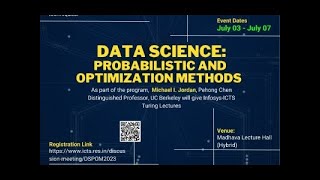
Alignment of Random Graphs: Informational and Computational Limits - Lecture 2
Explores informational and computational limits in aligning random graphs, focusing on advanced probabilistic techniques for data science and graph theory applications.