Computational Methods for Simulating and Analyzing Ecological Systems - Class 20
Explore computational methods for simulating and analyzing ecological systems. Learn equilibrium solutions, differential equations, and Python applications in quantitative ecology.
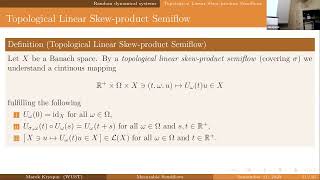
Theoretical and Numerical Approach to Lyapunov Exponents of Skew-Product Semiflows
Explore Lyapunov exponents in skew-product semiflows through theoretical and numerical approaches, enhancing understanding of dynamical systems.
Sharp Stability of Higher Order Dirichlet Eigenvalues
Explorez la stabilité des valeurs propres de Dirichlet d'ordre supérieur, en examinant les limites nettes pour les valeurs propres dégénérées et les groupes de valeurs propres.
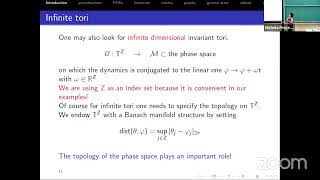
Stability and Recursive Solutions in Hamiltonian PDEs
Explore stability and recursive solutions in Hamiltonian PDEs, focusing on oscillating motions near elliptic fixed points, KAM theory applications, and the interplay between chaotic and recursive phenomena.
Polynomial Approximation of Random PDEs by Discrete Least Squares with Observations
Polynomial approximation of random PDEs using discrete least squares with random point observations. Explores stability, error bounds, and optimal index set selection for metamodel construction in high-dimensional parameter spaces.
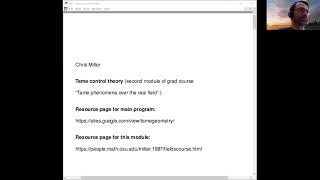
Tame Phenomena Over the Real Field - Graduate Course Lecture 1
Explore fundamental concepts of tame control theory, focusing on real field applications and advanced mathematical principles in this graduate-level lecture.
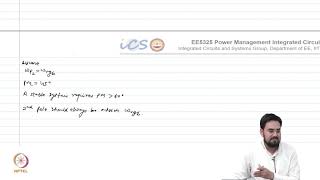
Closed Loop Response of Second Order Systems
Analyze closed loop responses of second-order systems, exploring key concepts and characteristics for enhanced system understanding and control.

Intuition Behind the Dominant and Second Poles in a Miller Compensated OTA
Explore dominant-pole compensation, phase margin, and Miller compensation in operational transconductance amplifiers. Gain insights into pole splitting for improved stability.
Stability and Learning in Strategic Queueing Systems
Explore stability and learning in strategic queueing systems with Éva Tardos. Discover how selfish behavior affects packet routing and server capacity in this insightful seminar on optimization and data analysis.
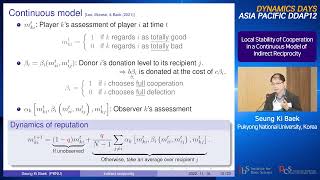
Local Stability of Cooperation in a Continuous Model of Indirect Reciprocity
Explore stability of cooperation in indirect reciprocity using continuous variables for reputation and behavior. Analyze Image Scoring vs Simple Standing and derive conditions for maintaining cooperation.

Introduction to Type-III Compensator
Explore Type-III Compensator fundamentals, understanding its principles, applications, and design considerations in control systems engineering.

First Order Systems and Phase Margin
Explore first order systems and phase margin concepts in control engineering, enhancing understanding of system stability and performance.

Phase Margin Example in Dominant-Pole and Miller Compensation
Explore dominant-pole compensation, phase margin, and Miller compensation techniques to enhance your understanding of electronic circuit stability and performance.

Introduction to Type-II Compensation
Learn about Type-II compensation techniques, their applications, and how they enhance system stability and performance in control engineering.

Finding the Poles of the Error Amplifier - Part 2
Explore error amplifier pole identification techniques, enhancing understanding of circuit analysis and design for improved electronic system performance.
Equivalence Between Contraction and Koopman Approaches and Its Application in Nonlinear System Identification
Explore connections between Koopman operator and contraction analysis frameworks for nonlinear systems. Learn a new data-driven method for stable model learning using Koopman embeddings.
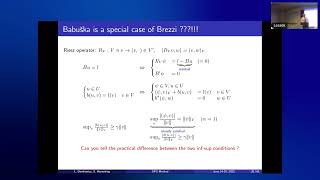
Full Envelope DPG Approximation for Electromagnetic Waveguides
Explore advanced finite element analysis for electromagnetic waveguides, focusing on stability and convergence of full envelope DPG approximation in optical amplifier simulations.
Stabilizing the Unstable Output of Persistent Homology Computations
Explore stabilizing techniques for persistent homology computations, focusing on generating cycles and their applications in topological data analysis.
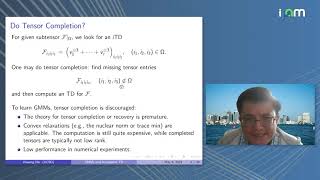
Learning Diagonal Gaussian Mixture Models and Incomplete Tensor Decompositions
Explore parameter learning in diagonal Gaussian mixture models through incomplete symmetric tensor decompositions, with applications in tensor approximation and stability analysis.
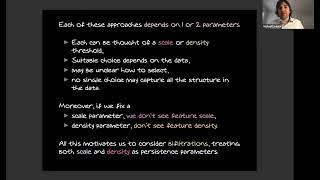
Stability of 2-Parameter Persistent Homology
Explores stability results for 2-parameter persistent homology, covering multicover bifiltration, subdivision bifiltrations, and degree bifiltrations. Discusses computational aspects and implications for practical applications.
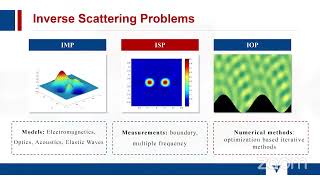
Mathematical Analysis and Numerical Methods for Inverse Scattering Problems
Explore mathematical analysis and numerical methods for inverse scattering problems, covering applications, challenges, algorithms, and recent progress in stability analysis and deep learning approaches.