Advanced Process Control
Comprehensive exploration of advanced process control techniques, covering linearization, modeling, stability analysis, stochastic processes, and control design methods for complex industrial systems.
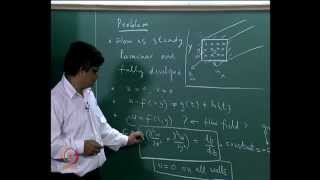
Computational Fluid Dynamics
Explore advanced fluid dynamics simulation techniques, from governing equations to turbulence modeling and complex geometries, enhancing your computational skills for real-world applications.

Control Bootcamp
Rapid overview of optimal control concepts, covering controllability, observability, LQR, and Kalman filter. Applies main approaches to simple Matlab examples for practical understanding.
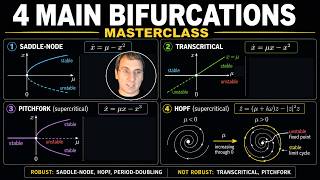
Bifurcation Theory - Saddle-Node, Hopf, Transcritical, Pitchfork
Explore saddle-node, transcritical, pitchfork, and Hopf bifurcations in dynamical systems. Learn how these phenomena affect phase portraits and system behavior as parameters change.
Why Would We Want a Multi-Agent System Unstable
Explores Control Barrier Function methods for collision avoidance in multi-agent systems, comparing stability and effectiveness of different algorithms through simulations and vehicle experiments.

Power System Dynamics and Control
This course first introduces a student to power stability problems and the basic concepts of modeling and analysis of dynamical systems. Modeling of power system components - generators, transmission lines, excitation and prime mover controllers - is cov…
Power System Dynamics and Control
This course introduces a student to power stability problems and the basic concepts of modeling and analysis of dynamical systems. Modeling of power system components - generators, transmission lines, excitation and prime mover controllers - is covered i…

DC Microgrid and Control System
Explore DC microgrid systems, their architecture, dynamics, control strategies, and applications. Learn about power electronics, renewable energy integration, and stability analysis in microgrid environments.

Process Control - Analysis, Design and Assessment
Comprehensive exploration of process control fundamentals, advanced techniques, and practical applications using MATLAB, covering modeling, analysis, design, and assessment of control systems.
Linear System Theory
We will cover time invariant, time varying, continuous and discrete time systems. This course will cover concepts of stability, controllability, observability, and design and serve as a necessary foundation for further study in the area of systems and co…

Introduction to CFD
Explore computational fluid dynamics fundamentals, from numerical methods to advanced techniques like multigrid and parallel computing, with practical demonstrations and applications.
Center Manifold Theory - Computing Center Manifolds
Explore center manifold theory for dynamical systems, focusing on computing and approximating center manifolds. Learn to analyze stability and dynamics near equilibrium points using Taylor series expansions and tangency conditions.
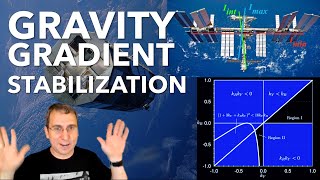
Gravity Gradient - Stability Conditions, Frequencies, Torque Equilibrium Angle, Space Station
Explore gravity gradient effects on spacecraft stability, including Euler equations, pitch stability, torque equilibrium angles, and applications to the International Space Station.
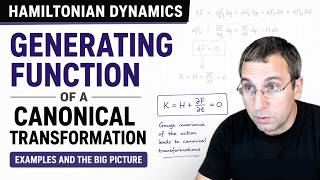
Generating Function of a Canonical Transformation - Examples and the Big Picture
Explore generating functions for canonical transformations in Hamiltonian systems. Learn about harmonic oscillator examples, near-identity transformations, and connections to quantum mechanics and gauge invariance.
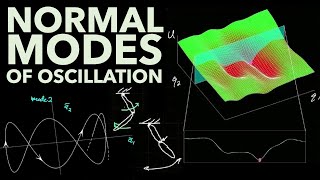
Normal Modes of Mechanical Systems - Oscillations and Instabilities
Explore normal modes in mechanical systems, including oscillatory patterns, steady drift, and instability. Learn about natural frequencies, mode shapes, and their applications in analyzing system responses to forcing.
Control System - Related to GATE Syllabus
Comprehensive GATE preparation covering control systems, including time and frequency responses, stability analysis, root locus, Bode plots, and state space analysis. Includes problem-solving and exam strategies.
Differential Equations
Comprehensive exploration of differential equations, covering theory, applications, and problem-solving techniques. Ideal for mastering this fundamental mathematical concept.
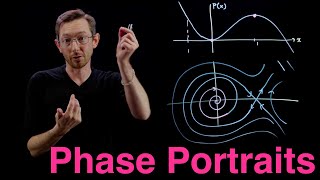
Drawing Phase Portraits for Nonlinear Systems
Learn to analyze nonlinear systems by drawing phase portraits, identifying fixed points, linearizing, and inferring global dynamics. Gain practical skills in stability analysis using eigenvalues and eigenvectors.
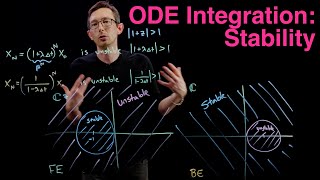
Stability of Forward Euler and Backward Euler Integration Schemes for Differential Equations
Explore stability of Forward and Backward Euler integration schemes for differential equations through eigenvalue analysis, covering continuous and discrete dynamics, scalar and matrix systems.
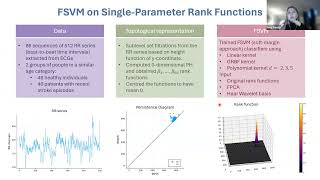
Computable Stability for Persistence Rank Function Machine Learning
Exploring persistent rank functions and rank invariants as alternatives to persistent homology barcodes, with applications in machine learning and topological data analysis.
Machine Learning from a Stability Point of View
Explore machine learning through a stability lens, examining how mathematical principles enhance algorithm robustness and reliability in real-world applications.