Promises in C++ - The Universal Glue for Asynchronous Programs
Explore promises in C++ for asynchronous programming, covering fundamental operations, construction helpers, continuations, and real-world examples to enhance your ability to write efficient and scalable code.
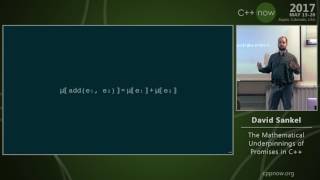
The Mathematical Underpinnings of Promises in C++
Explore the mathematical foundations of promises in C++ and their practical implementation, covering functional design principles, algebraic concepts, and real-world applications in library development.
Abusing C++17
Explore C++17's new language features and their creative applications. Learn about fold expressions, template deduction guides, constexpr if, and returning multiple values from functions.
Mocking C++
Explore mocking in C++ for efficient unit testing without dependencies. Learn techniques to create mock objects, overcome limitations, and improve test reliability and speed.
C++17 Features
Comprehensive overview of C++17 features, covering major language and library changes. Explores structured bindings, if constexpr, lambdas, inline variables, and new standard library components like filesystem and parallel algorithms.
C++11's Quiet Little Gem - System Error
Explore C++11's <system_error> header, focusing on std::error_code and std::error_condition. Learn their design, intended use, and potential for extensibility in error handling and reporting across platforms.

RaftLib - Simpler Parallel Programming
Explore RaftLib, a C++ library simplifying parallel programming for heterogeneous multicore processors. Learn to write efficient code for complex hardware without extensive low-level knowledge.
Building Useful Tools with LLVM and Clang for Fun and Profit
Explore LLVM and clang libraries for custom C++ tools. Learn AST representation, static analysis, and source-to-source transformations to enhance workflow and productivity.
The Shape of a Program
Explore how programs can be viewed as mathematical shapes using topology, examining connections between actions, capabilities, time, and possibility in software architecture.
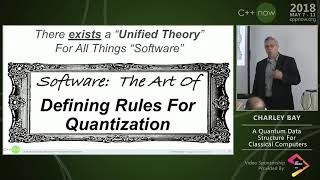
A Quantum Data Structure for Classical Computers
Explore quantum data structures for classical computers, understanding superposition, entanglement, and coherence in C++ programming to broaden computational options and prepare for emerging quantum-reliant hardware.
C++17's std::pmr Comes With a Cost
Explore C++17's std::pmr, its benefits and costs in large codebases. Learn about polymorphic allocators, their impact on move semantics, testing, performance, and when to use them effectively.
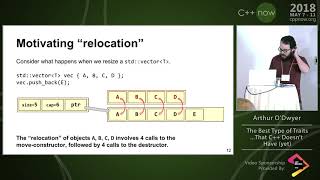
The Best Type Traits that C++ Doesn't Have
Explore advanced C++ type traits for efficient memory operations, comparisons, and optimizations. Gain insights into relocatable objects, equality comparisons, and tombstone traits for improved performance.
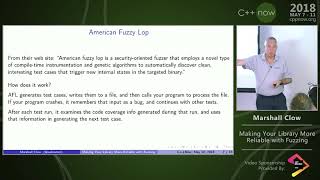
Making Your Library More Reliable with Fuzzing
Explore advanced fuzzing techniques to enhance library reliability, with insights on tools, guided fuzzing, and real-world examples from libc++ and Boost.Algorithm.
My Little -this Deduction - Friendship is Uniform
Explore C++ language enhancements: uniform call syntax, recursive lambdas, and simplified method templates. Learn how these features improve code clarity, reduce boilerplate, and enhance language uniformity.
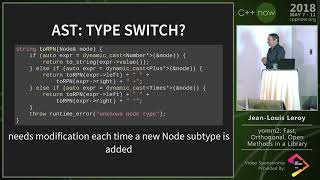
YOMM2 - Fast, Orthogonal, Open Methods in a Library
Explore fast, orthogonal open methods in C++ with yomm2 library. Learn to add virtual functions, solve dispatch problems, and enhance polymorphic behavior without modifying existing class hierarchies.

What Belongs in the C++ Standard Library
Panel discussion exploring criteria for including features in the C++ Standard Library, debating potential additions and their impact on the language's evolution and usability.
Initializer Lists Are Broken, Let's Fix Them
Explores flaws in C++11's initializer_list, demonstrating issues with dangling references and inefficiencies. Discusses potential solutions and seeks consensus on addressing these problems in the C++ standard.
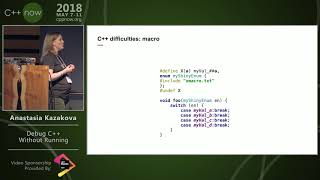
Debug C++ Without Running
Explore advanced C++ debugging techniques without running code, focusing on macros, templates, and preprocessor challenges. Learn IDE-based solutions for improved code understanding and efficiency.
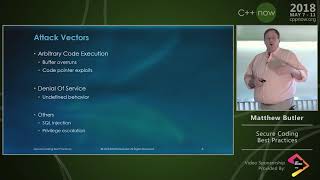
Secure Coding Best Practices
Explore secure coding practices in C++ to protect systems from vulnerabilities. Learn to identify attack surfaces, balance security with performance, and integrate security measures from the design phase.

C++ Development with Visual Studio Code
Explore Visual Studio Code for C++ development across platforms. Learn about editing, building, and debugging features in this lightweight, open-source code editor suitable for Windows, Mac, and Linux.

Git, CMake, Conan - How to Ship and Reuse Our C++ Projects
Explore efficient C++ project management using Git, CMake, and Conan. Learn modern techniques for dependency handling, modular design, and package creation to streamline development and improve code reusability.