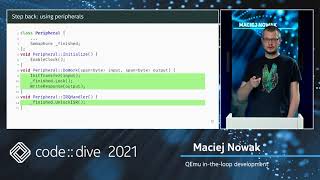
QEmu in-the-loop Development
Explore QEmu for embedded software development, enabling rapid iteration while closely simulating target hardware. Learn to overcome challenges and leverage tools for efficient cross-architecture development.
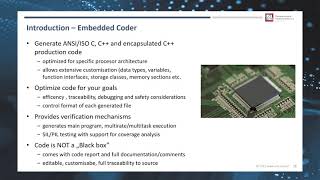
Automating Code Generation for Embedded Systems
Explore automated code generation for embedded systems, transforming high-level algorithms into optimized C/C++ code. Learn about enhancing efficiency, ensuring traceability, and meeting safety standards in software development.
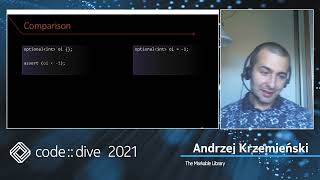
The Markable Library
Explore the Markable library, an alternative to std::optional that saves memory by repurposing an existing value. Learn its usage, benefits, and comparison to std::optional in C++ development.
How It's Done - Sorting Algorithms
Explore various sorting algorithms, their implementations in C and C++, and optimization techniques. Gain insights into the evolution of sorting methods from basic to highly efficient approaches used in modern libraries.
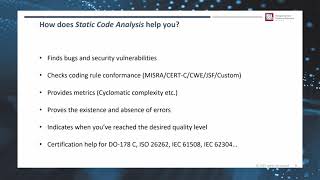
Implementing Innovations in a Safe and Secure Way
Explore automated static code analysis for software safety and security. Learn to prove absence of runtime errors using formal methods and tools like Polyspace for exhaustive testing.
Software Architecture Patterns - in One Hour or Less
Explore essential software architecture patterns with Dr. Maciej Norberciak, a Nokia architect. Learn key concepts and practical applications for embedded systems and telecommunications.
Static Code Analysis in Software Development Process
Explore static code analysis integration in DevOps workflows, code reviews, and verification pipelines to enhance software quality and streamline development processes.
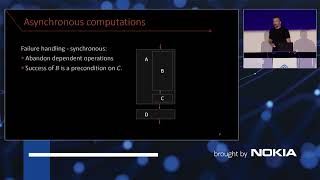
Asynchrony with ASIO and Coroutines
Explore asynchronous programming in C++ using ASIO and coroutines, enhancing performance and simplifying complex operations in high-performance systems.
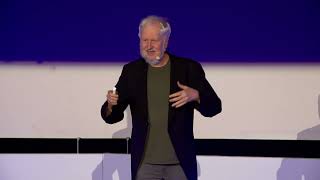
The Next Programming Language
Douglas Crockford explores the future of programming languages, drawing from his extensive experience to discuss potential improvements and innovations that could shape the next generation of coding.
Lazy Initialization
Explore lazy initialization techniques in C++ with Aleksander Augustyniak, covering implementation strategies, performance implications, and best practices for efficient memory management.
Stop Writing Test Doubles You Are Using
Discover strategies to eliminate unnecessary test doubles, improving code quality and maintainability. Learn practical techniques for more effective and efficient unit testing.
Fresh Paint
Explore C++11's focus on writing simpler, cleaner, and more elegant code. Learn techniques for effective programming without delving into cutting-edge features.

Now What? A Vignette in Three Parts
Exploring C++11's potential for beautiful, efficient code, addressing performance challenges, and adapting to the evolving landscape of networked devices and ubiquitous data access.
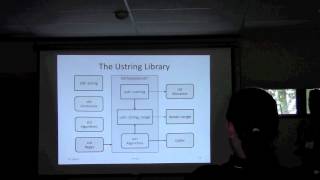
Ustring - A Modern Alternative to std::string
Explore Ustring, a modern C++11 alternative to std::string, addressing limitations and offering enhanced Unicode support and flexibility for efficient string handling.
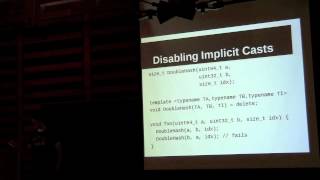
How We Switched to C++11 at SolidFire and How It Worked Out
Explore SolidFire's transition from C++03 to C++11, including team motivation, testing strategies, and new coding possibilities. Gain insights on overcoming challenges and leveraging modern C++ features.

Using Boost.Coroutine to Untangle a State Machine
Simplifying complex event-driven programming with Boost.Coroutine, transforming convoluted state machines into clear, maintainable code with improved control flow and easier debugging.
C++ Component Extensions for WinRT
Exploring approaches to integrate C++ with foreign object models, focusing on Microsoft's WRL library and C++ syntax extensions for cross-language component interaction in heterogeneous environments.

Optimizing the Emergent Structures of C++
Explore how C++ forms complex systems through emergent structures, and learn techniques to design programs that leverage modern optimizers while maintaining simplicity and power.
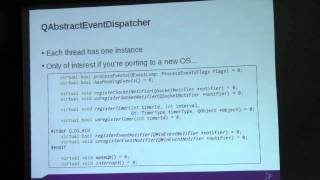
Qt Event Loop, Networking and I/O API
Explore Qt's event loop, networking, and I/O API. Learn about asynchronous mechanisms, TCP/UDP handling, and HTTP/FTP support. Gain insights for both application and library developers.
Containers in Boost
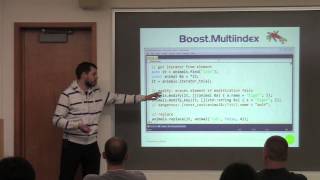
Explore advanced container libraries in Boost, including Multiindex, Bimap, CircularBuffer, and more. Learn to leverage these powerful tools to enhance your C++ projects with specialized data structures.
Non-Allocating std - future - promise
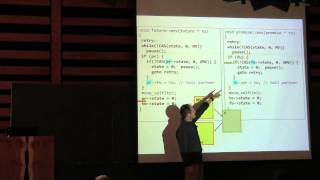
Explore lock-free techniques for implementing std::future/promise without allocation, addressing challenges of shared state and object lifetime in C++. Interactive session for hands-on learning.