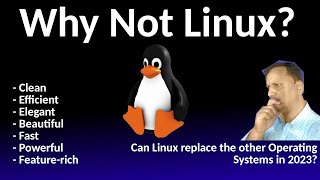
Why Not Linux? A Closer Look at Linux for Desktop Needs
Explore Linux as a viable desktop option, covering its GUI, communication tools, office suites, development capabilities, multimedia support, enterprise readiness, and gaming potential.

Breaking Down Barriers to High-Performance Computing
Exploring initiatives to enhance Ubuntu for scientific computing and HPC, discussing open-source projects, promoting wider adoption, and addressing challenges in the HPC ecosystem.

Teleporting to Modernity - Desktop Portals
Explore desktop portals in Linux: their functionality, benefits for developers and users, and future potential. Learn how this technology enhances security, performance, and cross-desktop compatibility.
Defining Open AI - Interactive Workshop
Interactive session exploring the definition of "open" in AI/ML systems. Participants contribute to shaping principles for collaborative AI development, reviewing a draft definition in real-time.
AutoGen - A Multi-Agent AI Framework
Explore AutoGen's core functionalities and key concepts for implementing complex AI workflows, integrating models, tools, and human inputs across various tasks and industries.
Building Ethical AI: The Power of Open Source and Education
Explore the fusion of Trusted AI, Responsible AI, and Generative AI education grounded in Open-Source principles for an ethical, equitable, and accessible AI future.

The Impact of AI Regulation on Open Innovation - Panel Discussion
Experts discuss how AI regulations in different jurisdictions may affect open innovation, comparing approaches and exploring implications for developers and researchers.
Chatbot Arena: An Open Crowdsourced Platform for Human Feedback on LLMs
Explore Chatbot Arena, a platform for evaluating language models through human feedback. Learn about its Elo rating system, datasets, and applications in content moderation and safety benchmarking.
Building a Custom AI Chatbot with Spring Boot, React, and LangChain4j
Learn to create an intelligent chatbot using Spring Boot, React, and LangChain4j. Explore practical AI integration, LLM interaction, and custom content implementation for business-specific applications.
How Generative AI Affects Open Source Developers and Downstream Consumers
Explore the impact of Generative AI on open source development, focusing on legal implications, data supply chains, and guidelines from leading foundations for balancing developer needs and business applications.
Intel and Open Source - Bringing AI Everywhere
Explore Intel's strategy for AI integration across platforms, emphasizing open-source contributions, software acceleration, and developer-friendly tools to maximize performance and productivity.
Accelerating AI/ML Development with Open Source Software
Explore AWS's strategy for AI/ML development using open source software. Learn about key projects and how they empower customers to innovate with cutting-edge tools while ensuring sustainability and stability.
Empowering Open-Source Generative AI by Integrating the Wikidata Knowledge Graph
Explore integrating Wikidata's open-source knowledge graph into generative AI applications for automated content creation, data augmentation, and semantic analysis, fostering collaborative development.
Testing in Production - Mirroring CQL Traffic to a Shadow Cassandra Deployment
Explore DataStax's shadow deployment system for testing Astra updates using mirrored CQL traffic, including challenges, architecture, and lessons learned in implementing this innovative approach.
How to Adopt Emerging Federated Learning Technologies
Explore Flame, a flexible system for deploying distributed federated learning applications, enabling customization and easy adoption of new architectures with reduced development effort.
Using Generative AI to Develop Open Source Code - Practical Guidance for Managing Legal, Copyright, and Licensing Risks
Practical guidance on managing legal risks when using AI for open source code development, covering copyright, licensing, and best practices for responsible AI contributions.

Continuous Profiling with Parca - From Kernel to Cloud
Explore high-resolution dynamic profiling with Parca, an open-source tool for continuous profiling. Learn to optimize code performance, enhance reliability, and reduce cloud costs across various languages.
Use Meridio to Create Network Services for Telco Use Cases Using Secondary Networking for Kubernetes
Explore Meridio, an open-source tool for Kubernetes, enabling advanced networking capabilities for telco use cases. Learn about traffic attraction, isolation, and simplified management using secondary networking.
Embracing Multi-Tenancy While Scaling MLOps
Explore multi-tenancy in MLOps: efficient resource sharing, isolation, and security for scaling ML operations. Learn implementation strategies using open-source tools like Flyte for cost-effective and secure multi-tenant environments.

Inspiring India: Meet the Women Leaders in Kubernetes
Inspiring panel discussion featuring women leaders in Kubernetes sharing their journeys, experiences, and insights on contributing to open source and navigating the cloud native ecosystem.
Efficient Kubernetes E2E Testing - Unleashing the Power of Prow
Explore Prow for efficient Kubernetes E2E testing. Learn setup, components, job configuration, test parallelization, result analysis, and troubleshooting strategies to enhance cluster reliability and stability.