Fully Abstract Normal Form Bisimulation for Call-by-Value PCF
Explore a fully abstract normal form bisimulation for call-by-value PCF, combining applicative and environmental bisimulation with game semantics for program equivalence checking.
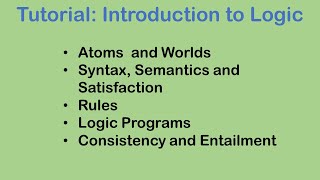
Introduction to Propositional Logic for AI
Explore propositional logic fundamentals, including syntax, semantics, and key concepts for AI applications. Gain insights into logic programming and its role in neuro-symbolic AI.
The Leverage of Language, or, How I Realized Information Theory Could Save Information Security
Explore how information theory can revolutionize cybersecurity through language leverage, visualization, and innovative approaches to incident response and threat intelligence.
Using Semantics to Help Learn Phonetic Categories
Discover how semantics can enhance phonetic category learning through computational models and linguistic analysis in this research-focused exploration of language acquisition.
The Semantics of Plurals in Expression Languages - SLE
Explore the semantics of plurals in software languages, examining bunch theory and its integration with relations for seamless modeling and programming.
All the Binaries Together: A Semantic Approach to Application Binary Interfaces
Explore a semantic approach to Application Binary Interfaces, enhancing interoperability and safety in multi-language systems through realizability models and formalized ABIs.
The Ins and Outs of Preposition Semantics - 2017
Explore preposition semantics, their crucial role in linking meaning, and challenges in comprehensive annotation and cross-linguistic analysis. Gain insights into ongoing research and corpus development.
Weighted Relational Models
Explore weighted relational models in differential λ-calculus and linear logic with Guy McCusker's insightful conference talk at CIRM.

How to Create a New JVM Language
Explore creating a new JVM language, covering grammar, semantics, interpreters, and interoperability. Learn about parsers, optimizations, and tackle common language design challenges.
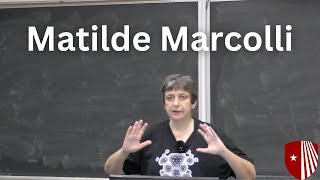
Mathematical Structures in Generative Linguistics
Explore mathematical structures in generative linguistics, from formal languages to Hopf algebras and geometric spaces for modeling semantics and syntactic variation across languages.
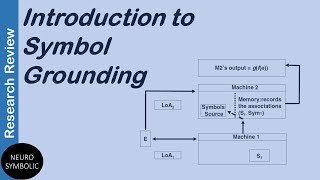
Introduction to Symbol Grounding
Explore the symbol grounding problem, its philosophical roots, and major approaches including representationalist, semi-representationalist, and non-representationalist solutions.
Norms and Exploitations: Mapping Meaning onto Use
Explore Corpus Pattern Analysis to map word meanings to typical contexts, reducing lexical entropy and linking patterns to applications like synonym sets or translations.

CDG-Based Language Models - 2009
Explore context-dependent grammar-based language models and their applications in natural language processing and speech recognition.

An Information State Approach to Collaborative Reference
Explore collaborative reference in dialogue systems using information state approaches. Gain insights into language processing and communication dynamics.
Towards Meaning: The Tectogrammatical Sentence Representation - 2001
Explore tectogrammatical sentence representation, a linguistic approach for analyzing sentence structure and meaning, presented by Jan Hajic in 2001.
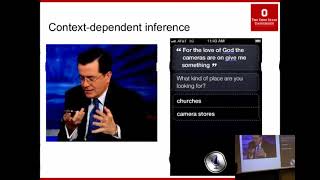
Automatically Deriving Adjectival Scales from Neural Network Language Models - 2013
Discover how computational linguistics can derive meaning from adjective scales, using web data and neural networks to understand gradable modifiers in everyday language and medical contexts.
An Enriched Category Theory of Language
Explore how enriched category theory provides a mathematical framework for analyzing language structure and semantics, with applications to large language models and linguistic expressions.