Origins and Habitats of Super-Giant Fields
Explore the geological events and processes that form super-giant oil and gas fields, focusing on trap formation, sag events, and their impact on field size and hydrocarbon accumulation.
Rapid Forecasting of Carbon Storage and Migration using Neural Operators and Transfer Learning
Leverage Fourier Neural Operators and Transfer Learning to predict CO2 migration in storage reservoirs efficiently, reducing computational time and data requirements for accurate analysis.
The Hit-and-Run Model for the Sevier and Laramide Orogenies of Western North America
Explore the Hit-and-Run Model's application to Western North American orogenies, examining geological processes and structural implications for the Sevier and Laramide events.
The Texas Permian Superbasin Geomodel: Examples from Reservoir Characterization Studies
Explore advanced techniques for building a comprehensive 3D geological model of the Permian Basin, integrating multidisciplinary workflows and detailed reservoir characterization studies.
Upscaling High-Resolution Core-Based Facies to Basin-Scale Stratigraphic Models
Learn to integrate core-based datasets with wireline logs using machine learning for upscaling high-resolution facies to basin-scale stratigraphic models in the Delaware Basin's Third Bone Spring Sand and Wolfcamp units.
Characterization of Lower Ordovician Ellenburger Dolomite in the Permian Basin
Explore the Lower Ordovician Ellenburger Dolomite's reservoir characteristics, depositional setting, and karst processes. Gain insights into pore networks relevant for waste-water disposal and CO2 storage in the Permian Basin.
Fluid Flow and Carbon Utilization in Unconventional Reservoirs
Explore fluid dynamics in shale reservoirs, focusing on multiphase flow, rock-fluid interactions, and carbon storage potential. Gain insights into permeability, wettability, and fracture-matrix interactions for enhanced oil recovery.
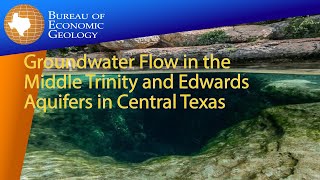
Overview of Groundwater Flow in the Middle Trinity and Edwards Aquifers of Central Texas
Explore hydrogeology of Edwards and Trinity Aquifers, focusing on groundwater flow, aquifer interactions, and surface water connections in central Texas.
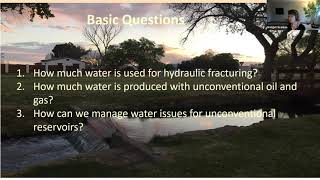
Reuse of Produced Water in Texas: Management Approaches and Challenges
Explore produced water management in Texas, focusing on volumes, reuse strategies, and environmental impacts in hydraulic fracturing operations.
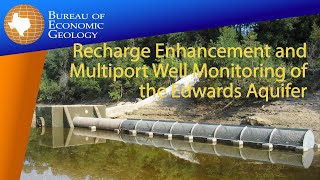
Recharge Enhancement and Multiport Well Monitoring of the Edwards Aquifer
Explore Edwards Aquifer conservation techniques, including recharge enhancement and multiport well monitoring. Learn about innovative approaches to protect water quality and manage aquifer resources.
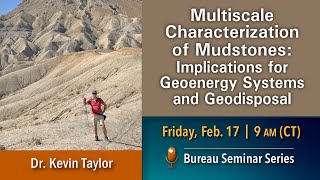
Multiscale Characterization of Mudstones - Implications for Geoenergy Systems and Geodisposal
Explore multiscale characterization of mudstones and its impact on geoenergy systems and geodisposal through advanced techniques and collaborative research.
U-Pb Geochronology of Low-U Phases - Expanding the Frontiers of Radiometric Dating
Explore advancements in U-Pb geochronology, focusing on dating low-U minerals using LA-ICPMS techniques. Learn about expanded applications and recent developments in this field.

Rough Paths for Physicists - Course 2: Rough Paths, Combinatorics and Regularity
Explore rough paths, combinatorics, and regularity in physics, focusing on Brownian motion and its applications in mathematical analysis.

Rough Paths for Physicists - Course 3: Controlled Rough Paths and Rough Integrals - Lecture 3
Explore controlled rough paths, rough integrals, and differential equations. Compare rough and stochastic integrals, and delve into the Itô stochastic area.

Rough Paths for Physicists - Motivations, Sewing Lemma, and Young Integrals - Lecture 1
Explore rough paths in physics, focusing on motivations, the sewing lemma, and Young integrals. Gain insights into advanced mathematical concepts for physical applications.

Marfan Syndrome vs. Ehlers-Danlos Syndrome - Biochemistry and Genetics
Explore the genetic and biochemical differences between Marfan Syndrome and Ehlers-Danlos Syndrome, focusing on connective tissue defects, symptoms, and clinical manifestations.

Uniform Circular Motion Formulas - Centripetal Acceleration, Tension Force, Frequency, and Period
Master uniform circular motion formulas: centripetal acceleration, tension force, frequency, and period. Gain essential physics knowledge for problem-solving and conceptual understanding.
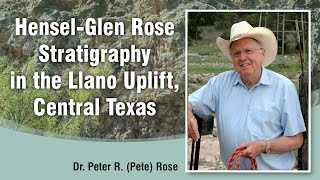
The Lower Cretaceous Hensel-Glen Rose Stratigraphic Couplet in the Llano Uplift, Central Texas
Explore the Lower Cretaceous Hensel-Glen Rose stratigraphic couplet in Central Texas, examining its depositional environments, thickness variations, and paleotopographic influences on the Llano Uplift.
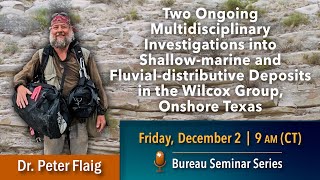
Two Ongoing Investigations into Shallow-Marine and Fluvial-Distributive Deposits in the Wilcox Group
Explore shallow-marine and fluvial-distributive deposits in the Wilcox Group. Gain insights into sedimentology, palynology, and drone photogrammetry techniques used in geological investigations.
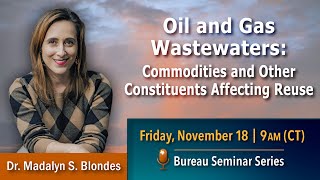
Oil and Gas Wastewaters: Commodities and Constituents Affecting Reuse
Explore new approaches for quantifying reusable produced water, sourcing commodities, and overcoming obstacles in oil and gas wastewater recovery and reuse.
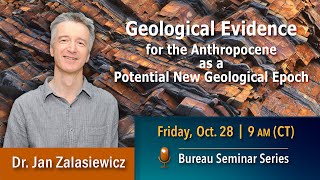
Geological Evidence for the Anthropocene as a Potential New Geological Epoch
Explore geological evidence supporting the Anthropocene as a new epoch, including stratigraphic signals, the Great Acceleration, and ongoing research for potential formalization in the Geological Time Scale.