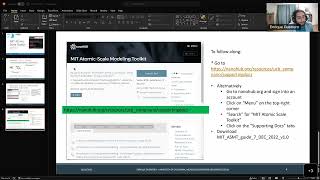
Teaching and Learning with the MIT Atomic Scale Modeling Toolkit - Classical and Quantum Atomic Modeling
Explore classical and quantum atomic modeling using MIT's toolkit. Perform molecular dynamics, Monte Carlo simulations, and quantum chemistry computations. Learn practical applications for various physics and chemistry courses.
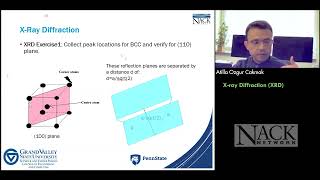
X-ray Diffraction and Spectroscopy Techniques for Nanomaterial Characterization
Explore wave-based characterization techniques including X-ray diffraction, photoelectron spectroscopy, FTIR, and UV-Vis spectroscopy. Gain insights into nanomaterial analysis and practical applications using simulation tools.
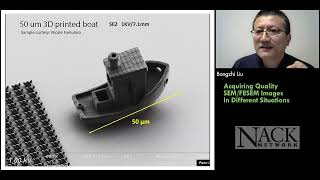
Acquiring Quality SEM/FESEM Images in Different Situations - Like Driving a Car
Master SEM/FESEM imaging techniques through practical analogies. Learn key parameters, beam control, and troubleshooting for high-quality microscopy results across various sample types and conditions.
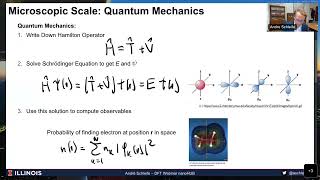
Density Functional Theory: Introduction and Applications
Explore Density Functional Theory fundamentals and applications using Quantum Espresso on nanoHUB. Learn to compute electronic structures, densities of state, total energies, and bulk modulus for materials.
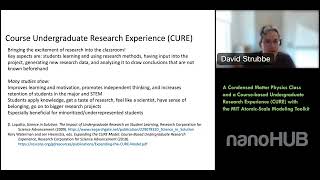
Condensed Matter Physics Class and Research Experience with MIT Atomic-Scale Modeling Toolkit
Explore condensed matter physics through simulations and research experiences using the MIT Atomic-Scale Modeling Toolkit. Learn about covalent bonding, bandstructure, phonons, and magnetic phase transitions.
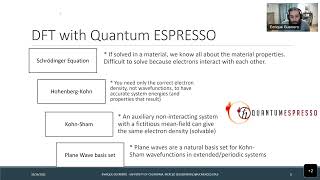
Interactive Modeling of Materials with DFT Using Quantum ESPRESSO - MIT Atomic Scale Toolkit
Explore interactive modeling of materials using density functional theory with Quantum ESPRESSO in the MIT Atomic-Scale Modeling Toolkit. Learn to compute and analyze various material properties through hands-on examples.
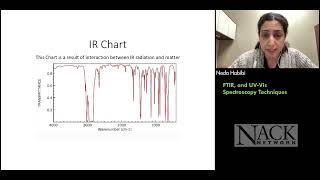
FTIR and UV-Vis Spectroscopy Techniques - Lecture 3
Explore FTIR and UV-Vis spectroscopy techniques, their principles, applications, and operational mechanisms. Gain insights into radiation interactions, vibration types, and spectrum analysis for nanoscale characterization.
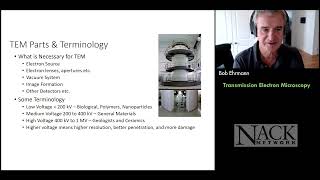
Transmission Electron Microscopy - Principles and Applications - Lecture 2
Explore transmission electron microscopy fundamentals, including microscope components, image formation, sample preparation techniques, and applications in materials science and biology.
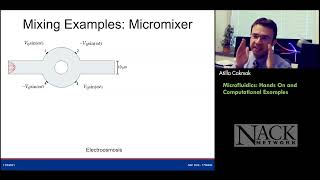
Microfluidics: Hands-On and Computational Examples
Explore microfluidics through hands-on demonstrations and computational simulations, focusing on mixing techniques, soft lithography, and practical applications like red blood cell separation in microfluidic channels.
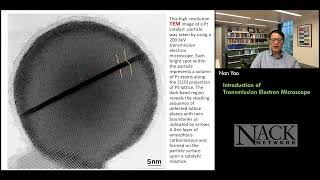
Introduction to Transmission Electron Microscopy - Lecture 1
Explore transmission electron microscopy's principles, components, and applications in nanotechnology. Learn about electron sources, lenses, aberration correction, and cutting-edge imaging techniques for nanomaterial characterization.
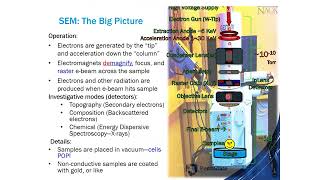
Charged-Particle Interaction Analysis - From Optical Microscopy Limits to Advanced Electron Microscopy Techniques
Explore charged-particle interaction analysis, covering SEM fundamentals, beam-sample interactions, detection methods, and advanced techniques like EPMA and EBSD for comprehensive micro/nano characterization.
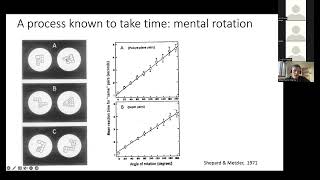
Modelling Mental Rotation in the Brain Using Deep Learning
Explore mental rotation in the brain and its potential implementation in deep learning, comparing human visual systems to neural networks.
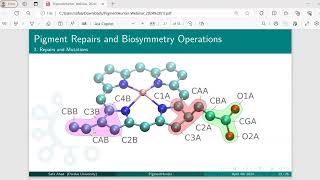
Building a Graphical Interface for Exploring Protein Dynamics and Spectroscopy - PigmentHunter
Explore protein dynamics and spectroscopy with PigmentHunter, a user-friendly nanoHUB tool for simulating excitonic spectra of chlorophyll proteins. Learn its interface, workflow, and applications in molecular dynamics and spectral analysis.
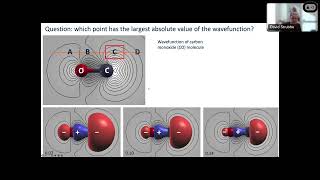
DFT with SIESTA, Data Visualization, and Sophomore-level CURE Using MIT Atomic-Scale Modeling Toolkit
Explore density functional theory, data visualization, and undergraduate research experiences using the MIT Atomic-Scale Modeling Toolkit for modern physics and condensed matter studies.
Simulation of Chemical Reactions on a Quantum Computer
Explore quantum computing algorithms for calculating scattering matrix elements in chemical reactions, focusing on the Møller operator formulation and its application to hydrogen exchange.
Quantum Energy Teleportation - Activating Ground State Energy
Explore quantum energy teleportation and its experimental demonstration using nuclear magnetic resonance. Discover how entanglement enables energy extraction from vacuum fluctuations.
Metamaterials for Broadband Light Absorption - Quantum Today
Explore metamaterials for efficient broadband light absorption and their applications in optical sensors, imaging, and quantum communication.
Revealing Spin Structures with Neutron Beams - Quantum Today
Explore quantum spin and magnetic skyrmions through neutron beam research, uncovering new pathways to rearrange topologically stable formations in disordered materials.
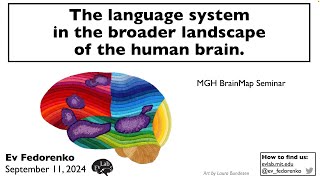
The Language System in the Broader Landscape of the Human Brain
Explore the language system's role within the human brain's broader landscape through Prof. Evelina Fedorenko's insightful seminar on cognitive neuroscience.
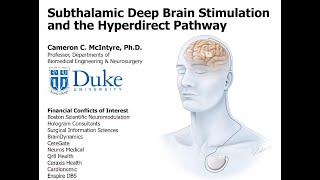
Characterizing the Role of the Hyperdirect Pathway in Subthalamic Deep Brain Stimulation
Explore the hyperdirect pathway's role in subthalamic deep brain stimulation, uncovering its impact on neurological treatments and brain function.
Revealing Brain Connectivity with Polarization Sensitive Optical Coherence Tomography
Explore brain connectivity using advanced optical coherence tomography techniques. Gain insights into cutting-edge neuroimaging research and its applications in understanding neural networks.