Rope Simulator - Building a Simple Rope Model - Episode 1
Explore the physics of ropes in video games by building a simple rope simulator using three atoms and two springs. Learn about the Euler-Cromer Method and VPython programming.
Wave Function Evolver - Implementing the Schrodinger Equation - Episode 1
Explore quantum mechanics through coding the Schrödinger Equation using finite difference methods. Implement and visualize wave function evolution in VPython.
Gravity Simulator - Poincare Maps in Phase Space - Episode 5
Explore Poincare maps in phase space plots with cool animations, enhancing understanding of gravitational systems through visual representations.
Gravity Simulator - Exploring Motion in Phase Space - Episode 4
Explore phase space plots in gravity simulations, offering deeper insights into system behavior beyond real-space animations. Includes VPython code examples and references to Stephen Hawking.
Traffic Light Dilemma - Exploring Physics with Code - Episode 2
Explore the physics behind the yellow light dilemma through coding. Learn to develop a program that simulates this common traffic scenario using VPython.
Police Chase: Impact of Reaction Times - Episode 6
Explore the impact of police officer reaction times on catching speeders through physics simulations and coding examples.
Police Chase - Variable Acceleration - Episode 5
Explore variable acceleration functions to model realistic police officer motion in a chase scenario using Scilab and gnuplot for visualization.
Root Finder in Space - Power Trip - Episode 6A
Explore gravitational potential energy's impact on aphelion and perihelion using different power laws. Discover the importance of log plots in analyzing orbital mechanics.
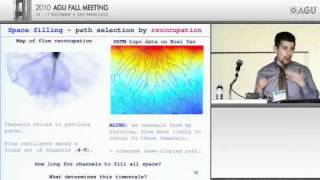
Noise is the New Signal: Moving Beyond Zeroth-Order Geomorphology - 2010 Sharp Lecture
Explore geomorphic transport laws, scale dependence, and robust patterns in Earth's surface processes. Gain insights into sediment transport systems and future research directions.
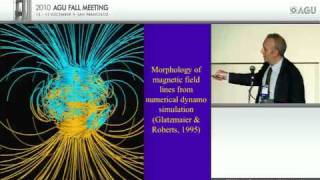
Geomagnetic Secular Variation and Earth's Core Dynamics - Edward Bullard Lecture
Explore Earth's core dynamics through geomagnetic secular variation. Gain insights into historical data, field morphology, and recent advancements in understanding fluid motions and magnetic induction.
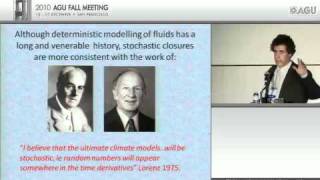
A Very Grand Challenge for the Science of Climate Prediction - Towards a Community-Wide Probabilistic Earth-System Model
Explore the future of climate prediction with a proposed community-wide probabilistic Earth-system model, addressing challenges and potential advancements in atmospheric science.
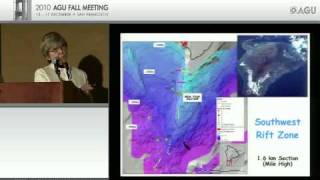
Geochemical Insights Into Mantle Geodynamics and Plume Structure
Explore mantle geodynamics and plume structure through geochemical analysis, gaining insights into Earth's deep processes and their impact on surface geology.
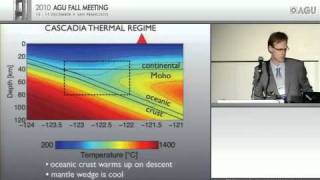
The Fate of Water in the Cascadia Forearc
Explore the complex journey of water in Cascadia's forearc through seismic profiles, revealing insights into plate boundaries, tremors, and oceanic crust behavior.
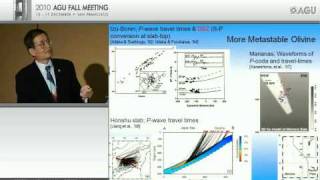
Global Tectonics: Quakes, Rocks, and Volatiles in the Mantle Transition Zone - Birch Lecture
Explore global tectonics, earthquakes, and mantle transition zone dynamics. Discover connections between seismic data, subduction zones, and petrological anomalies in this comprehensive geophysical lecture.
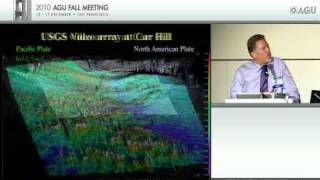
Ultra-High Resolution Four-Dimensional Imaging Across the Earth Sciences
Explore cutting-edge 4D imaging techniques revolutionizing Earth Sciences, offering unprecedented insights into geological processes and environmental changes over time.
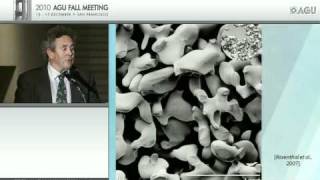
Mountain Hydrology, Fourth Paradigm, and Color of Snow - Nye Lecture
Explore mountain hydrology, data-driven science, and snow properties in this lecture. Learn about environmental applications, measurement techniques, and challenges in understanding snow dynamics and their impact.
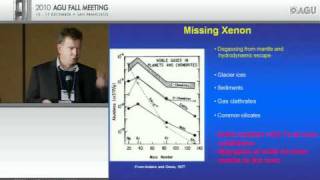
Volatiles in Earth's Interior - Bowen Lecture 2
Explore the role of volatile elements in Earth's deep structure and dynamics, focusing on their impact on mantle processes and global geochemical cycles.
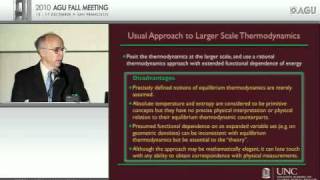
Opportunities for Impacting Hydrologic Model Development - Langbein Lecture
Explore advancements in hydrologic modeling, from tidal models to porous media challenges. Learn about innovative approaches and technologies shaping the field's future trajectory.
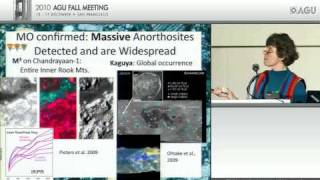
Template for the Terrestrial Planets - The Moon
Explore lunar geology and its implications for terrestrial planets in this AGU Fall Meeting lecture by C. M. Pieters from Brown University.
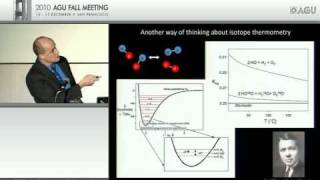
Isotope Geochemistry and Habitability Studies for Extraterrestrial Life - Sagan Lecture
Explore isotope geochemistry's role in studying habitability and potential life on other planets, focusing on Mars, Europa, and Titan. Learn about key indicators and future research directions.
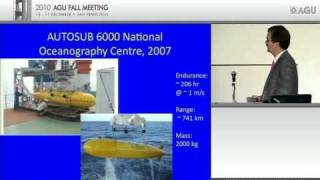
The Autonomous Revolution - Transforming Ocean Observation with Mobile Platforms
Explore cutting-edge autonomous mobile platforms revolutionizing ocean observation, enhancing our understanding of marine ecosystems and climate change impacts.