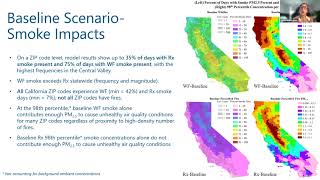
Igniting Early Career Wildfire Studies
Explore cutting-edge wildfire research and career opportunities in this engaging session for early-career scientists interested in fire ecology and management.
Climate Change and Wildfire Risk: Statistical Analysis of Fire Weather in Northern Colorado
Explore statistical analysis of Fire Weather Index data to understand climate's impact on wildfire risk in Colorado, examining factors like heat, humidity, and human activity.

The Influence of Multiple Scales in Fractured Media on Flow and Transport Properties
Explore how fracture geometry and network structure in low-permeability media affect fluid flow and solute transport using discrete fracture network models and high-fidelity simulations.
Deep Learning Applications for Automated Subsurface Model Building
Explore AI/ML applications in geoscience for automated subsurface model building, improving efficiency and accuracy in workflows using seismic, wellbore, and geophysical data.
Pore to Darcy to Field Scale: Challenges in Upscaling Porous Media Models
Explore multiscale modeling in porous media, from nanometers to kilometers. Discuss upscaling challenges, theoretical advances, and practical applications in geosciences, with insights on physics and data integration.

Landau Damping and Related Effects in Kinetic Models of Plasma Physics
Explore asymptotic stability in plasma physics, covering Landau damping, plasma echoes, and collision-enhanced dissipation. Gain insights into recent progress and open directions in collisionless and weakly collisional plasmas.
A Mathematical Introduction to the Molecular Biology of the Cell
Explore the intersection of mathematics and molecular biology in this insightful lecture, unveiling how mathematical concepts illuminate cellular processes and mechanisms.
Gaze and Attention in Human-Computer Interaction - Session 3
Explore the fascinating interplay between gaze and attention, delving into cutting-edge research and insights on visual perception and cognitive processes.
Automotive Collaboration: Progress and Challenges in the Last Year
Explore the progress in automotive software collaboration, focusing on recent improvements, challenges, and the impact of open-source initiatives on the industry's complex development landscape.
Anticipate and Adapt: Protecting Natural Resources Under Extreme Rainfall
Explore techniques for engaging resource managers, extreme precipitation research, climate adaptation co-production, and decision support activities in the Midwest and Northeast U.S. amid increasing heavy rainfall events.
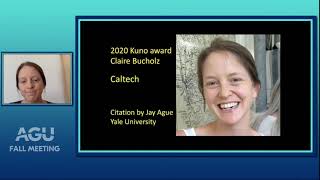
Volcanology, Geochemistry, and Petrology - Daly Lecture
Exemplary contributions to volcanology, geochemistry, or petrology honored through prestigious lecture series, showcasing groundbreaking research and advancements in Earth sciences.
Earth System Perspectives Inspired by Carl Sagan - AGU Lecture
Explore Earth system perspectives inspired by Carl Sagan's work in this lecture featuring expert discussions, Q&A, and an early career panel, honoring Sagan's contributions to astrobiology and science education.
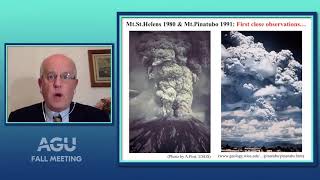
Modeling Explosive Eruption Dynamics and Hazards - Achievements and Future Challenges
Explores advancements in volcanic eruption modeling, highlighting contributions to understanding dynamics and forecasting hazards. Discusses various modeling approaches and their applications in risk assessment.
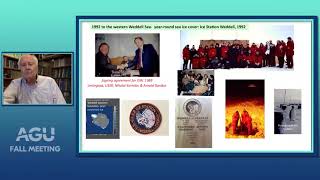
Tropical Ocean to Southern Ocean Coupling: Indonesian Throughflow and Weddell Sea Bottom Water
Explore the connection between Indonesian Throughflow and Weddell Sea Bottom Water, examining their interannual variability and potential coupling through atmospheric patterns like El Niño and Southern Annular Mode.
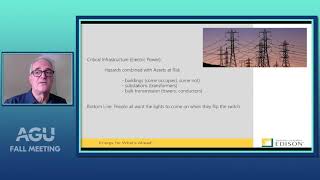
Implementing AGU's "Science for Solutions" to Address Societal Problems
Exploring strategies to apply scientific discoveries to societal challenges, focusing on collaboration with stakeholders and increasing diversity in geosciences for effective problem-solving.
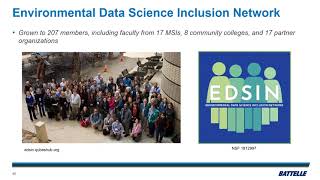
Enabling Transformative Space and Earth Science - Four Case Studies
Explore four case studies in space science, Earth science, and STEM education, covering suborbital ballooning, Arctic research, sensor technology, and educational initiatives for diverse audiences.
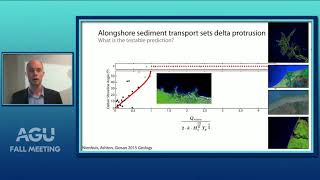
Testing Morphodynamic Theories by Comparing and Contrasting River Deltas
Explore coastal dynamics and river delta morphology, examining the impact of waves, tides, and fluvial forces on delta formation and future changes due to human activities and sea-level rise.
Revisiting the IPCC's "Discernible Human Influence" Finding - History and Lessons Learned
Explores the 1995 IPCC conclusion on human influence on climate, its historical context, subsequent scientific advancements, and personal reflections on lessons learned from this pivotal moment in climate science.
Stephen Schneider Memorial Lecture on Global Environmental Change
Explore interdisciplinary environmental studies and global environmental change in this memorial lecture honoring Dr. Stephen Schneider's pioneering work and lasting impact on climate science.
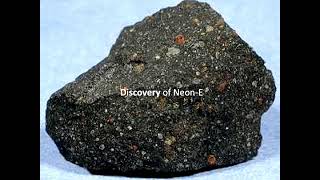
Adventures in Planetary Science 1960-2020 - Fred Whipple Lecture
Explore six decades of planetary science advancements, from early discoveries to recent breakthroughs. Gain insights into the field's evolution and its impact on our understanding of the cosmos.
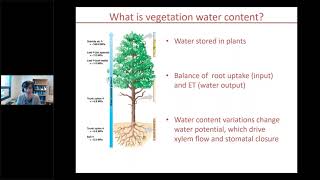
Global Environmental Change Early-Career and Mid-Career Award Lecture - Part 1
Explore groundbreaking research in global environmental change with award-winning scientists Dr. Alexandra G. Konings and Dr. Kimberly A. Novick as they present their innovative work and contributions to the field.