Quantum Field Theory of Exotic Systems - IPAM at UCLA
Explores quantum field theory for exotic systems, focusing on fracton phases and subsystem symmetries. Discusses challenges to traditional beliefs and examines novel approaches in 2+1 and 3+1 dimensions.
Predicting Many Properties of a Quantum System From Very Few Measurements
Efficient method for constructing approximate classical descriptions of quantum states using minimal measurements, enabling prediction of multiple properties with system size-independent measurement requirements.
Exactly Solved Models of Chaotic Many-Body Dynamics
Explore chaotic many-body dynamics through exactly solved models, focusing on Floquet quantum spin chains and their connections to random matrix theory and entanglement dynamics.
Strategies for Quantitative Imaging and Reconstruction from High Speed-Low Dose Data
Explore quantitative imaging techniques using AI/ML for analyzing large datasets of electron microscopy images, focusing on defect mapping in graphene and industrial catalyst studies.
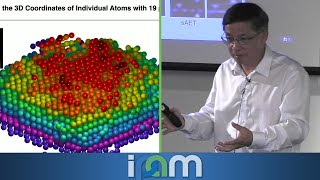
Capturing the 3D Atomic Structure of Non-Crystalline Materials - IPAM at UCLA
Explore advanced techniques for capturing 3D atomic structures of non-crystalline materials, presented by UCLA's John Miao at IPAM's Computational Microscopy Tutorials.
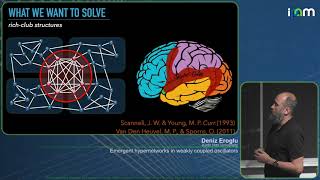
Emergent Hypernetworks in Weakly Coupled Oscillators - IPAM at UCLA
Explores emergence of hypernetworks in weakly coupled oscillators, demonstrating through experiments and simulations how triplet interactions can arise from pairwise nonlinear coupling under specific frequency resonance conditions.
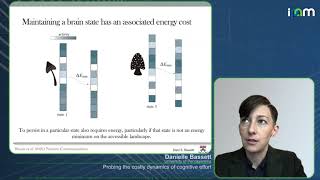
Probing the Costly Dynamics of Cognitive Effort
Explore cognitive effort through network theory, linking brain activity states, energy requirements, and entropy production. Gain insights into the biophysical nature of mental exertion and its implications for human behavior.
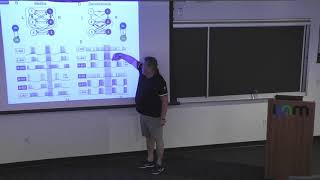
Reconstructed Rhythm-Generation by Neural Circuits in Two Sea Slugs
Explore biologically plausible models of swim center pattern generators in sea slugs, examining network-level bursting, stability mechanisms, and resilience to perturbations using dynamical systems and machine learning.
Identify Interactions in Complex Networked Dynamical Systems through Causation Entropy
Explore optimal causation entropy for inferring coupling structures in complex systems, with applications to functional brain networks and comparisons to correlation-based methods.
Ergodic Basis Pursuit Induces Robust Network Reconstruction - IPAM at UCLA
Explore robust network reconstruction using ergodic basis pursuit, with applications in neuroscience and beyond. Discover innovative techniques for analyzing complex network dynamics from data.
Daniel Faraco- Convex Integration and Mixing Flows
Explore convex integration and mixing flows in hydrodynamics, focusing on the Muskat problem and alternative approaches to understanding fluid behavior in unstable regimes.
Panorama of Mathematics - Andrew Neitzke
Explore new geometric applications of quantum field theory in this insightful talk by Andrew Neitzke, highlighting recent trends and challenges in mathematical sciences.
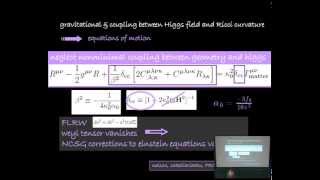
Aspects of the Bosonic Spectral Action
Explores noncommutative spectral geometry, its cosmological implications, scalar fields, and alternative definitions using zeta function regularization to address renormalizability and ultraviolet completeness.
Gapped Quantum Systems
Explore gapped quantum systems with Matthew Hastings, delving into advanced mathematical concepts and their applications in quantum physics and information theory.
AI-Driven Workflows for the Discovery of Novel Superconductors
Explore AI-driven methods for discovering novel superconductors, including data augmentation, ultra-fast machine-learning potentials, and symbolic regression to improve predictive equations for superconducting transition temperatures.
X-Ray Micro-Tomography at the Advanced Light Source and NERSC Superfacility
Explore X-ray micro-tomography at ALS and NERSC's "superfacility," enabling 3D micron-resolution imaging for diverse scientific applications, from earth science to biology, with advanced data processing workflows.
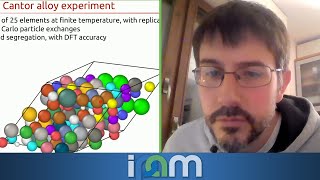
Machine Learning for Atomic-Scale Modeling - Potentials and Beyond - IPAM at UCLA
Explore machine learning techniques for atomic-scale modeling, addressing challenges in chemical diversity and integrating functional properties beyond interatomic potentials for advanced materials simulation.
Catalysis - Automated Multiscale Modeling and Active Exploration of Chemical Space
Revolutionizing catalysis through automated multiscale modeling and active exploration of chemical space, accelerating material discovery and optimizing processes from first principles to reactor scale.
High-Dimension Perspective on Extracting & Encoding Information in Chemical Systems
Explore high-dimensional data extraction and encoding in complex chemical systems, focusing on exascale computing opportunities, multiscale correlations, and challenges in feature selection and interpretability.
From Electrons to the Simulation of Materials - IPAM at UCLA
Explore computational workflows for predicting complex materials properties, from phase diagrams to nanostructures, using density functional theory and machine learning potentials.
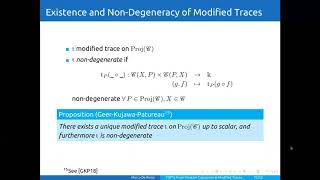
TQFTs from Non-Semisimple Modular Categories and Modified Traces - Marco de Renzi
Explore non-semisimple TQFTs and modified traces in topology, focusing on construction methods, invariants, and mapping class group representations derived from modular categories.