Christian Bogner: The Analytic Continuation of the Kite and the Sunrise Integral
Explores advanced Feynman integrals using elliptic generalizations of polylogarithms, discussing properties through periods of elliptic curves and the Picard-Lefschetz theorem.
6j-Symbols for SL(2,C) Group and Feynman Diagrams
Explore 6j-symbols for SL(2,C) group using Feynman diagrams, deriving Racah coefficients for infinite-dimensional unitary principal series representations and expressing results as complex integrals or Mellin-Barnes type sums.
Nonlocal Theories for Free Crack Propagation in Brittle Materials - Lecture 2
Explores mathematical upscaling of nonlocal fracture models, focusing on weak convergence, compactness, and Gamma-convergence for bridging mesoscopic and macroscopic scales in brittle material dynamics.
The Black Hole Stability Problem - IPAM at UCLA
Explore analytic and geometric tools for understanding black hole stability in Kerr-de Sitter and Kerr spacetimes, presented by Stanford's András Vasy at IPAM's Workshop on Mathematical Aspects of Gravitation.
A New Approach to the Binary Inspiral Problem - IPAM at UCLA
Explore modern scattering theory applications to gravitational wave calculations, focusing on advances in quantum scattering amplitudes and their relevance to binary black hole inspiral problems.
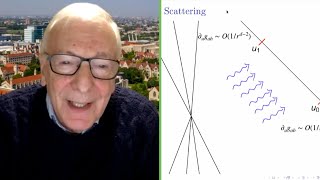
The Memory Effect and Infrared Divergences - IPAM at UCLA
Explores memory effect in gravitational radiation, infrared divergences in quantum field theory, and challenges in quantum gravity scattering. Discusses solutions and limitations in describing incoming/outgoing states.
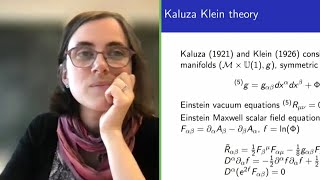
Global Existence for a System of Wave Equations on a Product Space - IPAM at UCLA
Explore global existence for wave equations on product spaces, a model for Einstein equations with compact dimensions in Kaluza-Klein theory. Presented by Cécile Huneau at IPAM's gravitation workshop.
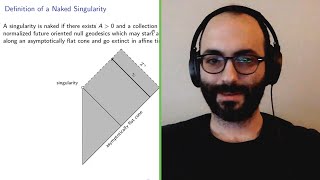
On Naked Singularities for the Einstein Vacuum Equations - IPAM at UCLA
Explore the construction of naked singularities in Einstein vacuum equations with Yakov Shlapentokh-Rothman, delving into cutting-edge research in mathematical aspects of gravitation.
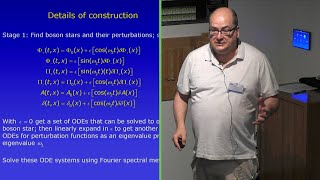
Multi-Oscillating Boson Stars - IPAM at UCLA
Explore multi-oscillating boson stars in general relativity, examining their characteristics, frequencies, and comparisons to single-frequency configurations in this advanced physics presentation.
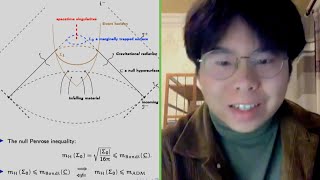
Null Hypersurfaces and the Penrose Inequality for a Perturbed Schwarzschild Black Hole
Explores the Penrose inequality in general relativity, focusing on null hypersurfaces and perturbed Schwarzschild black holes. Discusses recent breakthroughs and ongoing challenges in this field of gravitational physics.
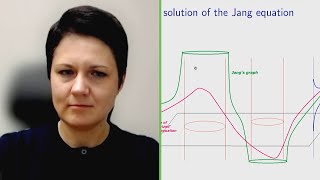
Positivity of Mass for Asymptotically Hyperbolic Initial Data Sets - IPAM at UCLA
Explore asymptotically hyperbolic initial data in Einstein equations, focusing on positivity of mass and its implications for understanding gravitational systems and Bondi mass.
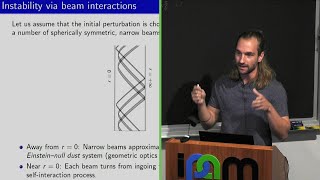
Instability of Anti-de Sitter Spacetime for the Einstein-Scalar Field System
Explores the AdS instability conjecture in Einstein-scalar field systems, presenting a rigorous proof and discussing potential extensions to vacuum cases in general relativity.
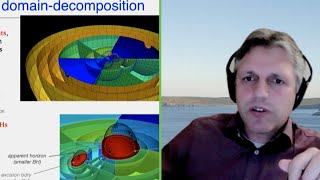
Numerical Relativity - Exploring New Capabilities with Binary Black Holes
Exploring advancements in numerical relativity for binary black holes, including improved gravitational wave extraction, computational algorithms, and extended parameter space coverage.
Multi-Messenger Aspects of Characteristic Evolution
Explore characteristic evolution in astrophysics, focusing on gravitational and electromagnetic fields, radiation extraction, and late-time effects in multi-messenger astronomy.
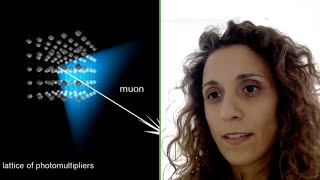
A Machine Learning Application in Multi-Messenger Astrophysics
Explore machine learning techniques for detecting gravitational waves from supernovae, connecting multiple messengers like neutrinos and electromagnetic signals for improved signal identification and classification.
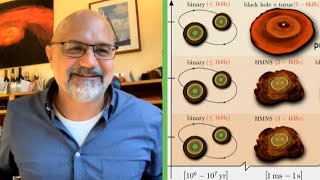
Binary Neutron Stars: From Gravitational to Particle Physics - IPAM at UCLA
Explore binary neutron stars as a rich laboratory blending gravity, astrophysics, and particle physics. Learn about recent modeling progress and insights into nuclear matter equations of state and phase transitions.
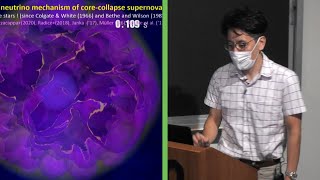
Multi-Dimensional Modeling of Core-Collapse Supernovae - IPAM at UCLA
Explore 3D modeling of core-collapse supernovae, focusing on neutrino and gravitational-wave signatures to unravel the long-standing mystery of the explosion mechanism.
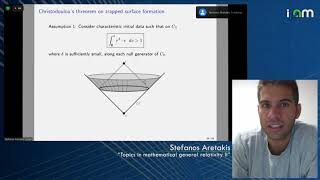
Topics in Mathematical General Relativity II - IPAM at UCLA
Explore black hole stability, linear wave equations, and Newman-Penrose constants in mathematical general relativity. Delve into extremal and subextremal cases, and examine key non-linear results in this field.
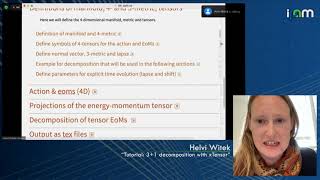
Tutorial: 3+1 Decomposition with xTensor - IPAM at UCLA
Learn to derive ADM-York equations for Einstein's equations using xTensor, an open-source tool for tensor algebra with Mathematica. Explore abstract tensor computations in gravitational wave astronomy.
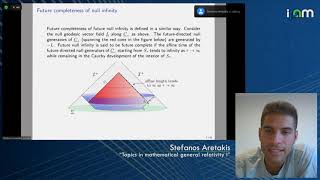
Topics in Mathematical General Relativity I
Explore key conjectures, problems, and methods in mathematical general relativity, including cosmic censorship, double null foliation, and short pulse method for studying trapped surfaces and Cauchy horizons.
Machine Learning for Gravitational Wave Astronomy - Concepts & Terminology
Explore machine learning concepts and terminology for gravitational wave data analysis, enhancing your understanding of this cutting-edge field in astronomy and physics.