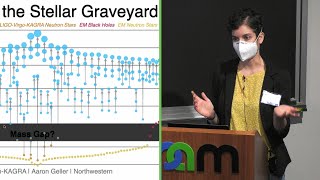
Black Hole Astrophysics With Gravitational-Wave Catalogs - IPAM at UCLA
Explore black hole astrophysics through gravitational-wave data, uncovering insights on mass distribution, spin, and redshift evolution. Learn about pair-instability mass gap and formation-to-merger time delays.
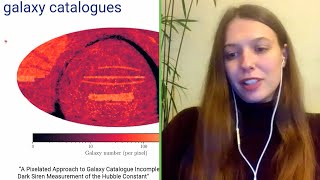
Cosmology with Dark Sirens - Attempting to Solve the Hubble Constant Tension
Explore gravitational waves for cosmology, focusing on dark sirens and galaxy catalogs to address Hubble constant tension. Learn challenges in GW-based cosmological parameter estimation.
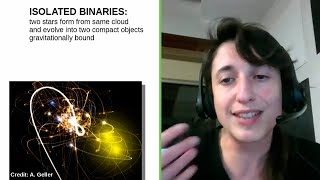
Astrophysical Models of Binary Compact Objects - IPAM at UCLA
Explore astrophysical models of binary compact objects, their formation, and implications for gravitational wave astronomy. Discuss key uncertainties and future challenges in the field.
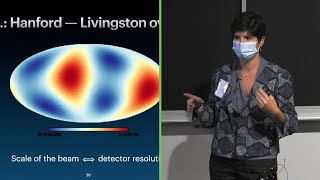
Stochastic Background Searches in GW Experiments - IPAM at UCLA
Explore stochastic gravitational wave backgrounds, their characteristics, detection methods, and future prospects in ground-based and space-borne observatories with insights from recent LVK collaboration searches.
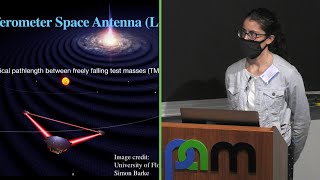
LISA and the Global Analysis of Galactic Binary Gravitational Wave Signals
Explore LISA's role in detecting galactic binary gravitational waves, including data analysis challenges, global fitting techniques, and future prospects for multi-source gravitational wave detection.
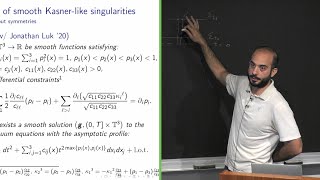
The Mysterious Nature of the Big Bang Singularity - IPAM at UCLA
Explore the enigmatic Big Bang singularity, Einstein's equations, and Kasner solutions in this advanced physics lecture on gravitational theory and cosmological origins.
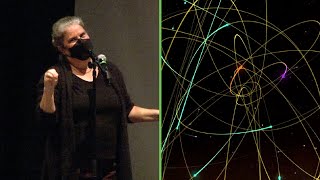
From the Possibility to the Certainty of a Supermassive Black Hole - IPAM UCLA
Explore groundbreaking research on supermassive black holes at the galactic center, including stellar orbit measurements, unexpected environmental discoveries, and new insights into gravity's behavior near these cosmic giants.
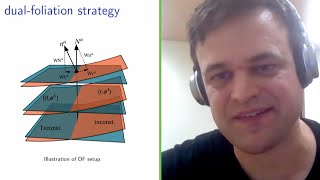
Dual-Frame Generalized Harmonic Gauge on Hyperboloidal Slices - IPAM at UCLA
Explore advanced techniques in general relativity, focusing on including future null-infinity in computational domains for cosmic censorship studies and gravitational wave astronomy applications.
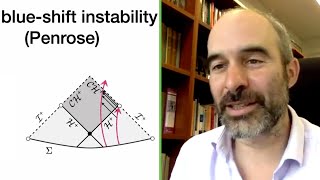
Strong Cosmic Censorship Versus Λ - IPAM at UCLA
Explore the strong cosmic censorship conjecture in general relativity, its challenges with non-zero cosmological constant, and implications for black hole physics and determinism.
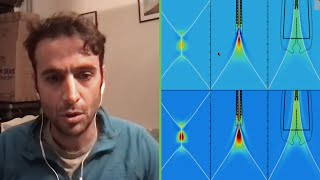
Binary Black Hole Mergers in Cubic Horndeski Theory - IPAM at UCLA
Explore binary black hole mergers in cubic Horndeski gravity, examining non-linear effects and comparing results to general relativity. Gain insights into alternative gravity theories and their implications for astrophysical phenomena.
Testing General Relativity with Black Hole Mergers - IPAM at UCLA
Explore testing general relativity with black hole mergers, focusing on numerical approaches to beyond-GR constructions and the challenges of extracting constraints from gravitational wave observations.
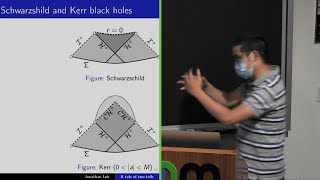
A Tale of Two Tails - IPAM at UCLA
Explore wave equations in asymptotically flat spacetimes, focusing on late-time tails and their implications for the strong cosmic censorship conjecture in odd spatial dimensions.
Challenges and Options for Beyond General Relativity Explorations - IPAM at UCLA
Explore challenges in extending General Relativity, including mathematical pathologies and potential solutions, with insights on computational approaches in multi-messenger astrophysics.
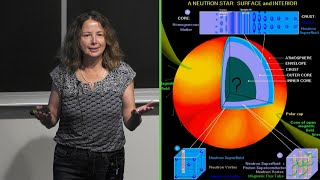
Realistic Binary Neutron Stars Collisions Simulations - Challenges and Opportunities
Explore challenges and opportunities in simulating binary neutron star collisions, focusing on realistic models, electromagnetic counterparts, and remnant properties using open-source codes and parametrized equations of state.
Merging Black Hole Binaries - Accretion Dynamics and Outflows
Explore accretion dynamics and outflows in merging black hole binaries, covering simulations, evolution, and multimessenger astronomy implications.
Numerical Relativity and the Next Generation of Gravitational Wave Detections
Explore numerical relativity's role in gravitational wave astronomy, its impact on understanding gravity, and future challenges as detectors improve. Insights into computational and data hurdles in this evolving field.
Computational Challenges with Modeling Core Collapse Supernovae - IPAM at UCLA
Explore computational challenges in modeling core collapse supernovae and gravitational wave emission, covering recent progress, physics requirements, and future directions in multi-dimensional simulations.
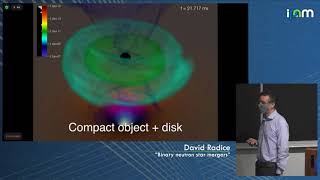
Binary Neutron Star Mergers - IPAM at UCLA
Explore neutron star mergers, their multimessenger emissions, and implications for astrophysics. Gain insights into recent simulations, future challenges, and prospects in this cutting-edge field.
Introduction to Modelling Gravitational Waves from Compact Binaries
Explore gravitational wave modeling techniques for compact binary systems, covering inspiral, merger, and ringdown phases. Learn about semi-analytic models crucial for detection and analysis.
Seeing Through Space-Time - IPAM at UCLA
Explore inverse problems in spacetime structure, light observation sets, and cosmic microwave background, delving into mathematical challenges in gravitational wave astronomy.
Helvi Witek - Introduction to Numerical Relativity, Part 2 - IPAM at UCLA
Explore advanced concepts in numerical relativity, including 3+1 spacetime decomposition, Einstein's equations, and stable simulation techniques for gravitational wave research.