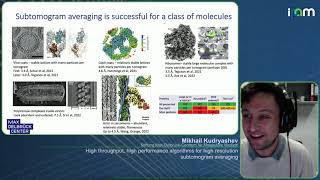
High Throughput, High Performance Algorithms for High Resolution Subtomogram Averaging
Explore high-performance algorithms for subtomogram averaging in cryo-electron microscopy, focusing on tools like TomoBEAR and SUSAN to enhance throughput and resolution in structural biology.
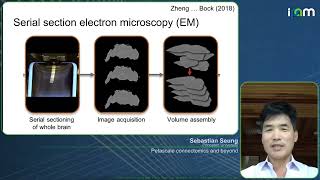
Petascale Connectomics and Beyond - IPAM at UCLA
Explore petascale connectomics, its advancements in brain mapping, and future exascale projects. Learn about automated image analysis techniques and their impact on understanding neural structures and brain function.
Inferring Coupled Oscillatory Dynamics From Data - IPAM at UCLA
Explore phase dynamics in oscillatory systems, focusing on phase demodulation techniques and network reconstruction. Learn about protophase-to-phase transformation and applications in cardiorespiratory interactions.
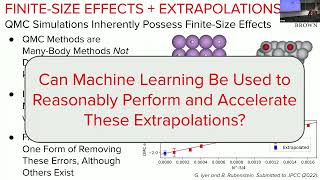
Extending the Reach of Quantum Monte Carlo Methods via Machine Learning
Explore how machine learning enhances quantum Monte Carlo methods for electronic structure modeling, improving force calculations and scaling to larger systems in molecular simulations.
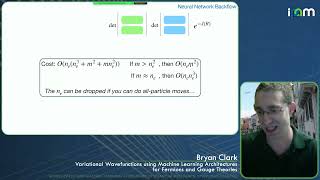
Variational Wavefunctions, Machine Learning Architecture for Fermions and Gauge Theories
Explore machine learning architectures for variational wavefunctions in fermion and gauge theory systems, focusing on preserving symmetries and achieving accurate results in quantum mechanics.
Machine Learning to Improve the Exchange and Correlation Functional in DFT
Explore machine learning approaches to improve exchange and correlation functionals in density functional theory, discussing physically informed methods and their advantages in quantum mechanics.
Compact Representations of Excited States from QMC, as Data for Low-Energy Models
Explore compact wave function representations for excited states in quantum mechanics, focusing on variational Monte Carlo methods and their applications in effective model development.
Quantum Time Correlation Functions in an Open-Chain Path Integral Distribution
Explore quantum time correlation functions using open-chain path integrals, offering a new perspective on semiclassical approximations in computational chemistry with potential applications in rate theory and spectroscopy.
The Reluctant Scientist: A Nobel Laureate's Journey Through Medicine and Research
Nobel laureate Dr. Lefkowitz shares his journey from reluctant scientist to groundbreaking researcher, exploring pivotal moments and lessons learned that led to his revolutionary work on G-protein coupled receptors.
Fundamentals of Energy, Work and Power - Lecture 1
Explore thermodynamics laws, efficiency, and work in systems. Gain insights into renewable energy concepts through interactive discussions and practical examples.
Fast, Accurate and Large-Scale Ab-Initio Calculations for Materials Modeling
Explore advanced computational methods for large-scale density functional theory calculations, their applications in materials modeling, and the performance of the DFT-FE open-source code.
Learning to Untangle Genome Assembly Graphs - IPAM at UCLA
Explore deep learning techniques for untangling genome assembly graphs, improving accuracy and efficiency in DNA sequencing without manual intervention.
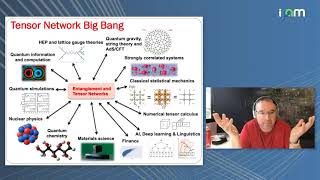
News on Tensor Network Simulations for Quantum Matter and Beyond
Explore recent developments in tensor network simulations for quantum systems and their applications beyond physics, including portfolio optimization in finance.
Emergent Gapless Quantum Spin Liquid from Deconfined Quantum Critical Point
Explores emergent gapless quantum spin liquid near deconfined quantum critical point using tensor network state methods, providing evidence for its existence in antiferromagnetic Heisenberg models.
Schrödinger Bridges - Classical and Quantum
Explore Schrödinger bridges in classical and quantum contexts, their applications to Markov chains and quantum channels, and their solutions for probability distributions and state evolutions.
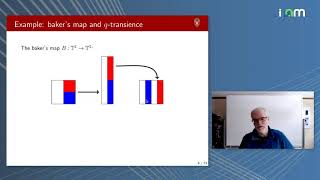
On Mix-Norms and the Rate of Decay of Correlations
Explores mix-norms and correlation decay rates in complex flows, discussing q-recurrence, q-transience, and their implications for measuring mixing intensity in various systems.
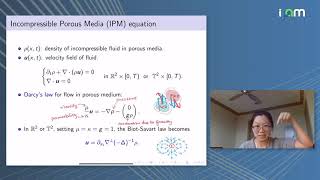
Small Scale Formations in the Incompressible Porous Media Equation
Explore small scale formations in incompressible porous media equations, including infinite-time growth of Sobolev norms and potential finite-time blow-up scenarios.
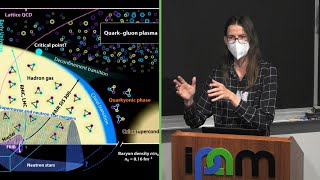
Gravitational-Wave Observations of Neutron-Star Mergers - IPAM at UCLA
Explore gravitational-wave observations of neutron-star mergers, their impact on understanding dense matter and stellar evolution, and future prospects in gravitational-wave astronomy.
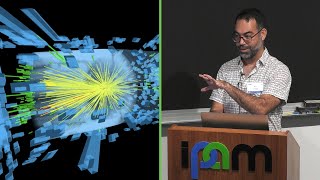
Simulation-Based Inference for Gravitational Wave Astronomy - IPAM at UCLA
Explore simulation-based inference techniques for gravitational wave astronomy, covering frequentist vs. Bayesian approaches, summary statistics, and the role of neural networks and inductive bias.
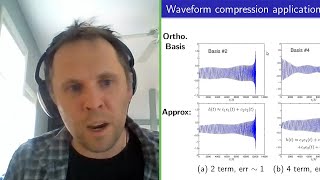
Gravitational Wave Parameter Estimation with Compressed Likelihood Evaluations
Explore advanced techniques for efficient gravitational wave parameter estimation, focusing on Reduced Order Quadratures (ROQs) to accelerate likelihood evaluations and improve Bayesian inference in GW astronomy.
Adventures in Practical Population Inference - IPAM at UCLA
Explore practical population inference in gravitational-wave astronomy, covering computational challenges, novel methods, and techniques for extracting astrophysical information from observations.