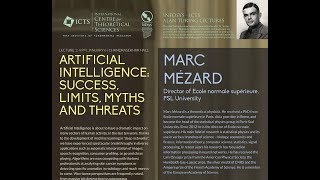
Statistical Physics and Statistical Inference - Lecture 2
Explore statistical physics and inference, covering Bayesian methods, error correction, spin glasses, and advanced algorithms like belief propagation. Gain insights into phase transitions and applications in machine learning.
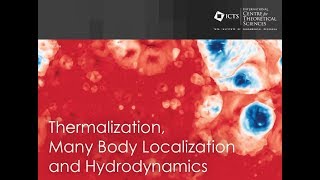
Turbulence - Arrow of Time and Equilibrium-Nonequilibrium Behaviour
Explore turbulence, time's arrow, and equilibrium-nonequilibrium behavior. Delve into fundamental physics concepts, Kolmogorov's theory, energy transfer, and connections to kinetic theory and cosmology.
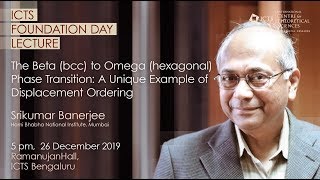
The Beta to Omega Phase Transition - A Unique Example
Explore the unique beta to omega phase transition in metals, examining its mechanism, pre-transition effects, and recent high-resolution electron microscopy findings.
Approximating Profile Maximum Likelihood Efficiently - New Bounds on the Bethe Permanent by Moses Charikar
Explore symmetric distribution properties and efficient estimation techniques, focusing on profile maximum likelihood and its connections to the Bethe permanent in statistical physics.
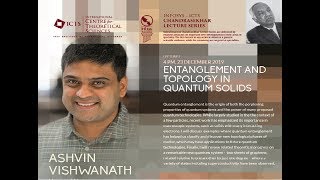
Entanglement and Topology in Quantum Solids - Lecture 1
Explore quantum entanglement in solids, topological phases, and their applications. Learn about Weyl semimetals, magic angle graphene, and surface topological order from a leading expert.
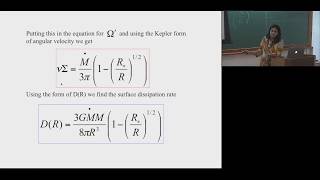
Formation, Fueling, and Feedback from Supermassive Black Holes - Lecture 2
Explore supermassive black hole physics: formation, growth, and environmental impact. Covers accretion discs, AGN structure, jets, and scaling relations. Ideal for graduate students in astrophysics.
Formation, Fueling, and Feedback from Supermassive Black Holes - Lecture 1
Explore the physics of supermassive black holes, from formation to accretion processes. Learn about observational evidence, modeling techniques, and key concepts in black hole astrophysics.
Active Processes in Cells and Tissues - Phase Separation in Active Systems - Lecture 2
Explore phase separation in active cellular systems, focusing on droplet physics, centrosome dynamics, and RNA-protein assemblies. Learn how these processes drive cellular organization and morphogenesis.

Active Processes in Cells and Tissues - Symmetry Breaking of Biological Cells - Lecture 1
Explore cellular dynamics, symmetry breaking, and active processes in living systems. Discover how energy-driven mechanisms shape biological patterns and morphologies at cellular and tissue levels.
A Lieb-Schultz-Mattis Type Theorem Without Continuous Symmetry by Hal Tasaki
Explores a Lieb-Schultz-Mattis type theorem for quantum spin chains without continuous symmetry, covering proof techniques, matrix product states, and operator algebraic approaches in infinite quantum systems.
Baryons, Determinants and Integrability at Large N - Lecture 1
Explore baryonic and determinant operators in large N gauge theories, their relation to D-branes, and new approaches for computing correlation functions using emergent semi-classical descriptions and integrability.
A Modern Take on the Information Paradox - Lecture 4
Explore recent progress on Hawking's black hole information paradox, including holographic approaches to unitary black hole evaporation and implications for quantum gravity.
A Modern Take on the Information Paradox and Progress Towards Its Resolution - Lecture 3
Explore recent progress on Hawking's black hole information paradox, including holographic approaches to reproduce the Page curve and models of unitary black hole evaporation.
A Modern Take on the Information Paradox and Progress Towards Its Resolution - Lecture 1
Explore recent progress on Hawking's black hole information paradox, including holography's role in reproducing the Page curve and a model of unitary black hole evaporation.
A Modern Take on the Information Paradox - Lecture 2
Explore recent progress on Hawking's black hole information paradox, including holography, Page curve reproduction, and unitary black hole evaporation models in theoretical physics.
Advanced Course in General Relativity - Lecture 1
Explore advanced general relativity concepts, including spacetime, Einstein equations, vacuum solutions, and geodesics. Gain insights into the fundamental principles of gravitational physics and their applications.
Self-Force and Radiation Reaction in General Relativity - Lecture 4
Explore advanced concepts in general relativity, including stress-energy tensors, two-timescale expansions, and matched asymptotic expansions. Gain insights into self-force and radiation reaction in gravitational wave astronomy.
The Origin of Stellar Energy by Professor G Srinivasan
Explore stellar energy origins, from hydrostatic equilibrium to fusion reactions. Uncover the physics behind star formation, energy production, and lifetimes in this comprehensive astrophysics lecture.
Neutrino Oscillations and the Solar Neutrino Puzzle by Professor G Srinivasan
Explore neutrino oscillations and the solar neutrino puzzle, from early experiments to groundbreaking discoveries. Uncover the physics behind missing neutrinos and their implications for astrophysics.
GWAS in Structured Populations by Magnus Nordborg
Explore genome-wide association studies in structured populations, covering linkage mapping, population structure confounding, and fine mapping challenges. Insights on heritability and adaptation across species.
Introduction to the Coalescent Theory - Lecture 3
Explores coalescent theory in population genetics, covering selection models, detecting selection, local adaptation, and challenges in interpreting genetic data for evolutionary insights.