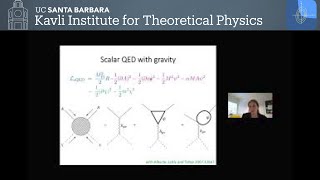
Causality and Positivity with Gravity - Claudia de Rham
Explores causality and positivity in gravitational theories, examining effective field theory bounds, scalar QED, and the interplay between gravity and quantum field theory concepts.
Thermal Dark Energy and Other String Candidates - Susha Parameswaran - EFTBounds
Explores string theory's implications for low-energy physics, focusing on thermal dark energy and other string candidates. Discusses swampland program, Weak Gravity Conjecture, and connections to particle phenomenology.
NIR Flares - Tests of GR Discussion - Accretion
Explore NIR flares and tests of General Relativity in the context of event horizon-scale accretion, discussing recent observations, particle acceleration, and potential future research directions.
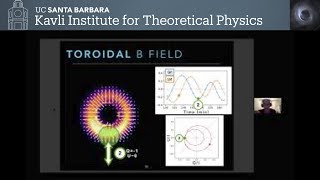
Polarised Properties of Magnetised Accretion Onto Black Holes - Alejandra Jiménez-Rosales
Explore polarised properties of magnetised accretion onto black holes, focusing on Sagittarius A* and M87. Learn about magnetic field structures, linear polarization, and future observations in astrophysics.
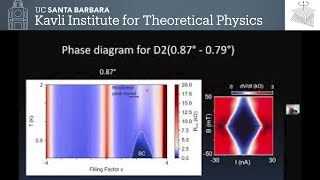
Superconductivity, Correlations and Chern Insulators in Twisted Bilayer Graphene - Stevan Nadj-Perge
Explore superconductivity, correlations, and Chern insulators in twisted bilayer graphene, focusing on recent developments and experimental findings in Moiré materials physics.
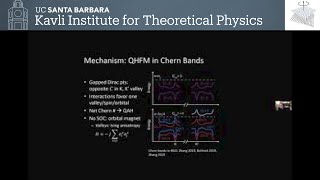
Pomeranchuk Effect and the Entropy of Fluctuating Ferromagnets in Twisted Bilayer
Exploring Pomeranchuk effect and entropy in twisted bilayer graphene's ferromagnets, discussing superconductivity, magnetism, and symmetry breaking in Moiré materials.
What Did T. Rex Taste Like - The Age of Dinosaurs
Explore the evolutionary link between dinosaurs and modern birds, examining fossil evidence, anatomical similarities, and behavioral traits that connect these ancient creatures to their avian descendants.
Carl Sagan, The Great Space Communicator
Explore Carl Sagan's impact on astronomy and science communication, from his groundbreaking research to his iconic TV show 'Cosmos', and learn how he made complex concepts accessible to the public.
How Do We Edit DNA? - CRISPR and Gene Editing Technology
Explore CRISPR gene editing technology, its groundbreaking applications in treating diseases, and the bioethical concerns surrounding this revolutionary advancement in synthetic biology.
The Science and History of Eating Insects - Why Insects Matter
Explore the history, cultural significance, and future potential of entomophagy. Learn about insect-based cuisine worldwide, nutritional benefits, and why bugs might become a sustainable food source.
The Fate of the Milky Way
Explore the future collision of Andromeda and the Milky Way galaxies through Hubble images and computer simulations, examining its impact on our solar system and the evolution of galactic structures.
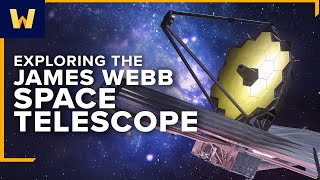
The Technology and Discoveries of the James Webb Space Telescope
Explore the groundbreaking James Webb Space Telescope with experts, discussing its mechanics, potential discoveries, and scientific implications. Gain insights into radio astronomy and the telescope's impact on our understanding of the universe.

Why the Speed of Light is the Ultimate Speed Limit - The Physics of the Universe
Explore the physics behind light's ultimate speed limit, from historical experiments to modern proofs, and understand why it remains constant for all observers regardless of motion.
How We Know Dark Matter Exists - The Evidence for Modern Physics
Explore the evidence for dark matter's existence, from historical observations to modern theories and testing methods. Delve into gravitational lensing, modified Newtonian equations, and potential explanations for this mysterious cosmic phenomenon.
Can We Travel Faster Than Light? - Understanding the Misconceptions of Science
Explore misconceptions about light speed, learn why objects can't exceed it in space, and discover surprising phenomena like Cherenkov radiation. Understand the nuances of light's behavior in different mediums and its role in cosmic expansion.

Basics of Exome Sequencing - Genetics 101 - Ambry Genetics
Learn exome sequencing technology, lab processes, and applications. Explore data formats, variant filtering, gene-disease prioritization, and report structure. Gain insights into unique aspects and advantages of exome sequencing in genetic diagnostics.

Spinal Muscular Atrophy - Webinar - Ambry Genetics
Comprehensive overview of Spinal Muscular Atrophy, covering genetics, diagnosis, and recent therapeutic advancements. Explores disease etiology, new FDA-approved treatments, and their impact on patient outcomes.

Breast Cancer Risk Assessment Using the Tyrer Cuzick Model - Webinar - Ambry Genetics
Comprehensive overview of breast cancer risk assessment using the Tyrer-Cuzick model, covering key risk factors, recent updates, and potential applications for screening and prevention strategies.

Increasing the Positive Yield of Hereditary Cancer Testing with DNA and RNA - Ambry Genetics
Explore how combining DNA and RNA genetic testing enhances detection of clinically-actionable variants and reduces inconclusive results in hereditary cancer testing, improving diagnostic yield.

Talking to Patients About Genetic Testing and Psychosocial Implications of That Discussion - Webinar
Explore psychosocial challenges in genetic testing decisions, communication strategies, and patient support. Learn to create personalized information plans and navigate emotional complexities across various hereditary conditions.

Will RNA Testing Be the Next Del-Dup for Clinical Genetics - Webinar - Ambry Genetics
Explore how RNA genetic testing enhances hereditary cancer diagnostics, increasing detection of actionable variants and reducing inconclusive results through concurrent DNA and RNA analysis.