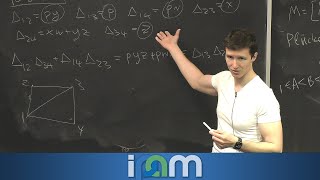
Introduction to Cluster Algebras - Part 1
Explore cluster algebras, quivers, and mutation through examples, with a focus on the Grassmannian. Gain insights into this fundamental algebraic structure and its applications.
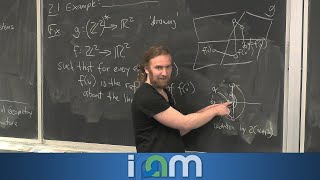
Introduction to Discrete Integrable Systems - Part 2
Explore fundamental concepts of discrete integrable systems in differential geometry, focusing on applications in statistical mechanics and geometric structures.
The Functional Volume Product Under Heat Flow
Explores monotonicity of functional volume product along Fokker-Planck heat flow, leading to improved Borell's hypercontractivity and Laplace transform quasi-norm lower bound.
Interpretations of Numerical Results for MBL by Piotr Sierant
Explore numerical results and interpretations for Many-Body Localization (MBL) in quantum systems, focusing on stability and dynamics in non-equilibrium physics.
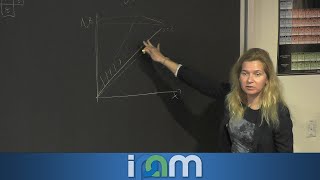
Symmetric Functions: Foundations and Applications in Combinatorics - Part 1
Explore symmetric functions in algebraic combinatorics, representation theory, and statistical mechanics. Learn formulas, combinatorial models, and key properties with applications and open problems.
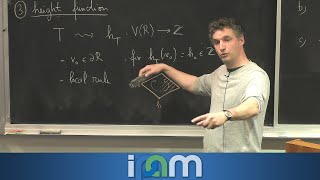
Dimer Models and Random Tilings - Part 1
Explore dimer models and random tilings with Cédric Boutillier. Learn about Kasteleyn's theory, combinatorial correspondences, and asymptotic methods for studying perfect matchings on lattices.
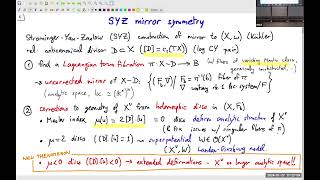
Holomorphic Discs of Negative Maslov Index and Extended Deformations in Mirror Symmetry
Explore holomorphic discs of negative Maslov index and their impact on mirror symmetry, focusing on extended deformations of Landau-Ginzburg models and family Floer theory in complex geometry.
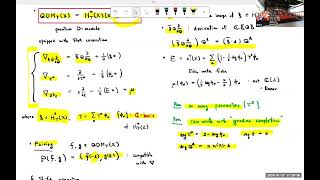
Fourier Analysis of Equivariant Quantum Cohomology II - 1-27-2024
Explore advanced concepts in Fourier analysis and equivariant quantum cohomology, building on previous research in homological mirror symmetry and mathematical physics.
Homological Mirror Symmetry - Recent Developments and Future Directions
Explore recent advancements in Homological Mirror Symmetry, surveying new results and opening avenues for future development and collaboration in this transformative field of mathematics.
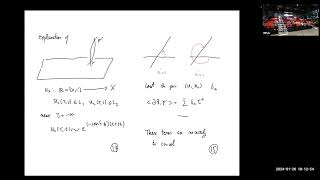
Homological Mirror Symmetry - Recent Developments and Future Directions
Survey of recent developments in Homological Mirror Symmetry, exploring new results and future directions. Part of a conference honoring Jeffrey Fuqua's contributions to mathematics.
Statistics in Medicine - Introduction to Clinical Research Analysis
Explore key statistical concepts in clinical research, including descriptive and inferential statistics, confidence intervals, p-values, and various statistical tests used in medical studies.
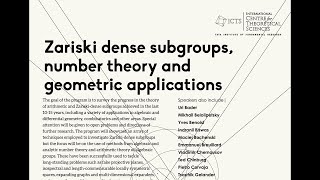
On Kissing Number of Hyperbolic Manifolds
Explore hyperbolic manifolds' kissing numbers with Plinio G. P. Murillo. Delve into Zariski dense subgroups, number theory, and geometric applications in this theoretical sciences lecture.
Understanding Tumour Responses to Radiotherapy Using Mathematical Models - Lecture 2
Explores mathematical modeling of tumor responses to radiotherapy, focusing on theoretical approaches to understand and predict treatment outcomes in cancer progression.
Mathematical and Computational Modelling to Explore Various Potential Cancer Treatments
Explore mathematical and computational modeling approaches for cancer research, covering topics from age-structured populations to machine learning techniques for understanding disease progression and treatment.
Introduction to Bruhat-Tits Theory - Lecture 2
Explore Bruhat-Tits theory in this advanced mathematics lecture, focusing on Zariski dense subgroups and their applications in algebraic geometry and number theory.
Things We Can Learn by Looking at Random Manifolds
Explore insights gained from studying random manifolds, covering applications in geometry, topology, and mathematical physics. Uncover connections between diverse mathematical fields.
Random Walks on Group Extensions
Explore random walks on group extensions in this advanced mathematics lecture, covering Zariski dense subgroups and their applications in algebraic geometry and number theory.
The Existence Problem of Compact Quotients of Pseudo-Riemannian Homogeneous Spaces
Explore the existence of compact quotients in pseudo-Riemannian homogeneous spaces, delving into advanced geometric concepts and their applications in mathematical physics and topology.
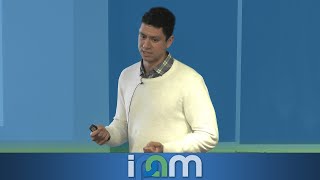
Perfect t-embeddings of Uniform Aztec Diamond Graphs
Explores t-embeddings of uniform Aztec diamond graphs, providing new formulas and asymptotic analysis to prove convergence of dimer model height fluctuations to a Gaussian Free Field.
Homological Mirror Symmetry - Recent Developments and Future Directions
Explore recent advancements in Homological Mirror Symmetry, surveying new results and opening avenues for future research and collaboration in this mathematical field.
Dimer Models and Random Tilings - Part 2
Explore dimer models, perfect matchings, and tilings with advanced mathematical tools. Delve into Kasteleyn's theory, combinatorial correspondences, and asymptotic methods for large-scale limits.