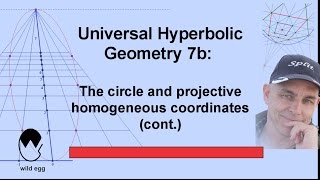
The Circle and Projective Homogeneous Coordinates in Universal Hyperbolic Geometry - Lecture 7b
Explores projective geometry as the foundation of universal hyperbolic geometry, focusing on the circle in projective homogeneous coordinates and its significance in mathematics and physics.
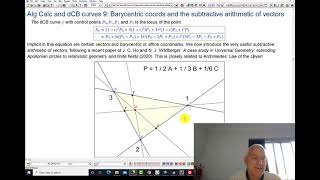
Barycentric Coordinates and Subtractive Arithmetic of Vectors - Algebraic Calculus and dCB Curves 9
Explore barycentric coordinates and vector arithmetic in affine geometry, enhancing understanding of de Casteljau Bezier polygons and curves. Gain insights into advanced mathematical concepts and their applications.
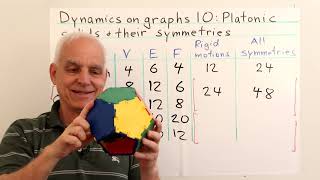
Platonic Solids and Their Symmetries - Dynamics on Graphs 10
Explore Platonic solids' symmetries, focusing on rotations and reflections. Discover connections to exceptional structures in mathematics and physics, laying groundwork for understanding 4D regular solids.
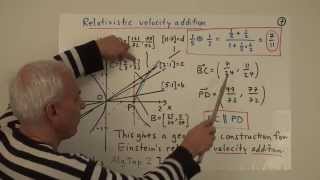
Relativistic Velocity and Core Circles in Rational Geometry - Lecture 4
Exploring relativistic velocity and core circles in rational geometry, extending Paul Miller's protractor concept to projective quadrance and comparing Euclidean and relativistic geometries.
The Chromatic Algebra of 2x2 Matrices - Part 2
Explores chromatic algebra of 2x2 matrices, focusing on subalgebras, complexions, dot products, and the four-dimensional Dihedrons algebra. Compares to quaternions and highlights unique properties.
The Chromatic Algebra of 2x2 Matrices - Wild Linear Algebra B41
Explore chromatic algebra in 2x2 matrices, covering subalgebras, complexions, trace, determinant, and characteristic polynomials. Introduces unique dot products on 2x2 matrices.
Relativistic Dot Products and Complex Numbers in Linear Algebra - Part 2
Exploring triality of dot products and associated complex numbers in chromogeometry, organized within 2x2 matrices. Delves into interactions between three geometries.
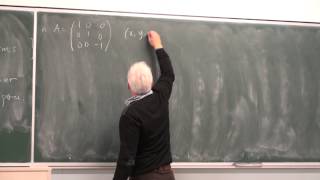
Duality, Polarity and Projective Linear Algebra - Differential Geometry Lecture 11
Explores projective geometry, quadratic forms, and pole-polar duality in relation to the unit circle. Connects these concepts to Lorentz/Einstein/Minkowski geometry and Apollonius' work.
The Rotation Problem and Hamilton's Discovery of Quaternions - Part 4
Practical implementation of quaternions for 3D rotations, focusing on half-turns and vector trigonometry. Explores quaternion multiplication and its geometric interpretation for rotations.
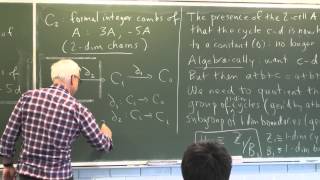
Introduction to Homology in Algebraic Topology - Part 2
Explores cycles, boundaries, and homology in algebraic topology, focusing on graph modifications and using commutative group theory to analyze formal combinations of geometric elements.
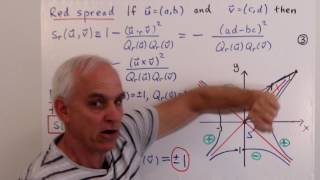
Colored Spreads and Generalizations in Rational Trigonometry - Lecture 2
Explore colored spreads in planar geometries, visualizing red and green spreads using cross products and determinants. Learn about generalized dot products and Pythagoras' theorem in different geometries.
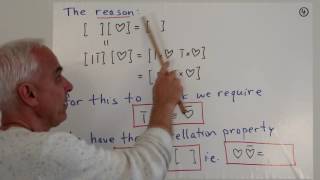
Numbers as Multipliers and Particle-Antiparticle Duality - Data Structures Math Foundations Lecture 211
Exploring the concept of anti-mathematical objects and their role in multisets, drawing parallels to particle/antiparticle symmetry in physics. Provides insights for modern algebra foundations.
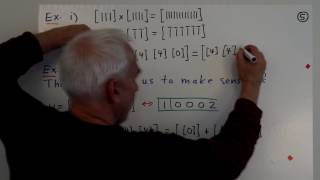
Numbers as Multipliers and Particle-Antiparticle Duality - Data Structures Math Foundations 210
Explores numbers as multipliers for sets and introduces particle/antiparticle duality, extending multiplication from natural numbers to integers in mathematical set theory.
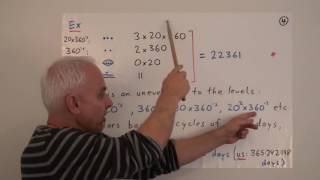
The Curious Role of Nothing in Mathematics - Data Structures Math Foundations 187
Exploring the concept of "nothing" in mathematics, from ancient civilizations to modern physics, and its impact on number systems and our understanding of empty space.
Numbers, the Universe and Complexity Beyond Us - Data Structures Math Foundations 177
Explore the limits of mathematical notation, the philosophy of numbers, and the physical constraints of our universe in representing extremely large quantities and complex mathematical concepts.
Introducing Box Arithmetic - Math Foundations 237
Explore a revolutionary approach to arithmetic using multisets and box/anti-box duality, offering new insights into mathematical foundations and their connection to particle physics concepts.
Central Polynumber Algebra and Baby Weyl Character Formula - Math Foundations 236
Explores central polynumber algebra and Weyl character formula, focusing on SU(2) and SU(3) representations. Connects to particle physics and quaternions, emphasizing polynumbers over complex exponentials.
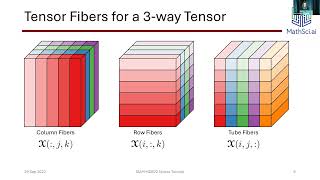
Tensor Decompositions - A Quick Tour of Illustrative Applications
Explore tensor decompositions for data analysis and dimensionality reduction. Learn fundamentals, applications in various fields, and hands-on examples using real-world datasets.
Homological Mirror Symmetry: Recent Developments and Future Directions
Explore recent advancements in Homological Mirror Symmetry and their impact on Mathematics. Join experts to survey new results and discover collaborative opportunities in this field.
Mathematics at the Roots: Empowering Agriculture with Artificial Intelligence
Explore how AI revolutionizes agriculture, enhancing crop yields and sustainability through data-driven insights and innovative mathematical models.
Atoms, Electrons and Birational Invariants in Hodge Structures
Explore new A,B Hodge structures and their non-rationality applications in algebraic geometry, bridging concepts from physics to advanced mathematical theory.