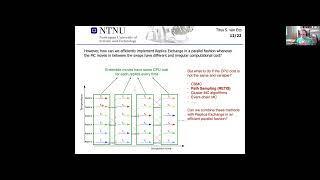
Exchanging Replicas with Unequal Cost, Infinitely and Permanently
Innovative replica exchange method for parallel simulations with varying computational costs, enhancing efficiency in Monte Carlo algorithms and path sampling techniques.
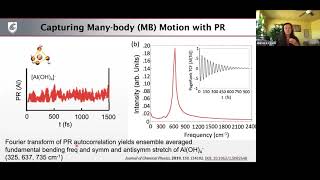
Multiscale Many-body Correlations and Structure in Chemistry Data
Integrating graphs, topology, and geometry to analyze complex chemistry data, providing insights into multiscale correlations and structures beyond traditional methods.
Configurations Spaces of Particles - Homological Solid, Liquid, and Gas
Exploring configuration spaces of particles with thickness, examining topological aspects of phase transitions in hard-sphere systems, and their implications for physics and mathematics.

Looking for Geometry in the Supreme Court
Exploring geometric approaches to analyze U.S. Supreme Court voting behavior, discussing recent investigations using planar geometry and phylogenetic trees, and suggesting future directions in topology and geometry.
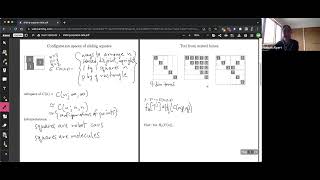
Homology of Sliding-Squares Configuration Spaces
Explore homology of sliding-squares configuration spaces, comparing point and square configurations in planes and rectangles. Discover surprising growth patterns in homology group ranks.
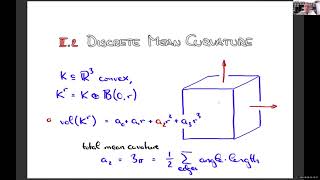
The Intrinsic Volumes of a Space Filling Diagram and Their Derivatives
Explore intrinsic volumes in molecular dynamics, focusing on space-filling diagrams and their derivatives. Learn formulas for weighted volumes and curvatures in Alpha shape representations.
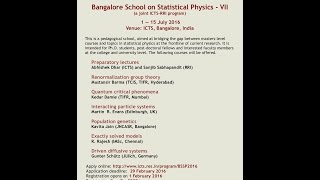
Introduction to Stochastic Processes by Sanjib Sabhapandit
Explore stochastic processes in this advanced lecture, covering key concepts and applications in statistical physics for graduate-level students and researchers.
An Introduction to Spectral Data for Higgs Bundles
Explore spectral data for Higgs bundles, a key concept in algebraic geometry and mathematical physics, with insights on integrable systems and moduli spaces.
Population Genetics of Multiple Loci by Nick Barton
Explore population genetics theory and its applications in evolutionary processes, covering multiple loci analysis, quantitative predictions, and integration of mathematical and biological concepts.

Dynamical Systems Applied to Biology - Part 1
Explore dynamical systems in biology, focusing on applications and mathematical approaches to understand complex biological processes and phenomena.
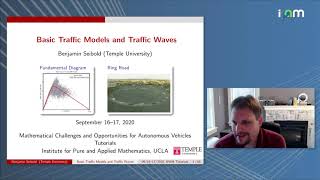
Basic Traffic Models and Traffic Waves
Explore fundamental traffic models and wave phenomena in vehicular flow, examining mathematical concepts crucial for understanding and optimizing autonomous vehicle systems.

Deep Learning of Dynamical Systems for Mechanistic Insight and Prediction in Psychiatry
Explore deep learning techniques for analyzing dynamical systems in psychiatry, uncovering mechanisms, and predicting outcomes using neural and behavioral data from various sources.

Subtly Knotted Surfaces Separated by Many Internal Stabilizations
Exploration of smoothly knotted surfaces in 4-manifolds, focusing on isotopy, internal stabilizations, and diffeomorphisms. Discusses infinite collections of surfaces with unique properties and infinite stabilization diameter.

Homology Cobordism and the Geometry of Hyperbolic Three-Manifolds
Explore the interaction between hyperbolic geometry and homology cobordism using monopole Floer homology, focusing on subgroups generated by hyperbolic homology spheres.
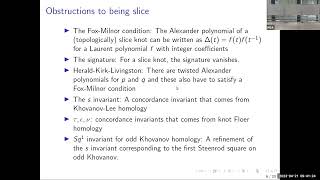
Ribbon Concordances and Slice Obstructions: Experiments and Examples
Explore ribbon concordances between knots, computational methods, and results in low-dimensional topology. Joint work with Nathan Dunfield on slice obstructions and experimental approaches.

Instantons, Suspension, and Surgery
Explore advanced concepts in gauge theory, including instantons, suspension, and surgery techniques for manifolds with boundary components and their applications in cobordism maps.
Instantons, Suspension, and Surgery - Part 1
Explore Dehn surgery number in 3-manifolds, using mod 2 instanton homology and Froyshov's q_3 invariant to prove existence of integer homology 3-spheres with arbitrarily large surgery numbers.
Fan Ye, Harvard University - 2-Torsions in Singular Instanton Homology
Exploration of 2-torsions in singular instanton homology for knots, comparing complex and Z/2 coefficients, with focus on fibered knots and genus 1 knot surgeries.
Instanton Floer Homology and Heegaard Diagrams
Exploring the connection between instanton Floer homology and Heegaard diagrams in 3-manifolds, with insights on extracting information and potential applications in topology.

Smooth Closing Lemma for Area-Preserving Diffeomorphisms of Surfaces
Explore the smooth closing lemma for area-preserving diffeomorphisms on surfaces, featuring a proof based on Weyl formula and Seiberg-Witten Floer homology. Joint work with Cristofaro-Gardiner and Prasad.
Fillable Contact Structures From Positive Surgery
Exploring conditions for fillable contact structures from positive surgery on Legendrian knots, with applications to topological consequences and lens space surgeries.