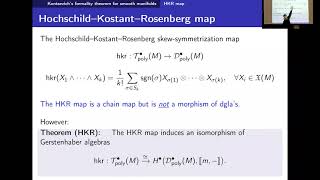
Formality Theorem for Differential Graded Manifolds
Explore formality theorem for differential graded manifolds, covering key concepts like polydifferential algebra, HKR map, and tangent distribution in supergeometry and bracket structures.
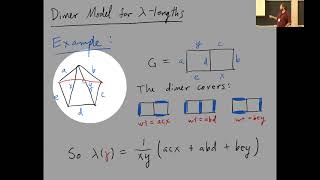
Cluster Algebra Structures from Decorated Super-Teichmüller Spaces
Explore cluster algebra structures derived from decorated super-Teichmüller spaces, examining dimer models and labels in the context of supergeometry and bracket structures.
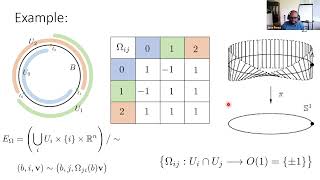
Vector Bundles for Data Alignment and Dimensionality Reduction
Explore vector bundles in data science, focusing on synchronization problems and topology-preserving dimensionality reduction. Applications in computational chemistry and dynamical systems are presented.
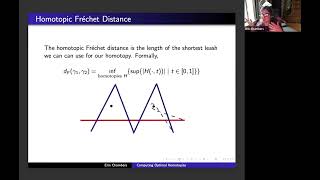
Computing Optimal Homotopies
Explore optimal curve similarity measures using homotopy-based approaches, examining structural properties, algorithms, and open questions in topology and computational geometry.
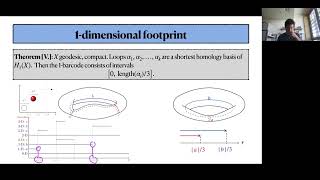
Žiga Virk - Information Encoded in Persistence Diagrams
Explore topological data analysis through persistence diagrams, uncovering spatial properties like homology, geodesics, and proximity in various mathematical contexts.
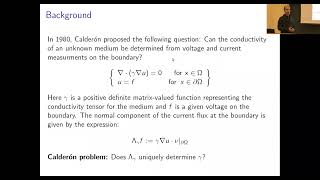
Inverse Problems and the Anisotropic Calderón Conjecture
Explore geometric inverse problems, focusing on the Calderon Problem and its anisotropic variant. Learn about harmonic functions, complex geometric optics, and wave equation properties in this advanced mathematics lecture.
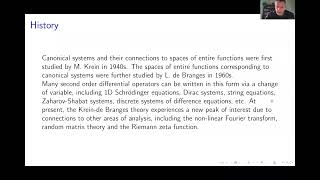
Convergence of Scattering Data and Non-Linear Fourier Transform - Part 1
Explore canonical systems, spectral problems, and Hilbert spaces of entire functions in this advanced mathematical analysis lecture on scattering data and non-linear Fourier transform.
Introduction to Contact Geometry by Dheeraj Kulkarni
Explore contact geometry fundamentals, including Frobenius theorem, contactomorphisms, and Gray stability theorem. Learn about symplectic structures and their relation to contact manifolds.
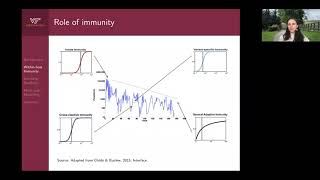
Modelling Immunity to Malaria
Explore mathematical models of malaria immunity, examining within-host dynamics, antigenic variation, and population-level impacts to enhance understanding and control strategies.
Sampling Using Diffusion Processes, From Langevin to Schrödinger
Explore diffusion processes in sampling, from Langevin dynamics to Schrödinger bridges, with insights on geometric methods in optimization and their applications.
Order and Patterns in Randomness by Abhishek Dhar
Explore hidden patterns in seemingly random events through examples of Random Walk, Brownian Motion, Statistical Physics, and a card trick. Gain insights into physicists' and mathematicians' approaches.
Approximate Message Passing for Statistical Inference and Estimation by Cynthia Rush
Explore approximate message passing techniques for statistical inference and estimation, focusing on applications in machine learning and data analysis.
Why Study Fluid Mechanics?
Explore the importance and applications of fluid mechanics in this engaging lecture by Rama Govindarajan, offering insights into this fundamental field of physics and engineering.
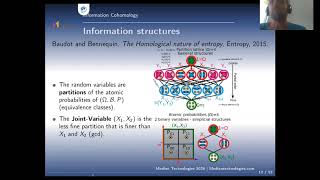
Cohomological Characterization of Information Structures
Exploring cohomological methods to quantify statistical interactions in datasets, linking information theory, statistical physics, and machine learning for improved data analysis and interpretation.
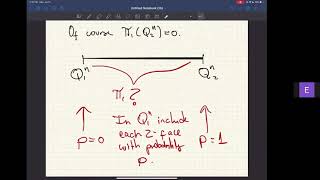
The Fundamental Group of 2-Dimensional Random Cubical Complexes
Explores fundamental groups in random 2D cubical complexes, analyzing their behavior and structure at different probability thresholds. Insights into topology and percolation theory.
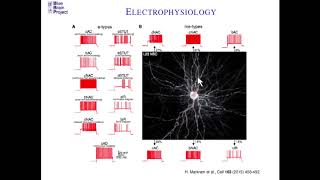
Kathryn Hess - Bedlewo: Topology Meets Neuroscience
Explore how topology applies to neuroscience across scales, from neurons to brain regions. Discover topological analysis of microconnectomes and neuron classification, with insights into brain imaging data.

A Physicist's Favorite Function
Explore a physicist's perspective on mathematical functions, blending humor and science to illuminate key concepts in continuity and piecewise functions.
Cosmological Simulations by R. Angulo
Explore cosmological simulations in this lecture, covering key concepts, techniques, and applications in modern cosmology research for understanding the universe's structure and evolution.
Introduction to Classical and Quantum Integrable Systems by Leon Takhtajan
Explore classical and quantum integrable systems, from historical examples to modern developments. Learn about Hamiltonian mechanics, r-matrix formalism, and the quantum Yang-Baxter equation.
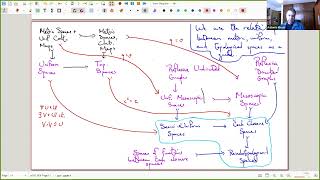
Antonio Rieser - Algebraic Topology for Graphs and Mesoscopic Spaces
Explore algebraic topology for graphs and mesoscopic spaces, covering homotopy, homology, and metric cohomology. Learn about pseudotopological spaces and their applications in various mathematical categories.
Torsion Homology Growth and Related Topics
Explore torsion homology growth in compact CW complexes, examining Betti number growth in finite covers and connections to amenable category and minimal volume entropy.