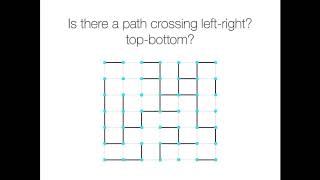
Homological Percolation: The Formation of Giant Cycles
Explore homological percolation, analyzing giant cycles in random structures and their phase transitions. Learn to differentiate signal from noise in persistence diagrams and discover connections to Euler characteristic curves.
Pawel Dlotko - A Few Simple Stories on Topology in Action
Explore practical applications of computational topology in material science, dynamical systems, and brain research. Learn how theory and algorithms work together to solve real-world problems.
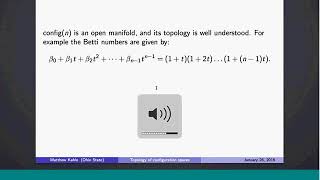
Matthew Kahle - Topology of Configuration Spaces of Hard Spheres
Explore configuration spaces, homology, and topology in hard sphere systems. Learn about critical points, computational approaches, and theoretical foundations in applied algebraic topology.
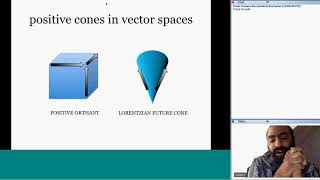
Sanjeevi Krishnan - Homological Programming
Explore algebraic topology applications in programming, covering pursuit-evasion problems, positive cones, Alexander duality, and directed topology, with insights into decomposability and computational aspects.
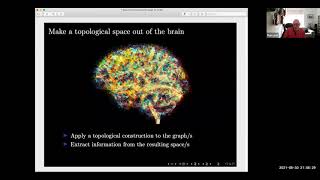
An Application of Neighborhoods in Directed Graphs in the Classification of Binary Dynamics
Explore graph theory applications in classifying binary dynamics, focusing on vertex neighborhoods and their use in analyzing neuronal network activity, with insights from the Blue Brain Project.
Persistence and First-Passage Properties of Stochastic Processes by Satya N Majumdar
Explore stochastic processes, focusing on persistence and first-passage properties. Covers applications in chemistry, finance, astrophysics, and more. Examines Markov processes and run-and-tumble particle models.
Cyclotomic KLR Algebras - Part 1 of 4
Exploring cyclotomic KLR algebras, their connection to quantum groups, and their role in categorifying highest weight representations, with a focus on type A and the Ariki–Brundan–Kleshchev theorem.
Drinfeld Center, Tube Algebra, and Representation Theory of Monoidal Categories
Explore connections between category theory, subfactor theory, and quantum groups. Learn about Drinfeld center, tube algebra, and representation theory of monoidal categories.

SRB Measures and Young Towers - Lecture 3 of 4
Explore SRB measures and Young towers in dynamical systems, focusing on nonuniformly hyperbolic systems and their statistical properties. Learn about recent advances in this field of mathematics.
Symbolic Dynamics for Nonuniformly Hyperbolic Systems - Lecture 4
Explore advanced techniques in nonuniformly hyperbolic dynamics, focusing on symbolic coding and statistical properties of complex systems using Markov Partitions and Young Towers.
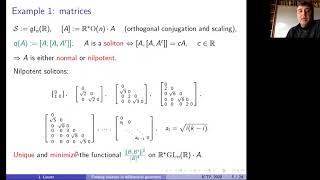
Finding Solitons in Differential Geometry
Explore solitons in differential geometry, their role in discovering distinguished geometric structures, and applications in various mathematical contexts including Lie groups and algebras.
The Rogers-Ramanujan Identities and the Icosahedron - Lecture 3
Explore the deep connections between Rogers-Ramanujan identities and the icosahedron, spanning number theory, modular forms, combinatorics, and more. Uncover the beauty and complexity of these mathematical gems.
The Rogers-Ramanujan Identities and the Icosahedron - Lecture 2
Explore connections between Rogers-Ramanujan identities and icosahedron, linking number theory, modular forms, combinatorics, and conformal field theory in an accessible survey for mathematicians.
The Rogers-Ramanujan Identities and the Icosahedron - Lecture 1
Explore the deep connections between the Rogers-Ramanujan identities and the icosahedron, spanning number theory, modular forms, combinatorics, and more in this accessible mathematical lecture.
Invariants of Manifolds from 6 Dimensions
Explore advanced mathematical concepts in gauge theories and differential invariants, focusing on invariants of manifolds from 6 dimensions and their applications in theoretical physics.
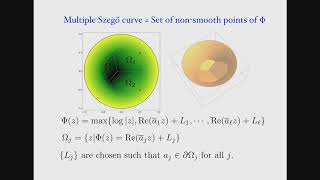
Asymptotics of the Averaged Characteristic Polynomial for Ginibre Ensemble
Explore asymptotics of averaged characteristic polynomials in Ginibre Ensemble, covering Coulomb gas, Szego curves, orthogonal polynomials, and partition functions in random matrix theory.
Entropy Method for Hypocoercive BGK and Fokker-Planck Equations
Explore entropy methods for hypocoercive equations, focusing on BGK and Fokker-Planck models. Learn about decay rates, auxiliary functionals, and regularization techniques in non-symmetric systems.
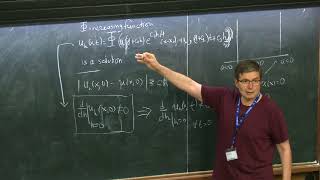
Phase-Field Models for Motion by Mean Curvature - Lecture 2
Explore phase-field models for motion by mean curvature, covering topics like skew symmetry, levelsets, distance functions, and classical statements with expert Panagiotis Souganidis.
Spectral Approximation of Transfer Operators
Explore spectral approximation of transfer operators using Galerkin methods and Lagrange-Chebyshev interpolation, with applications in number theory and quantum chaos.
Manfred Denker: Toral Automorphisms Driven by Continued Fractions
Explore toral automorphisms driven by continued fractions, discussing Poisson limits, homoclinic groups, and Steiner's theorem in dynamical systems and number theory.
The Dynamical Systems Approach to Spatially Homogenous Einstein-Vlasov Cosmology
Explore spatially homogenous Einstein-Vlasov cosmology using dynamical systems analysis. Investigate asymptotic solutions near singularities and expanding futures, focusing on Kantowski-Sachs models with Vlasov matter.