Landscape Function and Its Relations With Eigenvectors of a Schrödinger Operator
Explore landscape functions and their connections to Schrodinger operator eigenvectors, covering effective potentials, energy computations, and exponential decay in various contexts.
CoFTs for GLSMs
Explore enumerative invariants for GLSMs, generalizing Gromov-Witten and FJRW theories. Learn about virtual fundamental classes, Atiyah classes, and matrix factorizations in this context.
Homological Mirror Symmetry for Log Calabi-Yau Surfaces
Explore homological mirror symmetry for log Calabi-Yau surfaces, including construction of mirror Landau-Ginzburg models and connections to SYZ fibrations and previous research.
Nonrational Toric Geometry I - Symplectic Toric Quasifolds Minicourse
Explore symplectic toric quasifolds, generalizing toric varieties to non-rational polytopes. Learn about quasilattices, quasirationality, and quasitori through examples like quasispheres and Penrose tilings.
Is There Geometric Recursion for the Moduli Space of Toric Varieties?
Explore moduli space of quantum toric varieties, drawing parallels with geometric recursion. Delve into quantum lattices, tori, and CP1, examining group actions, calibration, and quantum geometric invariant theory.
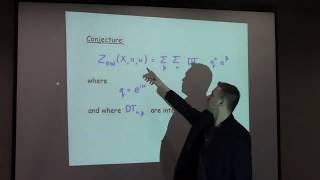
A Proposal for Open DT Invariants
Explore open DT invariants, refined invariance, and boundary conditions in moduli spaces with Sergei Gukov. Delve into generating series, topological vertex, and infinite projects in this advanced mathematics lecture.
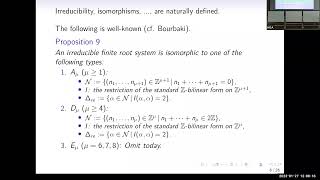
Homological Mirror Symmetry - Atsushi Takahashi, Osaka University
Exploring generalized root systems of type D, constructing Frobenius manifolds, and examining their potential applications in algebraic geometry and mathematical physics.
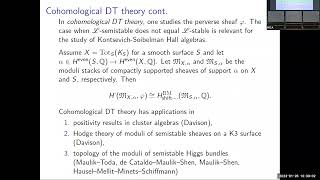
Homological Mirror Symmetry - Categorical Donaldson-Thomas Theory of C^3 and Beyond
Explore advanced concepts in Donaldson-Thomas theory, including categorifications, refinements, and applications to C^3 and beyond, with a focus on categorical invariants and correspondences.
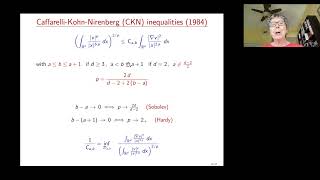
Functional Inequalities and Improvements: Stability - Part 2
Explore functional inequalities, their optimal constants, and stability properties. Learn strategies for addressing these issues and recent developments in improved inequalities for non-optimizers.
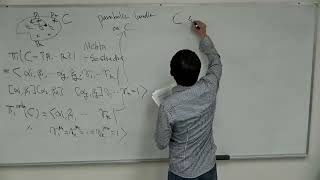
Higgs Bundles on Elliptic Surfaces and Logarithmic Transformations
Explore Higgs bundles on elliptic surfaces and their transformations, examining vector bundles' importance in mathematics and the impact of logarithmic transformations on these structures.
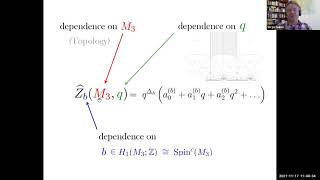
From Turaev to Rokhlin via VOA Characters and Curve Counting
Explore q-series invariants of 3-manifolds, their properties, and connections to topology, vertex algebras, and enumerative problems. Gain insights into recent developments in this mathematical field.
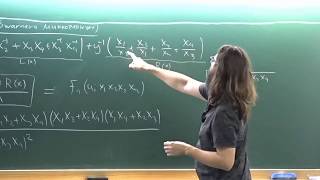
Mirror Symmetry for Character Varieties and Field Theory by Sergey Galkin
Explore mirror symmetry for character varieties, using threespace mirrors to construct SU(2) character variety mirrors on Riemann surfaces, with applications in topological field theory and random walks.
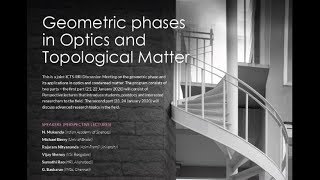
Phases to Phases - An Invitation to Topological Phases of Many Particles by Vijay Shenoy
Explore topological phases in many-particle systems, covering quantum condensed matter physics, electronic phases, and the tenfold way. Gain insights into topological insulators and their potential technological applications.
Geometry and Topology in Quantum Mechanics - Mathematical Properties
Explore geometric phases in quantum mechanics, from foundational concepts to advanced topics like Berry phases and null phase curves, with applications in optics and condensed matter physics.
Introductory Lectures on First-Order Convex Optimization - Lecture 1
Explore first-order convex optimization, covering gradient descent, complexity, smoothness, and Nesterov's accelerated algorithm. Gain insights into theoretical foundations and practical applications in machine learning.
Modular Forms by Mahesh Kakde
Comprehensive exploration of modular forms, covering definitions, properties, and applications. Delves into Eisenstein series, theta functions, and related mathematical concepts for advanced learners in number theory.
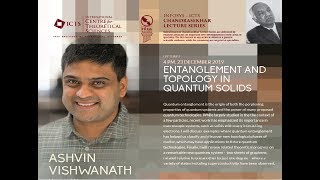
Topology, Correlations and Superconductivity in Magic Angle Graphene - Lecture 2
Explore topology, correlations, and superconductivity in magic angle graphene. Dive into band structures, symmetries, and experimental findings. Gain insights on flat bands, Landau levels, and correlated electron paradigms.
Asymmetry in Dynamics
Explore symmetries in dynamical systems and progress on Smale's conjecture about generic smooth systems having only trivial symmetries. Delve into complex analytic, Hamiltonian, and smooth dynamics.
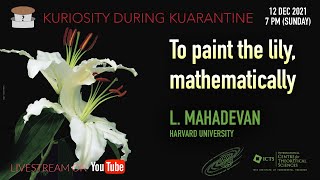
To Paint the Lily, Mathematically by L Mahadevan
Explore the mathematical beauty of nature with L Mahadevan as he uncovers the hidden patterns in everyday phenomena, blending biology, physics, and mathematics to reveal the sublime in the mundane.

The Finite Part of Infinity by Joseph Samuel
Explore the paradoxical equation 1+2+3...=-1/12, its mathematical interpretation, and its impact on physics, including the Casimir effect, with insights from differential geometry and topology.
Applying Physics to Mathematics by Tadashi Tokieda
Explore how physical intuition can uncover mathematical truths. Discover diverse examples that challenge both beginners and experts, bridging the gap between physics and mathematics.