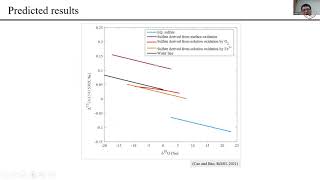
Small Triple Oxygen Isotope Variations in Sulfate - Mechanisms and Applications
Explore sulfate's triple oxygen isotope variations, their mechanisms, and applications in geochemistry. Gain insights into the sulfur cycle and oceanic anomalies.
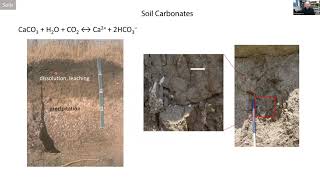
Triple Oxygen Isotopes in Carbonates, Biological Apatites, and Continental Paleoclimate Reconstruction
Explore triple oxygen isotopes in carbonates and apatites for paleoclimate reconstruction, covering evaporative modification, closed basin lakes, and aridity gradients.

Deep Learning for Fundamental Sciences Using High-Performance Computing
Exploring deep learning applications in fundamental sciences using high-performance computing to uncover universe secrets and improve discovery sensitivity.
What Is Machine Learning Anyway?
Explore the fundamentals of machine learning, its applications in microscopy, and different types including supervised and unsupervised learning.
Thresholding and Morphological Operations Using OpenCV in Python
Learn to enhance image quality using OpenCV's thresholding and morphological operations for noise reduction and feature extraction in Python.
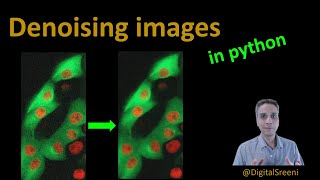
Denoising Microscope Images in Python
Learn techniques for denoising microscope images using Python, exploring algorithms from Scikit-image and NumPy libraries to extract relevant information and improve image quality.
Biologically Inspired Neural Networks
Explore biologically plausible learning algorithms for neural networks, inspired by brain function. Discover synaptic plasticity rules and their application in deep learning architectures.

How Convolutional Neural Networks Work, in Depth
Comprehensive exploration of convolutional neural networks, covering their structure, operation, and training process, including key concepts like filtering, pooling, and backpropagation.
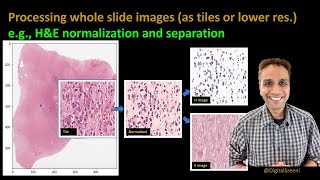
Processing Whole Slide Images as Tiles
Efficient processing of whole slide images using OpenSlide, including H&E normalization and signal separation. Demonstrates tile extraction, processing, and saving for large-scale histopathology analysis.
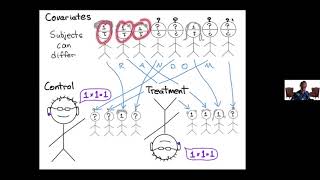
Using Discrepancy Theory to Improve the Design of Randomized Controlled Trials - Daniel Spielman
Explore discrepancy theory's application in randomized controlled trials, enhancing experimental design and statistical analysis for more accurate and efficient research outcomes.
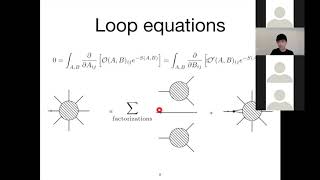
Solving Random Matrix Models with Positivity - Henry Lin
Explore advanced matrix models, focusing on positivity constraints and loop equations. Learn techniques for solving complex mathematical problems in high-energy physics.
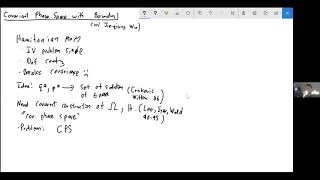
Covariant Phase Space with Boundaries - Daniel Harlow
Explore covariant phase space with boundaries in field theory, covering key concepts like configuration space, prephase space, and Hamiltonian construction.
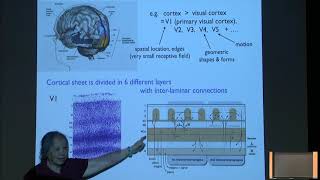
Towards a Mathematical Model of the Brain - Lai-Sang Young
Explore mathematical approaches to modeling brain dynamics, from local neural populations to complex cognitive functions, with insights on synchronization, memory, and visual processing.
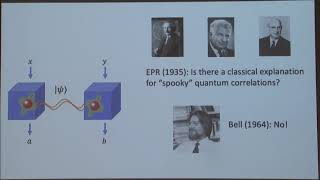
MIP* = RE - Henry Yuen
Explore quantum correlations, nonlocal games, and entanglement models in this seminar on MIP* = RE, delving into complexity theory and efficient tests for quantum phenomena.
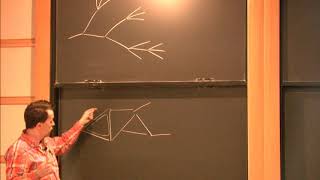
Inverse Problems for Quantum Graphs - Pavel Kurasov
Explore inverse problems for quantum graphs, covering Ambartsumian-type results, trace formulas, and implications for various graph structures. Gain insights into local inverse problems and explicit formulas.
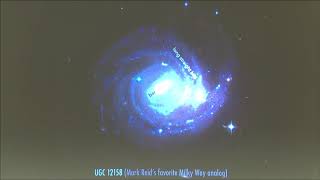
Teasing Out the True Milky Way
Explore the structure and dynamics of our galaxy with Harvard astrophysicist Alyssa Goodman. Discover recent findings like the Radcliffe Wave and learn about innovative techniques for mapping the Milky Way.
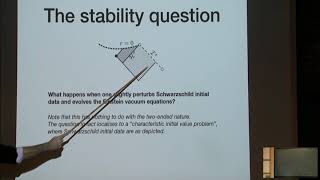
The Nonlinear Stability of the Schwarzschild Metric Without Symmetry - Mihalis Dafermos
Explore the nonlinear stability of the Schwarzschild metric in general relativity, covering key concepts, theorems, and challenges in mathematical physics and black hole dynamics.
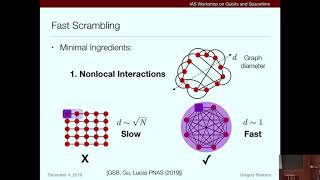
Treelike Geometries and Fast Scrambling from Nonlocal Spin Models - Gregory Bentsen
Explore treelike geometries and fast scrambling in nonlocal spin models, delving into quantum spacetime, artificial spacetime, and optical cavities with numerical simulations and experimental insights.
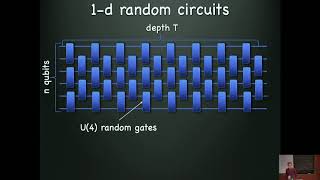
Random Quantum Circuits, Phase Transitions and Complexity - Aram Harrow
Explore quantum complexity, random circuits, and phase transitions in higher dimensions, with applications to tensor networks and simulation algorithms.
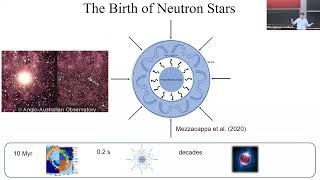
Neutrino Quantum Kinetics in Neutron Star Mergers - Sherwood Richers III
Explore neutrino quantum kinetics in neutron star mergers, focusing on flavor transformation, radiation transport, and their impact on heavy element formation and kilonova observations.
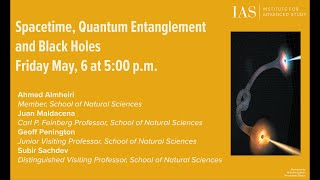
Spacetime, Quantum Entanglement and Black Holes
Explore quantum entanglement's role in resolving spacetime puzzles, focusing on black holes and their connections to various physics fields. Four researchers present fascinating insights.