
Psychology - Consciousness
Explore consciousness, sleep, dreams, and altered states in this comprehensive tutorial series covering key concepts, theories, and practical implications of human awareness.
Opportunities and Challenges for ML in Genomics Research
Explore opportunities and challenges of machine learning in genomics research through expert keynotes and discussions, covering tools, resources, clinical applications, and ethical considerations.
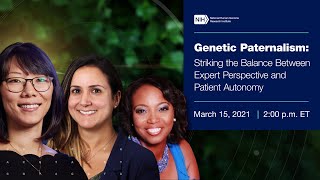
Genetic Paternalism: Striking the Balance Between Expert Perspective and Patient Autonomy
Panel discussion exploring the balance between expert guidance and patient autonomy in genomics research and medicine, offering strategies for ethical decision-making and community engagement in healthcare.
Julia in Astronomy and Astrophysics Research - JuliaCon 2022
Explore how Julia enhances astronomical research through talks on instrument simulation, stellar modeling, exoplanet characterization, cosmology, and more. Discover Julia's impact on productivity and scientific advancement in astronomy.
Simulating Chemical Kinetics with ReactionMechanismSimulator.jl - JuliaCon 2021
Explore chemical kinetics simulation using ReactionMechanismSimulator.jl. Learn about mechanism analysis, symbolic reduction, and efficient steady-state solution identification in Julia.
Changing Physics Education with Julia
Revolutionizing physics education by integrating Julia programming, focusing on nonlinear dynamics. Demonstrates how coding enhances understanding, introduces interactive applications, and discusses benefits of real-world exercises.
Agents.jl and the Next Chapter in Agent-Based Modelling
Explore Agents.jl for complex system modeling: learn its philosophy, simplicity, performance, interactivity, and integration with Julia ecosystem. Discover the future of agent-based modeling.

A Mathematical Look at Electronic Structure Theory - JuliaCon 2021 Workshop
Explore density-functional theory and numerical techniques for solving it using Julia. Learn about discretization, solution algorithms, and practical implementation with hands-on coding exercises.
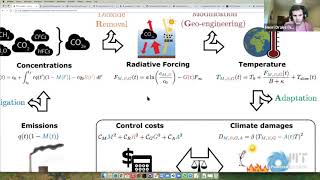
Modeling Climate Change with MARGO - Lecture 25
Explore climate change modeling using Julia, featuring MARGO for optimization, inverse problem solving, and policy analysis. Learn computational approaches to address global warming challenges.
Discrete and Continuous Mathematics - MIT Computational Thinking Spring 2021 - Lecture 14
Explore discrete and continuous mathematics, bridging concepts through indexing, function evaluation, area calculation, and random walks in computational thinking.
Raytracing in 2D - Week 8 - MIT Fall 2020
Explore 2D raytracing, covering light behavior, reflection, refraction, and Snell's law. Learn to implement these concepts in code using Julia, with practical examples like mirrors and lenses.
Macroscopic Models of Epidemic Dynamics - Week 6
Explore macroscopic epidemic models, transitioning from stochastic to deterministic approaches. Learn about SIR models, continuous-time dynamics, and differential equations in epidemiology.
DFTK - A Julian Approach for Simulating Electrons in Solids
Introducing DFTK: A Julia package for density-functional theory simulations, offering flexibility for practical calculations and mathematical development in electronic structure research.
Riprap Sizing in HEC-RAS Version 6.1
Learn advanced riprap sizing techniques using HEC-RAS 6.1's new Riprap Calculator. Explore Australian methods, design considerations, and practical demonstrations for effective hydraulic engineering solutions.
Pumped Hydro: The Biggest Batteries on Earth!
Explore pumped-storage hydroelectricity's potential as a large-scale energy storage solution, featuring home-built systems, the Loch Ness project, and global trends in this innovative technology.
Tsunami and Dam Failure and Non-Newtonian Modelling
Explore advanced hydraulic modelling techniques for tsunamis, dam failures, and non-Newtonian flows. Learn to accurately simulate extreme inundation events using benchmarked methods and real-world case studies.
Probable Maximum Flood
Explore the Probable Maximum Flood concept, its influencing factors, and design implications with experts. Gain insights on envelope curves, palaeofloods, and practical applications in hydrology and flood management.

Natural Dams - Inherent Risk Factors
Explore impacts of natural dam failures through case studies, 3D visualizations, and risk assessments. Learn about prehistoric events, climate change effects, and recent disasters like the 2021 Uttarakhand tragedy.
What's New in HEC HMS, Part II
Explore advanced features in HEC-HMS, including GIS tools, Expression Calculator, and Gridded Data Processing. Learn to integrate Australian Rainfall and Runoff patterns into meteorological modeling.
Next Generation 2D Hydraulic Modelling
Explore advancements in 2D hydraulic modeling, comparing 1D and 2D approaches through case studies and discussing pros and cons for enhanced reliability and efficiency in open channel simulations.
Geomorphology for Project Planning and Implementation
Explore fluvial geomorphology's role in project planning, including case studies, technological advances, and palaeoflood hydrology for improved flood risk estimation and engineering around water.