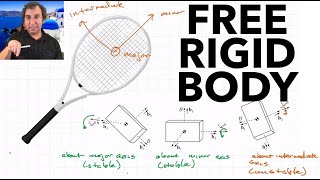
Rigid Body Dynamics - Stability About Principal Axes - Qualitative Analysis of Spinning Objects
Explore rigid body dynamics, stability of principal axes, and qualitative analysis of spinning objects. Understand the tennis racket theorem and intermediate axis instability through demonstrations and intuitive explanations.
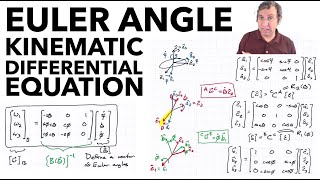
Rigid Body Kinematic Differential Equation for Euler Angles and Rotation Matrix
Comprehensive exploration of rigid body kinematics, focusing on Euler angles, rotation matrices, and differential equations. Covers singularities, alternatives, and applications in free rigid body motion analysis.
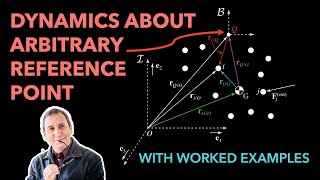
Rotational Dynamics About an Arbitrary Reference Point - Planar Rigid Body Motion - Car Jump Example
Explore rotational dynamics of rigid bodies using arbitrary reference points, with applications to car jumps and planar motion. Covers angular momentum, Euler's equations, and moment of inertia concepts.
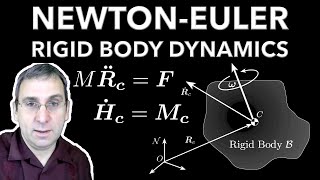
Newton-Euler Equations for a Rigid Body - Center of Mass & Inertia Tensor Calculation Worked Example
Comprehensive exploration of rigid body dynamics, covering mass distribution, center of mass calculation, Newton-Euler equations, and rotational motion, with practical examples and mathematical formulations.
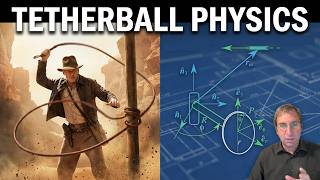
Tetherball, Angular Momentum, and Central Forces - Indiana Jones's Whip, Snake Wrapping Around a Tree
Explore tetherball dynamics, angular momentum, and central forces through real-world examples like Indiana Jones's whip and tree snakes. Learn to solve nonlinear ODEs and analyze spring-mass systems in the plane.
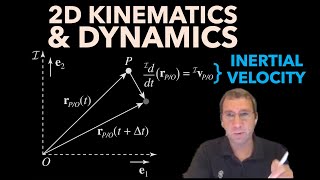
Planar Kinematics & Dynamics of a Particle
Explore planar kinematics and particle dynamics, covering projectile motion, pendulums, polar coordinates, and the transport equation for rotating frames. Gain insights into 2D motion analysis.
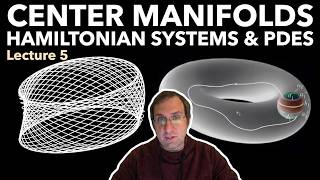
Center Manifolds for Hamiltonian Systems and PDEs - Lorenz System Bifurcation, Part 2
Explore center manifolds in Hamiltonian systems and PDEs, including Lorenz system bifurcation, unstable directions, and applications to flame front evolution and celestial mechanics.
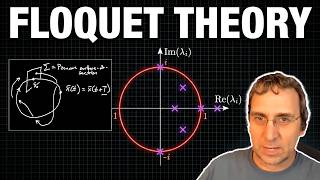
Stability of Periodic Orbits - Floquet Theory - Stable and Unstable Invariant Manifolds
Explore stability of periodic orbits using Floquet theory. Learn about monodromy matrices, Floquet multipliers, and invariant manifolds in Hamiltonian systems. Understand the foundations of chaos in dynamical systems.
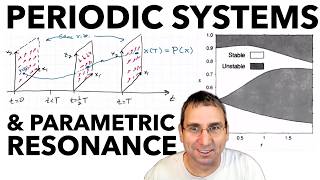
Periodic Systems and Periodic Motion - Parametric Resonance Tongues of Instability, Mathieu Equation
Explore periodic systems, parametric resonance, and the Mathieu equation. Learn about resonance tongues, stability analysis, and the fascinating Kapitza pendulum phenomenon in nonlinear dynamics.
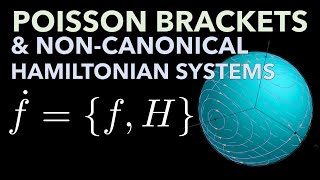
Poisson Brackets, Non-Canonical Hamiltonian Systems and Euler's Rigid Body Equations
Explore Poisson brackets, non-canonical Hamiltonian systems, and Euler's rigid body equations in this advanced dynamics lecture. Gain insights into abstract algebra, Lie algebra, and their applications in physics and mechanics.
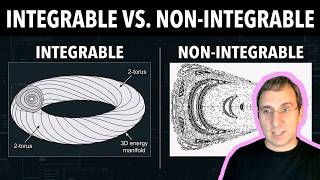
Integrable and Non-Integrable Hamiltonian Systems - KAM Tori - Poincare Sections - Poisson Brackets
Explore integrable and non-integrable Hamiltonian systems, KAM theory, Poincaré sections, and Poisson brackets in this advanced dynamics lecture, offering insights into complex nonlinear systems and their behavior.

Geophysical Fluid Dynamics - Geometry and Ecology
Exploring geophysical fluid dynamics in ecology, focusing on atmospheric transport of microorganisms and its impact on biodiversity. Discusses Lagrangian coherent structures and their role in predicting environmental changes.
Spring Forces
Learn to simulate spring forces using vectors and create oscillating motion in p5.js. Explore Hooke's Law, particle systems, and advanced techniques for realistic spring animations.
Lagrangian Coherent Structures Introduction
Explore Lagrangian coherent structures in fluid flows, revealing particle transport patterns. Learn theoretical foundations and applications in fluid mechanics, with insights on reduced order modeling.
Gravity Gradient - Stability Conditions, Frequencies, Torque Equilibrium Angle, Space Station
Explore gravity gradient effects on spacecraft stability, including Euler equations, pitch stability, torque equilibrium angles, and applications to the International Space Station.
Dual-Spin Spacecraft - Instability of Intermediate and Minimum Principal Axes for Free Rigid Bodies
Explore dual-spin spacecraft stabilization, intermediate axis instability, and long-term minimum axis instability. Learn about historical space missions and passive attitude stability techniques.
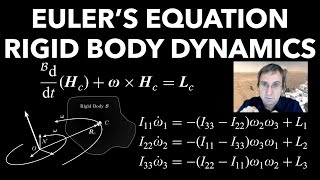
Euler's Equations of Rigid Body Dynamics Derived - Qualitative Analysis - Build Rigid Body Intuition
Comprehensive exploration of Euler's equations for rigid body dynamics, covering derivation, analysis, and practical applications through various examples like spinning tops and fidget spinners.
Center of Mass and Moment of Inertia Matrix - Example Calculations
Example calculations for center of mass and moment of inertia matrix in space vehicle dynamics. Covers planar rigid bodies, composite shapes, and practical applications using integrals and common approximation methods.
Moment of Inertia Matrix and Principal Axis Frame - MATLAB Example Calculation
Explore moment of inertia matrix calculation, principal axis frame, and their significance in rigid body dynamics. Includes MATLAB demonstration for practical application in spacecraft attitude control.
Worked Example of 2 Particle System - MATLAB Tutorial - Implications of Energy and Momentum Conservation
Detailed analysis of a two-particle spring system, exploring conservation laws and using MATLAB to solve complex dynamics problems in space vehicle motion.
Generating Function of a Canonical Transformation - Examples and the Big Picture
Explore generating functions for canonical transformations in Hamiltonian systems. Learn about harmonic oscillator examples, near-identity transformations, and connections to quantum mechanics and gauge invariance.