Quantum Devices in Graphene by Klaus Ensslin
Explore quantum devices in graphene, focusing on their unique properties and potential applications in quantum information processing and condensed matter physics.
Superconducting Qubits - Lecture 1
Explore superconducting qubits in quantum computing, covering fundamental concepts, device physics, and applications in this comprehensive lecture by R. Vijayaraghavan.
Introduction to Quantum Information Theory - Lecture 3
Explore quantum information theory foundations, including entropy, reversible computation, and universal quantum computation in this advanced physics lecture.
Superconducting Qubits - Lecture 3
Explore superconducting qubits in quantum computing, covering fundamental concepts, implementation challenges, and recent advancements in this cutting-edge field of condensed matter physics.
Quantum Error Correction - Lecture 4
Explore quantum error correction techniques to protect quantum information from decoherence and noise, enhancing the reliability of quantum computations and communication systems.
Strong Backaction on a Mechanical Resonator by a Few Photons
Explore the interaction between photons and mechanical resonators, focusing on strong backaction effects and their implications for quantum systems and information processing.
Understanding Quantum Advantage in Unsupervised Machine Learning
Explore quantum advantage in unsupervised machine learning, examining how quantum systems can enhance computational capabilities and revolutionize data analysis techniques.
Field Driven Physics of a Kitaev Magnet by Adhip Agarwala
Explore field-driven physics in Kitaev magnets, examining quantum phases and their potential for quantum information processing. Gain insights into cutting-edge research in condensed matter and quantum systems.
Quantum State Steering Using Weak Quantum Measurements by Parveen Kumar
Explore quantum state steering through weak measurements, delving into theoretical concepts and practical applications in quantum information and condensed matter physics.
Fractional Statistics of Anyons in Mesoscopic Colliders by Gwendal Feve
Explore fractional statistics of anyons in mesoscopic colliders, delving into quantum phenomena and their potential applications in condensed matter physics and quantum information.

CES 2024 Experience: AI Technology Trends and Future Innovations
Explore the future of technology through CES 2024, featuring AI integration, robotics, spatial computing, innovative vehicles, and cutting-edge displays. Gain insights into emerging tech trends.
Discovering Quantum Error Correcting Codes with Reinforcement Learning
Explore reinforcement learning techniques for discovering quantum error correcting codes, enhancing quantum computing reliability and performance.

AI with a Human Perspective - What We See and What We Value
Explore AI's evolution in visual intelligence, from neuroscience-inspired algorithms to addressing ethical concerns and developing human-centered applications in healthcare and robotics.
Shrinking Deep Learning Models: Techniques and Energy Considerations
Explore techniques to shrink deep learning models, reduce energy consumption, and run advanced architectures on commodity hardware. Gain insights into model efficiency and accessibility.
Numerical Analysis for Hamiltonian Simulation and Hamiltonian Learning
Explore numerical analysis for Hamiltonian simulation and learning, covering accuracy measures, semiclassical Schrödinger equation, and efficient algorithms for learning interacting N-qubit local Hamiltonians.
Hybrid Variational Algorithms for Classical and Quantum Complex Systems
Exploring hybrid classical-quantum variational algorithms for complex systems, focusing on QAOA applications in NISQ era. Discusses implementations on classical emulators and Rydberg atom quantum machines.
Introduction to Quantum Information Science - Part II
Explore advanced quantum information science concepts with UCLA expert Wes Campbell in this comprehensive lecture, part of IPAM's Winter School on Quantum Information Science for Chemistry.
Introduction to Quantum Information Science - Part I
Comprehensive introduction to quantum information science, covering fundamental concepts and their applications in chemistry, presented by expert Wes Campbell at UCLA's IPAM Winter School.
Advancing Weather and Climate Prediction with Data-Driven Methods
Exploring machine learning's transformative role in weather and climate prediction, enhancing forecast accuracy, facilitating scientific discovery, and revolutionizing atmospheric science methodologies.
Artificial Intelligence: A Guide for Thinking Humans - Interview with Melanie Mitchell
Explore AI's current state and future potential with Melanie Mitchell, discussing conceptual abstraction, analogy-making, and the challenges in developing human-like artificial intelligence.
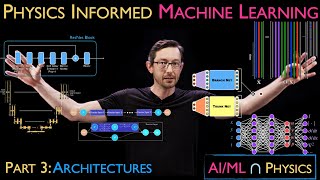
Designing an Architecture for Physics-Informed Machine Learning - Part 3
Explore various neural network architectures for physics-informed machine learning, including ResNets, UNets, and PINNs. Learn how to incorporate physical principles and symmetries into model design for improved performance.