Learning to Predict Arbitrary Quantum Processes
Explore quantum learning theory and its surprising ability to predict local properties of arbitrary quantum circuits, contrasting with classical limitations and highlighting potential for efficient quantum dynamics prediction.
ChatGPT - Water Sector Applications
Explore AI and large language models in water industry applications, including ChatGPT capabilities, live demos, software integration, and potential risks and opportunities.
The Geometry of Tensors - Carolina Araujo
Explore tensor decomposition, its applications, and geometric interpretation. Learn about recent developments in determining tensor ranks and their significance in various fields.
Approximating Many-Electron Wave Functions Using Neural Networks - IPAM at UCLA
Explore neural network applications in quantum mechanics, focusing on Fermionic neural networks for approximating many-electron wave functions and enhancing variational quantum Monte Carlo methods.
Message Passing Neural Networks for Atomistic Systems - Molecules
Explore message passing neural networks for molecular systems, focusing on their application in quantum mechanics and multiscale approaches to atomistic modeling.
Non-Locality in Machine Learning Force Fields - IPAM at UCLA
Explore non-locality in machine learning force fields with Stefan Chmiela, focusing on multiscale approaches in quantum mechanics and their applications in computational chemistry.
Creating Complex Scientific Workflows that Reach into the Real World - IPAM at UCLA
Explore laboratory automation and complex scientific workflows with ESCALATE software, focusing on experiment planning, data capture, and machine learning integration for halide perovskite synthesis.
Accurate Global Machine Learning Force Fields for Molecules with Hundreds of Atoms
Explore innovative approaches to developing accurate global machine learning force fields for large molecular systems, overcoming scaling limitations without compromising on non-local interactions.
From A to B via a Synthesis of Rare-Event Sampling and Machine Learning
Explore machine learning and rare-event sampling techniques for analyzing molecular transitions and generating pathways between energy basins, with applications in materials science and biomolecules.
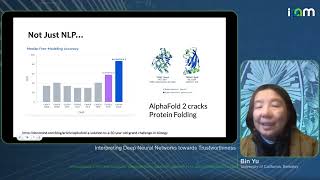
Interpreting Deep Neural Networks Towards Trustworthiness - IPAM at UCLA
Explore techniques for interpreting deep neural networks, including ACD and AWD methods, to enhance trustworthiness in AI applications across scientific domains.
New Approaches in Simulation of Transition Paths - IPAM at UCLA
Explores tensor methods for simulating chemical transition processes, focusing on compressing high-dimensional PDE functions and introducing a novel tensor-network generative modeling approach without optimization.
Contextual Conformational Variability in CryoEM and CryoET Using Deep Learning
Explore deep learning methodologies for analyzing CryoEM and CryoET data, focusing on population dynamics and contextual annotation of macromolecules in cellular environments.
Neural Network-Assisted Atomic Electron Tomography - IPAM at UCLA
Neural network-assisted atomic electron tomography for 3D atomic structure measurement of nanoparticles, enabling precise surface characterization and functional property analysis at single-atom level.
AI Inroads in Imaging Sciences for Materials Research - IPAM at UCLA
Explore deep learning applications in materials research, focusing on convolutional neural networks for transmission electron microscopy and tomographic imaging advancements.
Algorithms for Non-Local Filtering - Application Cryo-Electron and Biological Microscopy
Efficient algorithms for non-local filtering in microscopy, focusing on fast implementations of Non-Local Means Denoising and feature detection in biological images for improved image processing and analysis.
Stabilizer Formalism & Quantum Error Correction Through the Lens of Tensors - Part 1
Explore stabilizer formalism and quantum error correction using tensor methods. Learn about many-body systems, error correction challenges, and connections to finite symplectic geometries.
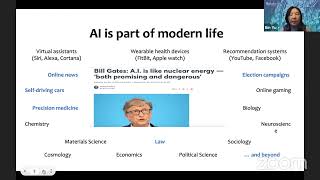
Interpreting Deep Neural Networks Towards Trustworthiness
Explores methods for interpreting complex neural networks, introducing ACD and AWD techniques. Advocates for a quality-controlled data science lifecycle to ensure trustworthy model interpretation.
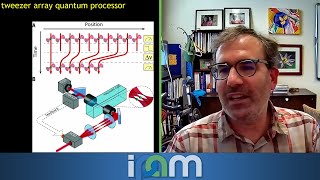
Approaches to Quantum Information Processing With Cold Atoms
Explore quantum simulation and computation approaches using cold atoms for understanding nature and advancing computational capabilities.
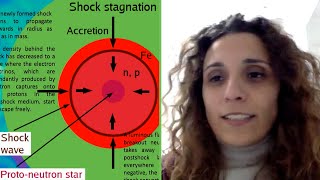
Deep Learning Algorithm for Core-Collapse Supernova Detection
Explore deep learning algorithms for detecting gravitational waves from core-collapse supernovae, enhancing multi-messenger astronomy and uncovering insights into extreme cosmic events.
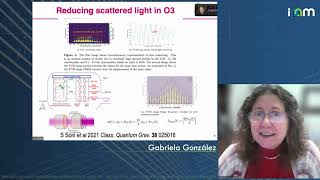
Non-Astrophysical Transients in LIGO Detectors: Help With Machine Learning
Explore machine learning techniques for diagnosing non-astrophysical transients in LIGO detectors, enhancing gravitational wave detection and analysis in multi-messenger astrophysics.
Black-Hole Radiation Decoding as a Cryptographic Assumption
Explore the intriguing connection between black-hole radiation decoding and quantum cryptography, revealing how high-energy physics phenomena can imply the existence of secure cryptographic primitives.