Deepsets, Graph Neural Networks, and Transformers in Machine Learning - Lecture 7
Explore advanced machine learning techniques for high energy physics, including Deepsets, Graph Neural Networks, and Transformers, to analyze complex particle physics data.
Differentiable Programming for End-to-end Optimization of Experiments - Lecture 6
Explore differentiable programming for optimizing experiments in high-energy physics, focusing on end-to-end solutions and advanced machine learning techniques.
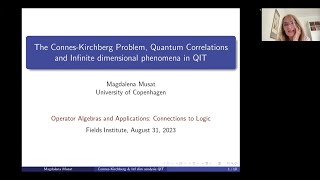
The Connes-Kirchberg Problem, Quantum Correlations and Infinite Dimensional Phenomena in QIT
Explore quantum correlations and infinite-dimensional phenomena in quantum information theory, focusing on the Connes-Kirchberg Problem and its implications.
Neural Simulation-based Inference - Lecture 2
Explore advanced neural simulation-based inference techniques for high energy physics, focusing on applications in data analysis and new physics discovery at particle colliders.
Opening up Quantum Criticality
Explore quantum criticality, long-range entanglement, and open quantum systems. Discover local adaptive circuits, critical mixed states, and their implications for quantum information theory.
Quantum Algorithms - From Far to Near Future
Explore quantum algorithms' evolution, from Hamiltonian simulations to empirical hardness models, and their applications in quantum field theory and state preparation.
Ran Levi- Topological Analysis of Neural Networks
Explore topological analysis of neural networks, from C. elegans to complex brain structures. Discover surprising findings and innovative approaches in computational neuroscience.
Estimating Oxygen in the Southern Ocean Using Argo Temperature and Salinity - Donata Giglio
Explore innovative techniques for estimating oxygen levels in the Southern Ocean using Argo float data. Learn how temperature and salinity measurements contribute to understanding ocean biogeochemistry and climate change impacts.
Using AI to Facilitate Environmental Justice - The Need for Ethical & Responsible AI
Explores the application of AI in environmental justice, emphasizing ethical considerations and responsible practices for weather and climate research. Discusses potential impacts and challenges in this emerging field.
Deep Learning and Energy Models for Fine Dead Wood Segmentation - Jacquelyn Shelton
Explore deep learning and energy models for fine dead wood segmentation in climate research, focusing on carbon cycle implications and advanced image analysis techniques.
Deep Learning for Subseasonal Global Precipitation Prediction - Maria Molina
Explore deep learning techniques for predicting global precipitation patterns on a subseasonal timescale, advancing climate science through innovative machine learning approaches.
Representation Learning and Custom Loss Functions for Atmospheric Data - Christian Lessig
Explores representation learning and custom loss functions for atmospheric data analysis, advancing climate science through machine learning techniques to extract insights from complex Earth system observations.
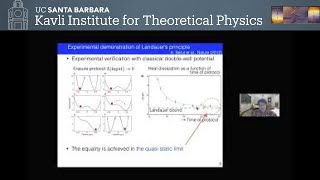
Effects of Finite Speed and Quantum Coherence in Thermodynamic Control - Heat Engines and Landauer Principle
Explores finite speed and quantum coherence impacts on thermodynamic control in heat engines and Landauer principle, discussing optimal protocols for energy/information transport and state preparation.
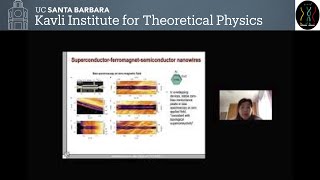
Latest Semiconducting Nanowire Designs in the Search for Majorana Modes - Elsa Prada
Explore cutting-edge semiconducting nanowire designs for Majorana modes, focusing on ferromagnetic and full-shell hybrid nanowires. Discover recent advancements in this exciting field of condensed matter physics.
Chasing Polar Alignment in Hierarchical Triple Systems
Explores polar alignment in hierarchical triple systems, discussing circumbinary gas evolution, observational signatures, and numerical modeling techniques for stellar and black hole binaries.
Disks Around Binaries and Binaries in Big Disks - Dong Lai
Explore the dynamics of circumbinary gas and its influence on binary systems, from stellar pairs to supermassive black holes. Gain insights into observational signatures and numerical modeling techniques.
Simulating Binaries in Thin Disks - Chris Tiede
Explore numerical techniques for modeling binary systems in circumbinary gas, focusing on thin disks. Learn about evolution, observational signatures, and cross-scale similarities in astrophysics.
Quantum Information and Geometry - Raphael Bousso (Berkeley)
Explore quantum information and geometry with Raphael Bousso from Berkeley in this 25-minute talk from the 2022 Snowmass Theory Frontier Conference, discussing recent advances and future opportunities in high-energy physics theory.

Unbiased and Consistent Algorithm Classes in Photorealistic Rendering - Lecture 31
Explore photorealistic rendering algorithms, their classifications, and expected behaviors. Learn about biased/unbiased and consistent/inconsistent methods in global illumination.
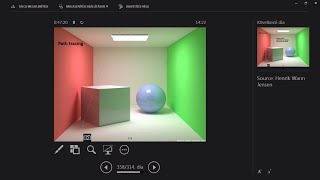
Path Tracing and Next Event Estimation - TU Wien Rendering Lecture 25
Explore path tracing and next event estimation techniques for solving the rendering equation, enhancing light source handling in computer graphics and 3D visualization.
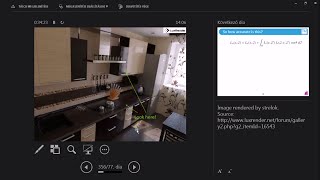
Rendering Equation Properties - TU Wien Rendering Lecture 15
Exploring the Holy Rendering Equation's properties, including its infinite dimensions and singularities, and discussing approaches to solve this complex problem in computer graphics.