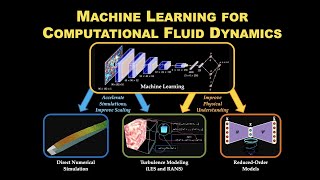
Machine Learning for Computational Fluid Dynamics
Explore machine learning's potential to enhance computational fluid dynamics, covering applications in simulations, turbulence modeling, and reduced-order models while emphasizing physics-informed approaches.
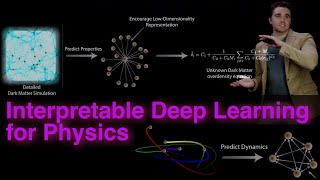
Interpretable Deep Learning for New Physics Discovery
Explore a novel method combining deep learning and symbolic regression to uncover physical laws from data, with applications in physics and cosmology.
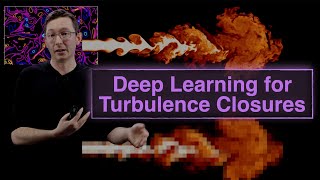
Deep Learning for Turbulence Closure Modeling
Explore how deep learning revolutionizes turbulence modeling in fluid dynamics, focusing on RANS equations and large eddy simulations for advanced computational techniques.
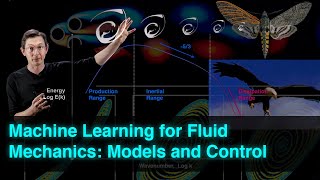
Machine Learning for Fluid Dynamics: Models and Control
Explore machine learning applications in fluid dynamics modeling and control, covering patterns, complexity, RANS closure models, SINDY, and deep MPC for flow control.
Machine Learning for Fluid Dynamics - Patterns
Explore machine learning applications in fluid dynamics, focusing on pattern extraction and coherent structure identification in high-dimensional systems.
Machine Learning for Fluid Mechanics
Overview of machine learning applications in fluid mechanics, exploring historical context, pattern recognition, reduced-order modeling, and flow control, with insights on AI's impact on this data-rich field.
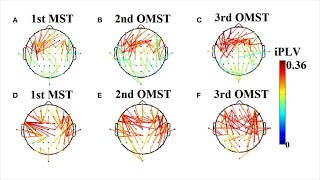
Orthogonalized Minimum Spanning Tree and Their Application for Human Brain Mapping - Paper Review
Explore Orthogonalized Minimum Spanning Trees for brain connectivity analysis. Learn about data-driven thresholding methods, their application in human brain mapping, and practical implementation through code examples.
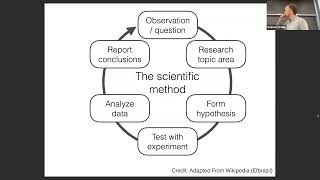
CMU Advanced NLP: Experimental Design
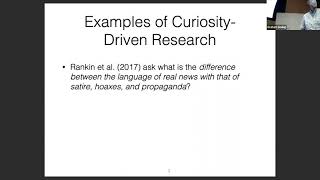
Learn advanced NLP research techniques, from formulating questions to conducting experiments, with a focus on scientific methods and practical applications in natural language processing.
CMU Advanced NLP: NLP Experimentation
Learn advanced NLP experimentation techniques, from forming research questions to running experiments, with insights on data annotation and hypothesis testing.
TU Wien Rendering - Metropolis Light Transport
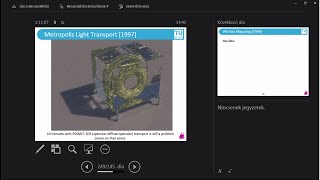
Explore Metropolis Light Transport, an advanced rendering technique that outperforms Bidirectional Path Tracing in difficult scenes, offering optimal importance sampling and improved convergence for caustics.
Rendering - Path Tracing Implementation & Code Walkthrough
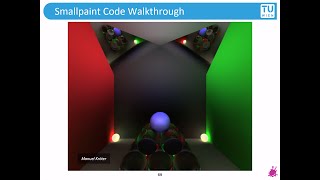
Comprehensive walkthrough of implementing a path tracer in C++, covering key concepts like vector class, object representation, camera setup, sampling, and rendering techniques.
Elon Musk - A Future Worth Getting Excited About
Elon Musk discusses groundbreaking innovations in sustainable energy, AI, robotics, space exploration, and brain-machine interfaces, envisioning a future of abundance and interplanetary human civilization.
Particle Methods for Optimization Over Measures - Lecture 3
Explore particle methods for measure optimization in this advanced lecture, covering theoretical foundations and practical applications in data science and machine learning.
Cold Atoms, Quantum Simulation, and Driven Quasicrystals - Part 1
Explore quantum simulation using cold atoms and driven quasicrystals. Delve into advanced physics concepts and their experimental applications in this cutting-edge lecture.
Quantum Computing with Rydberg-Interacting Qubits by Ajay Wasan
Explore quantum computing using Rydberg-interacting qubits, delving into advanced concepts and applications in this cutting-edge field of quantum technology and information processing.
Pseudorandomness: From Quantum States to Binary Strings
Explore quantum pseudorandom generators, their construction from logarithmic-output pseudorandom quantum states, and applications in cryptography beyond classical one-way functions.
Generative Models Application in High Energy Physics
Explore generative models in high-energy physics, focusing on applications and techniques for data analysis and new physics discovery in particle collider experiments.
Generative Models in High Energy Physics
Explore generative models in high-energy physics, focusing on applications for data analysis and new physics discovery. Learn techniques to handle large datasets and improve experimental outcomes.
Neural Simulation-based Inference - Lecture 5
Explore neural simulation-based inference techniques for high energy physics data analysis, focusing on advanced machine learning applications in particle physics research.
Lectures on Deepsets, Graph Neural Networks and Transformers with Applications - Lecture 6
Explore advanced deep learning architectures like Deepsets, Graph Neural Networks, and Transformers, with applications in high energy physics data analysis and research.
Introduction of BDT and Neural Networks for Classification in High Energy Physics - Lecture 2
Explore Boosted Decision Trees and Neural Networks for particle classification in High Energy Physics, enhancing data analysis techniques for groundbreaking discoveries.