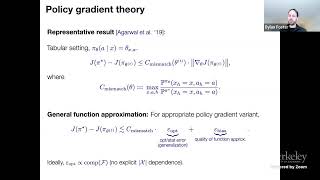
Reinforcement Learning - Part I
Explore reinforcement learning fundamentals, including credit assignment, dynamic programming, and exploration algorithms. Gain insights into algorithm design and sample complexity in this comprehensive introduction.
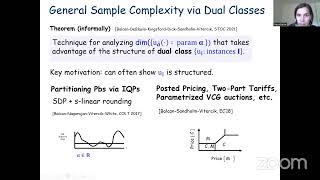
Learning Theoretic Foundations of Data-Driven Algorithm Design
Explore machine learning techniques for data-driven algorithm design, focusing on combinatorial problems and online optimization. Learn to adapt algorithms to specific domains for improved performance.
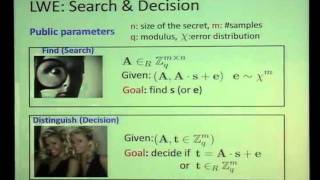
Pseudorandom Knapsacks and the Sample Complexity of LWE Search-to-Decision Reductions
Explore pseudorandom knapsacks and LWE search-to-decision reductions, delving into their sample complexity and implications for cryptographic systems.
Sample Complexity of Estimation in Logistic Regression - Lecture
Explore sample complexity in logistic regression, examining parameter estimation across temperature regimes. Gain insights into non-asymptotic analysis and critical points in the complexity curve.
Learning Quantum with Generative Models
Explore generative models for quantum state learning, covering neural networks, RBMs, and applications to GHZ states and local Hamiltonians.
Optimal Algorithms for Learning Quantum Phase States
Delve into optimal algorithms and complexity analysis for learning quantum phase states, focusing on sample complexity bounds, measurement techniques, and applications in quantum computation.
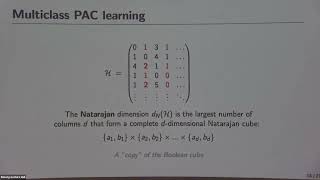
Characterizations of PAC Learnability
Explore key characterizations of PAC learnability in machine learning theory with insights from postdoctoral researcher Nataly Brukhim.

Learning with Volterra Series - Convolutional Networks without Activation Functions
Explore Volterra Series in machine learning, reducing sample and model complexity while maintaining high performance in inference problems.
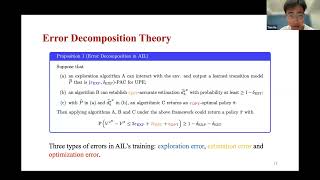
Provably Efficient Adversarial Imitation Learning with Unknown Transitions - Oral Session 4
Explore provably efficient adversarial imitation learning with unknown transitions. Discover a framework connecting reward-free exploration and AIL, and learn about the MB-TAIL algorithm's optimal performance and generalization ability.
Privacy, Stability, and Online Learning
Explore the intersection of privacy, stability, and online learning, focusing on sample complexity, private learnability, and mistake-bounded learning in classification algorithms.
Towards Fast Autonomous Learners: Advances in Reinforcement Learning - 2015
Explore reinforcement learning for AI agents interacting with humans, focusing on sample efficiency and transfer learning to improve educational tools and decision-making systems.
Tree Learning: Optimal Algorithms and Sample Complexity - Hierarchical Clustering and PAC Learning
Explore optimal algorithms and sample complexity for learning hierarchical tree representations from labeled data, covering PAC learning, online learning, and efficient tree classifier construction.
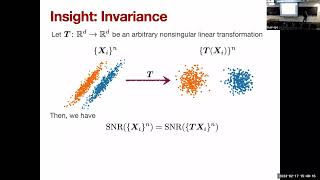
Clustering a Mixture of Gaussians with Unknown Covariance - Lecture
Explore clustering with Gaussian mixtures, focusing on maximum likelihood estimation, Max-Cut solutions, and efficient algorithms. Investigate statistical-computational gaps and challenges in high-dimensional settings.
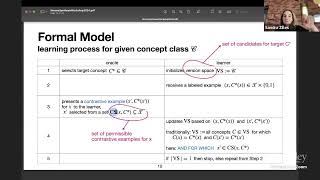
Learning From Contrastive Examples in Machine Learning
Explores how contrastive training examples impact active learning algorithms, focusing on sample complexity for geometric concepts and Boolean functions, with connections to self-directed learning.