Safer C++ with MISRA-C++-2023
Explore MISRA-C++:2023 guidelines for safer, higher-quality C++ programming in critical systems. Learn key rules, modern C++ design, and strategies for adhering to seemingly challenging guidelines.
Safety and Open Source Software: Evolution and Future Directions
Explore the evolution and future of safety in open source software, focusing on challenges, best practices, and the ELISA Project for safety-critical systems.
Formal Verification of Embedded Linux Systems Using Trace-Based Models
Explore trace-based models for formal verification of embedded Linux systems, focusing on safety-critical aspects, real-time properties, and system instrumentation techniques.
Mentorship Session: Software Engineering and Functional Safety in Automotive Industry
Explore software engineering fundamentals, quality metrics, and their application in creating functionally safe systems, with a focus on automotive industry standards and practices.
Reproducible Multi Element System Composition with Linux, Xen and Zephyr
Explore system architectures for safety-critical systems using Linux, Xen, and Zephyr. Learn about reproducible prototyping, documentation, and collaboration in open-source projects for complex systems.
Coding Guidelines: To Comply or Not Comply - Myth Busting
Explore coding guidelines for safety-critical applications, focusing on MISRA rules. Learn when to comply, when to deviate, and how to apply lessons to other languages.
RT Linux in Safety Critical Systems - The Potential and Challenges
Explore the potential and challenges of implementing Real-Time Linux in safety-critical systems, with insights from industry experts on cutting-edge applications and best practices.
Panel Discussion - Enabling Linux in Safety Applications
Explore the integration of Linux in safety-critical applications with industry experts, discussing challenges, opportunities, and best practices for secure and reliable implementations.
Xen in Safety-Critical Systems
Explore Xen's role in safety-critical systems, examining its implementation, benefits, and challenges in high-stakes environments like automotive and aerospace industries.
Deploying Linux in Safety Critical Applications - Three Key Challenges
Explore key challenges in deploying Linux for safety-critical applications, including conformance, integrity, and integration. Learn mitigation strategies and best practices for secure implementation.
Industrial DevOps - Applying DevOps to Cyber-Physical Safety-Critical Systems
Explores applying DevOps principles to cyber-physical safety-critical systems in highly regulated environments, addressing challenges and approaches for ensuring traceability, reliability, and safety.
Realtime, Safety, and Mainline Linux - Future Directions Panel Discussion
Explore real-time safety in Linux through expert panel discussion, covering strategies, standards, certification, and hardware considerations for critical systems.
Is Linux Kernel Development Suitable for Safety-Critical Systems? - Progress and Methods
Explore Linux kernel development for safety-critical systems, examining methods to assess and improve its suitability for use in autonomous driving and other high-stakes applications.
Elements Towards Functional Safety Use Cases with Linux in Automotive
Explore Linux's role in automotive functional safety, focusing on warning signs in instrument clusters as a starting point for more complex safety-critical applications.

How ELISA Is Helping Use Linux in Safety-Critical Systems
Explore how the ELISA Project facilitates Linux adoption in safety-critical systems, enhancing reliability and security for critical applications across industries.
Enabling Linux in Safety-Critical Applications - ELISA Project Overview
Explore ELISA project's efforts to enable Linux in safety-critical systems, covering goals, strategies, work groups, and challenges in automotive, medical, and industrial IoT applications.
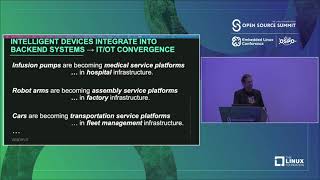
Hypervisor-less Virtio for Real-time and Safety in Intelligent Edge Devices
Explore hypervisor-less virtio for real-time and safety applications in embedded systems, focusing on intelligent edge devices, multicore SoCs, and Linux integration for IoT convergence.
Functional Safety Basics for Open Source Software Developers
Learn essential functional safety principles for open-source software development, focusing on risk assessment, safety requirements, and industry standards to enhance software reliability and safety.
Display Sharing in Heterogeneous Systems Using Linux as High Level Operating System
Explore display sharing in heterogeneous systems, focusing on Linux as a high-level OS. Learn about resource partitioning, safety considerations, and driver implementation for seamless integration.
Real-Time Linux: What Is Next?
Panel discussion on the future of real-time Linux kernel, exploring its current state, ongoing developments, and potential applications in safety-critical systems.
Cybersecurity Risk Assessment for Safety-Critical Systems
Explore cybersecurity threats to space systems, motivations behind attacks, and essential perspectives for securing these critical infrastructures.