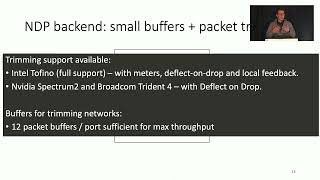
An Edge-Queued Datagram Service for All Datacenter Traffic
Edge-queued datagram service for datacenters moves queuing to sending hosts, enabling multiple protocols to coexist, improving performance, and facilitating future enhancements without modifying higher-layer stacks.
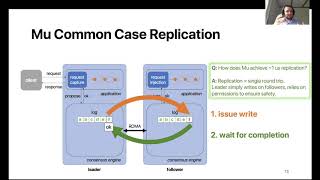
Microsecond Consensus for Microsecond Applications
Innovative consensus protocol leveraging RDMA for microsecond-scale replication and rapid fail-over in latency-sensitive applications, significantly outperforming existing systems.
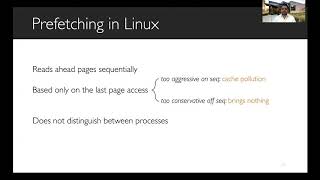
Effectively Prefetching Remote Memory with Leap
Innovative prefetching solution for remote memory access, improving latency and performance in memory disaggregation systems through online algorithms and efficient kernel data paths.
No Provisioned Concurrency - Fast RDMA-codesigned Remote Fork for Serverless Computing
Explore MITOSIS, a novel OS primitive enabling rapid remote container initialization for serverless platforms, reducing function latency and memory usage while improving state transfer in serverless workflows.
Flor - An Open High Performance RDMA Framework Over Heterogeneous RNICs
Explore Flor, an innovative framework enabling high-performance RDMA across diverse network interface cards, addressing bandwidth imbalances and enhancing datacenter application efficiency.
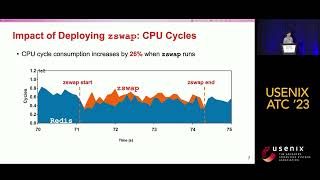
STYX - Exploiting SmartNIC Capability to Reduce Datacenter Memory Tax
Innovative framework offloading memory optimization tasks to SmartNICs, reducing server CPU load and cache pollution while maintaining efficiency. Demonstrates significant latency improvements for co-running applications.
LAG and Hardware Offload to Support RDMA and IO Virtualized Interfaces
Exploring LAG implementation for RDMA and virtualized interfaces, focusing on active-backup mode, flow-based active-active mode, and a new active-active mode for virtual functions.
Production Multi-node Jobs with Gang Scheduling, K8s, GPUs and RDMA
Explore distributed execution of DL/ML jobs in Kubernetes, covering gang scheduling, GPU acceleration, and high-speed networking for improved performance and scalability.
Getting GPUDirect to Work with Broadcom NICs
Discover how to integrate Broadcom NICs with NVIDIA GPUs for enhanced packet processing using GPUDirect RDMA, exploring necessary DPDK ecosystem modifications and implementation steps.
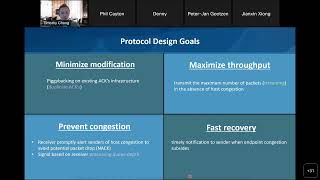
Addressing Endpoint-Induced Congestion in Scale Out Accelerator Domain
Discover innovative RDMA mechanisms for handling endpoint congestion in accelerator domains, focusing on UDP/IP/Ethernet implementation and efficient congestion control for improved network performance.
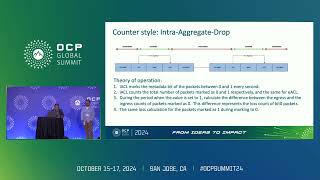
Network Stability Challenges and Solutions in Large-Scale Computing Clusters
Discover advanced network stability techniques for large-scale computing clusters, focusing on AI/ML training optimization, unified monitoring, and innovative congestion control through AMD implementation.
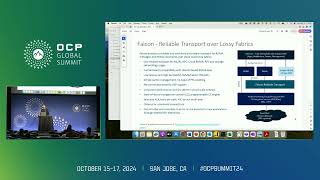
Falcon Reliable Transport: High-Performance RDMA at Data Center Scale
Discover Intel's FalconRT technology for high-performance RDMA transport, enabling efficient data center networking with hardware-assisted optimization and backward compatibility for existing infrastructure.
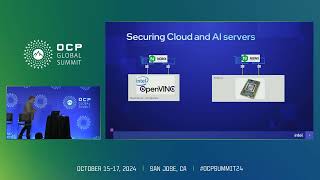
Optimizing Networks with Infrastructure Processing Units for Cloud and Enterprise
Discover how Infrastructure Processing Units (IPUs) revolutionize datacenter performance through secure workload acceleration, improved CPU utilization, and next-generation transport protocols for cloud and AI connectivity.
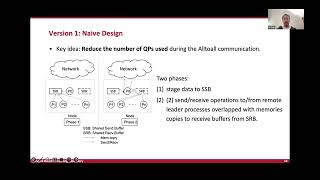
OHIO: Improving RDMA Network Scalability in MPI_Alltoall Through Optimized Communication Design
Discover optimized RDMA network communication techniques for MPI_Alltoall operations through hierarchical design and improved overlap strategies for enhanced scalability and performance.
Supporting Trusted Virtual Machines with Hardware-based Secure Remote Memory
Explore hardware-assisted secure memory disaggregation, combining trusted VMs with a dedicated engine for efficient isolation and protection of remote memory pages, ensuring confidentiality and integrity.
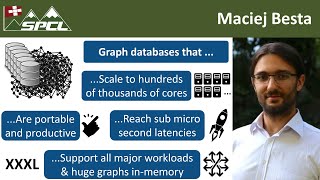
The Graph Database Interface: Scaling Online Transactional and Analytical Graph Workloads
Explore cutting-edge graph database technology scaling to 100,000+ cores. Learn about GDI, a new interface for high-performance, scalable graph processing in distributed memory systems.

eBPF Strengthens SR-IOV for Powerful Kubernetes Networking
Explore how eBPF enhances SR-IOV for high-performance networking in Kubernetes, enabling clusterIP resolution and optimizing AI workloads without dual CNIs.

Motor: Enabling Multi-Versioning for Distributed Transactions on Disaggregated Memory
Innovative system for efficient distributed transactions on disaggregated memory, improving throughput and reducing latency through multi-versioning and RDMA-based protocols.
Conspirator - SmartNIC-Aided Control Plane for Distributed ML Workloads
Innovative control plane design using SmartNICs to optimize distributed ML workloads, reducing bottlenecks and improving resource utilization for enhanced performance and efficiency.
PeRF - Preemption-enabled RDMA Framework for Multi-tenant Environments
Innovative RDMA framework for multi-tenant cloud environments, offering performance isolation and work conservation without compromising bare-metal performance through a novel RNIC preemption mechanism.

How to Extend AD/ADAS Sensors Accessibility to IVI Domain in the Software Defined Vehicle Era
Explore high-performance computing in software-defined vehicles, focusing on device sharing concepts, architectural requirements, and implementation strategies for multiple SoCs and sensor accessibility.