Applications of Sub-linear Algorithms in Other Fields
Explore how sub-linear algorithms impact diverse fields, enhancing efficiency and scalability in data analysis and problem-solving across disciplines.
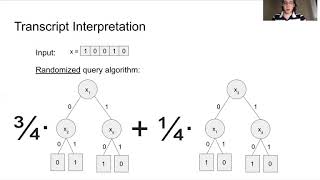
A New Minimax Theorem for Randomized Algorithms
Explore a novel minimax theorem for randomized algorithms, comparing it with Yao's minimax and discussing its implications for algorithm analysis and design.

Compacting the Uncompactable
Innovative memory allocation technique eliminating fragmentation in C/C++ programs, reducing memory consumption and improving performance without modifying existing code.
Probabilistic Programming with Stochastic Probabilities
Explore a novel approach to probabilistic programming languages using stochastic probability estimation, enabling unrestricted stochastic control flow and programmable inference with custom proposals.
Optimal Prediction Using Expert Advice and Randomized Littlestone Dimension
Delve into optimal prediction strategies and online learning theory through exploration of expert advice systems and the randomized Littlestone dimension, focusing on practical applications in weather forecasting and image classification.
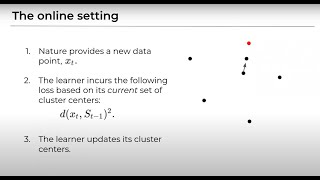
Online k-means Clustering on Arbitrary Data Streams - Lecture
Explore online k-means clustering for arbitrary data streams, focusing on a novel algorithm with polynomial space and time complexity and provable guarantees without input assumptions.
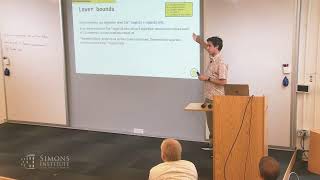
Optimal Quantile Estimation for Streams
Explore optimal quantile estimation for data streams, focusing on space-efficient algorithms and recent advancements in deterministic sketching techniques for improved accuracy and memory usage.
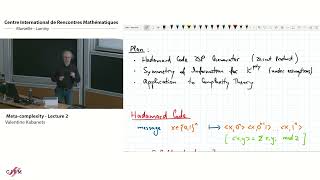
Derandomization and Meta-complexity - Part 2
Explore meta-complexity in derandomization through an advanced tutorial. Delve into cutting-edge mathematical concepts and their applications in randomness and complexity theory.
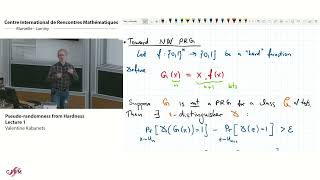
Derandomization: Pseudo-randomness from Hardness - Part 1
Explore pseudo-randomness from hardness in derandomization with Valentine Kabanets. Gain insights into this mathematical concept through a comprehensive tutorial.
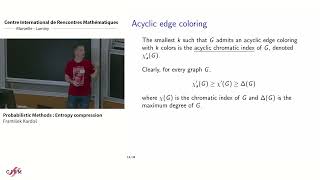
Probabilistic Methods - Entropy Compression
Explore probabilistic methods and entropy compression in mathematics through an in-depth lecture by František Kardoš at CIRM's ALEA days conference.

Constant-Cost Communication in Randomized Computing
Explore the fascinating role of randomness in communication complexity, focusing on efficient protocols for solving equality problems and their broader implications in computing theory.