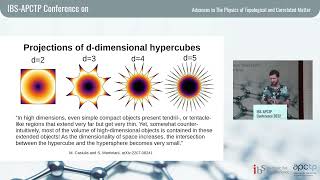
Persistent Homology Analysis of Phase Transitions in Quantum Systems
Explore persistent homology for analyzing phase transitions in complex physical systems. Learn how this topological machine learning method extracts meaningful information from sparse data in condensed matter physics.
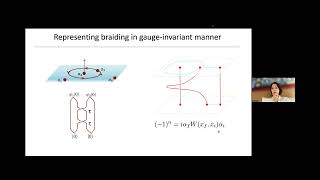
Non-Abelian Braiding with Plaquette Surface Code on Noisy Intermediate Scale Quantum Devices
Explore non-Abelian braiding in plaquette surface code on NISQ devices, uncovering quantum computing advancements and topological quantum information processing.
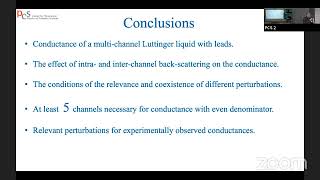
Fractional Conductances in Strongly Interacting 1D Systems
Explore fractional conductances in strongly interacting 1D systems with N channels. Analyze conditions for perturbation coexistence, gap opening, and conductance calculations in complex quantum systems.
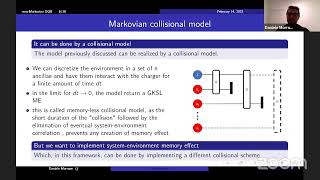
Charging a Quantum Battery in a Non-Markovian Environment: A Collisional Model Approach
Explore non-Markovian effects on quantum battery charging using collisional models. Analyze ergotropy, information backflow, and memory effects to optimize energy extraction in open quantum systems.
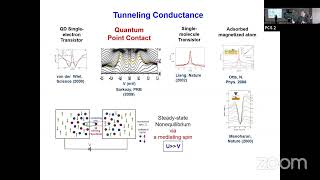
Gate-Voltage-Driven Quantum Phase Transition in Quantum Point Contacts
Explore gate-voltage-driven quantum phase transitions in quantum point contacts, focusing on localized spin formation, symmetry breaking, and Kondo coupling effects on tunneling conductance.
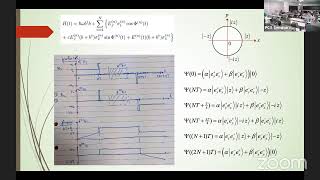
Nanomechanical Control of Superconducting Charge-Qubit Networks
Explore nanomechanical manipulation of superconducting charge-qubit networks using nanoelectromechanical setups and time-protocols for quantum information transduction and entanglement.
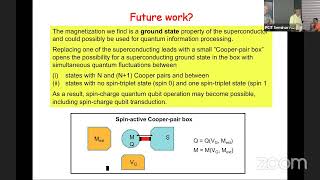
Magnetizing a BCS Superconductor by Spin-Dependent Tunneling
Explore spin-dependent tunneling in BCS superconductors and its potential for unlocking spin degrees of freedom, enabling novel spintronics applications and dissipation-less spin currents.
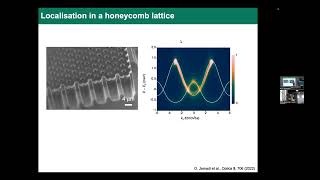
Engineering Localized Modes via Drive and Dissipation in Photonic Lattices
Explore innovative techniques for engineering localized modes in photonic lattices using drive and dissipation. Learn about reconfigurable photon localization and its applications in enhancing nonlinear effects and controlling light-matter interactions.
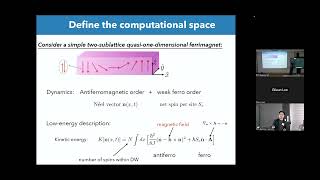
Shuttling Domain Wall Qubit on the Magnetic Racetrack
Explore a scalable quantum computing implementation using mobile domain walls on magnetic racetracks, with long-lived qubits and noise-resistant operations.
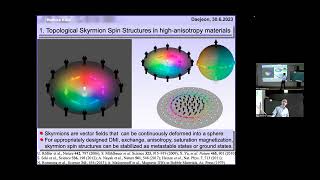
Skyrmions in Spin-Orbitronics and Orbitronics - Novel Science and Applications in Memory and Non-Conventional Computing
Explore novel spintronic devices using skyrmions for energy-efficient memory and non-conventional computing. Learn about topological stability, efficient manipulation, and applications in stochastic and reservoir computing.
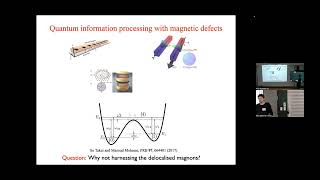
Cavity Magnonics with Domain Walls in Insulating Ferromagnetic Wires
Explore cavity magnonics with domain walls in ferromagnetic wires, uncovering quantum states, entanglement, and detection methods for potential computing applications.
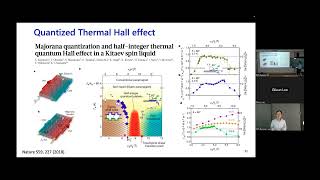
Structure and Magnetic Anisotropy of Alpha-RuCl3
Explore alpha-RuCl3's structure and magnetic properties, focusing on Kitaev interactions and quantum spin liquid states. Gain insights into recent experimental findings using high-quality samples.
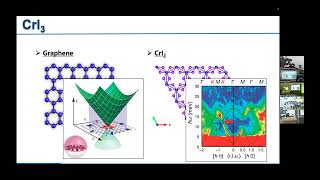
Magic Angle of Moire Magnetic Materials
Explore the emergence of flatbands in twisted bilayer magnetic materials and their impact on magnon behavior, contrasting with electronic flatbands in graphene.
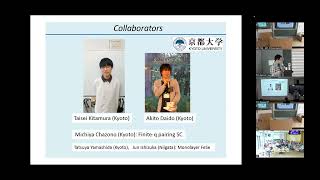
Generation, Modulation, and Enhancement of Superconductivity by Quantum Geometry
Explore quantum geometry's role in superconductivity, from high-temperature systems to finite-momentum pairing states and spin-triplet superconductivity triggered by ferromagnetic fluctuations.
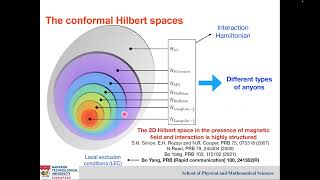
Quantum Geometry in Topological Bands - Chern Insulators from Landau Level Description and Beyond
Explore quantum geometry in topological bands, comparing Landau levels and Chern bands. Examine ideal flatband formalism, Anderson localization, and electron-electron interactions in 2D quantum materials.
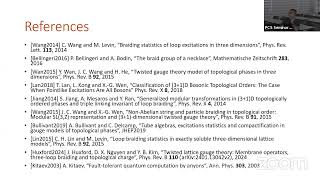
Generalized Loop Braiding Statistics in 3+1D Topological Phases - The Case of Twisted Lattice Gauge
Explore generalized loop braiding statistics in 3+1D topological phases, focusing on twisted lattice gauge theory. Gain insights into advanced concepts in quantum field theory and condensed matter physics.
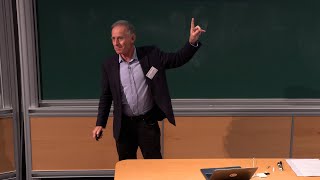
Thirty-Six Entangled Officers of Euler: Quantum Solution to a Classical Problem
Explore quantum combinatorial designs and their application in solving Euler's 36 officers problem, revealing insights into quantum information processing and error detection.
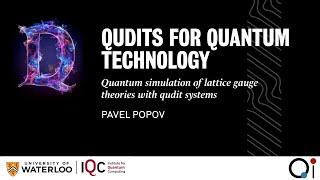
Quantum Simulation of Lattice Gauge Theories with Qudit Systems
Explore quantum simulation of lattice gauge theories using qudit systems, focusing on advanced techniques and applications in quantum computing.

Simple Factorization and Other Properties of D-Dimensional Unitaries
Explore d-dimensional unitaries, their factorization properties, and average characteristics in quantum computing. Gain insights into constructing and analyzing higher-dimensional quantum transformations.
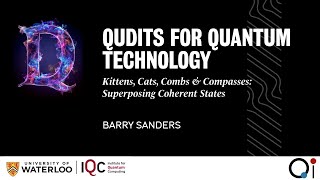
Kittens, Cats, Combs and Compasses - Superposing Coherent States
Explore superpositions of coherent states in quantum computing, communication, and sensing. Discover nuclear cat states on nuclear qudits.
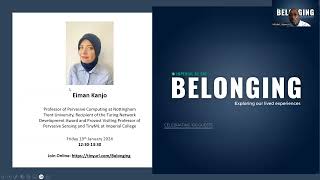
Beyond Limits: Making the Connection - Perspective, Resilience, and Personal Renewal
Explore personal growth, resilience, and overcoming challenges through Professor Kanjo's journey of self-discovery and professional development in engineering and computing.