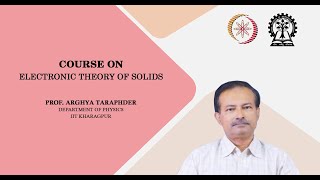
Electronic Theory of Solids
Comprehensive exploration of solid-state physics, covering electron behavior, quantum mechanics, band theory, magnetism, and superconductivity, with applications in modern technology.

Chirality and Topology in Materials Science - Lecture 34
Explore chirality and topology in materials science with Prof. Claudia Felser's lecture on cutting-edge research and applications.
Complex Magnetism in High Temperature Two-Dimensional Magnets
Explore complex magnetism in high-temperature 2D magnets, focusing on emergent phenomena, topological effects, and novel materials in reduced dimensions.
Spin-Polarization and Topological Hall Effects in Oxide Interfaces and Thin Films
Explores spin-polarization and topological Hall effects in oxide interfaces and thin films, discussing emergent phenomena in 2D quantum materials and their potential applications.
Active Ballistic Orbital Transport in Ni/Pt Heterostructure
Exploration of active ballistic orbital transport in Ni/Pt heterostructures, examining emergent phenomena in 2D quantum materials and their potential applications in spintronics and quantum computing.
Non-Linear Hall Effect in Flatlands and Chiral Crystals
Explore non-linear Hall effect in flatlands and chiral crystals, examining emergent phenomena in 2D quantum materials and their potential applications in advanced electronics.

Machine Learning Based on Stochastic Magnetic Tunnel Junctions
Explore spintronics-based neuromorphic systems for efficient machine learning, addressing device variability through in situ learning in Boltzmann machines for autonomous AI applications.
Quantitative Modeling of Magnetic Materials at the Atomic Scale
Explore quantitative modeling of magnetic materials at atomic scale, focusing on atomistic spin dynamics and quantum thermostat implementation for accurate thermodynamic calculations.
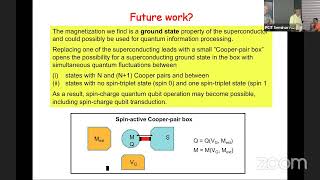
Magnetizing a BCS Superconductor by Spin-Dependent Tunneling
Explore spin-dependent tunneling in BCS superconductors and its potential for unlocking spin degrees of freedom, enabling novel spintronics applications and dissipation-less spin currents.
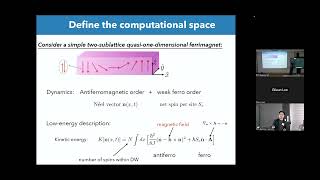
Shuttling Domain Wall Qubit on the Magnetic Racetrack
Explore a scalable quantum computing implementation using mobile domain walls on magnetic racetracks, with long-lived qubits and noise-resistant operations.
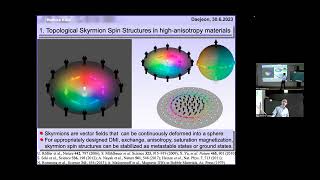
Skyrmions in Spin-Orbitronics and Orbitronics - Novel Science and Applications in Memory and Non-Conventional Computing
Explore novel spintronic devices using skyrmions for energy-efficient memory and non-conventional computing. Learn about topological stability, efficient manipulation, and applications in stochastic and reservoir computing.

Chiral Induced Spin Selectivity and Time-Reversal Symmetry Breaking
Explore chiral-induced spin selectivity in helical molecules, examining theoretical explanations and experimental findings. Analyze various models to overcome Bardarson's theorem and achieve spin polarization.