Topological Evolution of Time in Unimodular Gravity
Explore the concept of topological evolution of time within the framework of Unimodular Gravity, as presented by Sayyed Rassouli from the University of Nottingham.
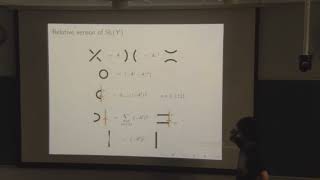
3D Quantum Trace Map: Construction and Applications in Ideally Triangulated 3-Manifolds
Explore the construction of the 3d quantum trace map, linking Kauffman bracket skein modules to quantum gluing modules in ideally triangulated 3-manifolds.
Probably Approximately Correct Mathematical Physics
Explore applications of machine learning in string theory and mathematical physics, focusing on black holes and higher-spin holography.
Physmatics - The Tip of the Iceberg
Explore quantum field theory, string theory, and black hole physics with a theoretical high energy physicist. Uncover spacetime's building blocks and matter's essence.
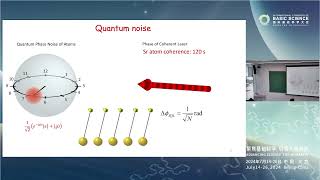
Quantum Frontier for Atomic Clocks and Fundamental Physics
Explore quantum entanglement's impact on precision measurement, atomic clocks, and fundamental physics. Discover advances in atomic interactions, gravitational time dilation, and spin entanglement.
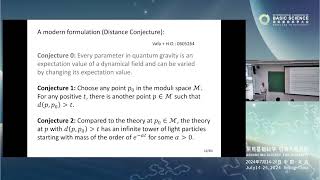
Constraints on Quantum Gravity
Explore constraints on quantum gravity theories, focusing on AdS/CFT correspondence and recent progress in holographic approaches. Examine symmetry constraints and the Distance Conjecture proof.
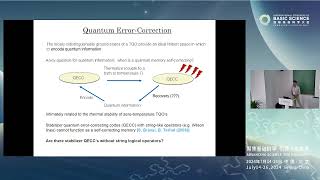
Fracton Quantum Order
Explore fracton phases in quantum systems, their restricted mobility excitations, and ground-space degeneracy. Review key developments and unifying perspectives on these emergent phases.
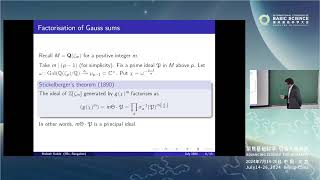
Mathematical Theories for Metamaterials: From Condensed Matter Theory to Subwavelength Physics
Explore mathematical theories for metamaterials, bridging quantum and classical physics to revolutionize nanotechnology and subwavelength wave manipulation.
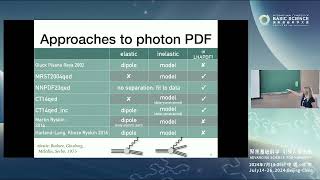
How Bright is the Proton? A Precise Determination of the Photon Parton Distribution Function
Explore the precise determination of photon distribution in protons using electron-proton scattering data, enhancing our understanding of particle physics at the Large Hadron Collider.
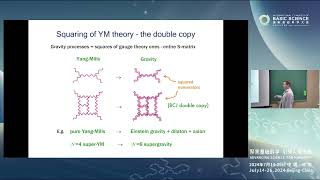
Gravity as a Double Copy of Gauge Theory
Explore the gravitational double copy framework, connecting gravity to Yang-Mills theory and enabling advanced quantum computations and classical general relativity studies.
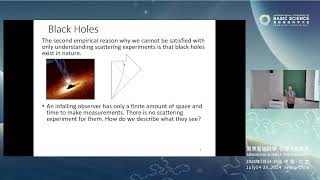
Bulk Locality and Quantum Error Correction in Holography
Explore quantum gravity through AdS/CFT correspondence, unraveling the emergence of local physics and its connection to quantum error correction.
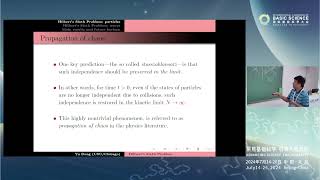
Hilbert's Sixth Problem: From Particles to Waves
Explore Hilbert's Sixth Problem in statistical physics and kinetic theory, examining the derivation of macroscopic laws from microscopic systems in classical and quantum settings.
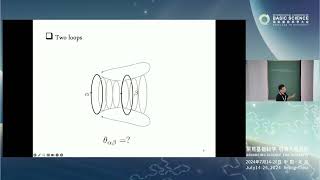
Exploring Loop-Like Topological Excitations in Three Dimensions
Explore loop-like topological excitations in 3D quantum matter, their unique braiding statistics, and role as order parameters for characterizing topological phases.
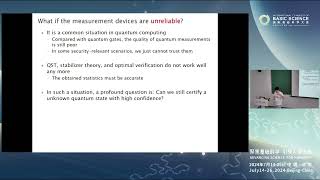
Certifying Bipartite Pure Quantum States Efficiently Using Untrusted Devices
Explore efficient certification of bipartite pure quantum states using untrusted devices, requiring fewer measurements while maintaining reliability in quantum experiments.
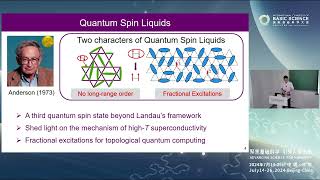
Neutron Spectroscopy Studies of Kitaev Quantum Magnets
Explore Kitaev quantum magnets through neutron spectroscopy, examining the Kitaev model, its realization in α-RuCl3, and extension to higher-spin systems like Na3Ni2BiO6.
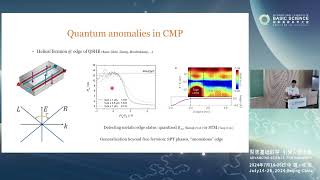
Detecting Quantum Anomalies in Open Systems
Explore novel approach for detecting quantum anomalies in open systems, focusing on mixed anomalies in spin chains and their distinctive characteristics in measurements.
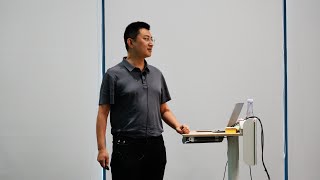
Alterfold Topological Quantum Field Theory
Explore the connection between injective ground states of gapped Hamiltonians and TQFT, bridging topological orders with constructive quantum field theory.
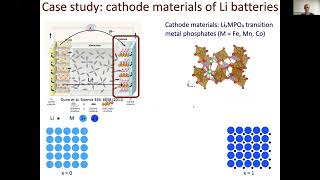
DFT+U and DFT+U+V: Basic Concepts and Applications - Advanced Quantum ESPRESSO Tutorial 2022
Explore DFT+U and DFT+U+V concepts, applications in materials science, and their impact on electronic localization and energetics in various systems.
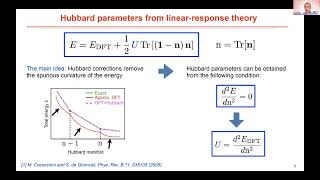
First-Principles Calculation of Hubbard Parameters Using Linear-Response Theory - Tutorial 2022
Learn advanced techniques for calculating Hubbard parameters using linear-response theory in DFT+U(+V) approach. Explore applications in materials science, including battery voltages and vacancy formation energies.
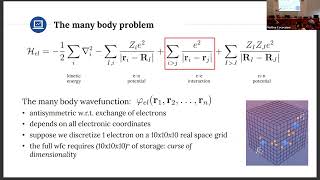
Introduction to Density-Functional Theory - QE School 2023 Lecture 1.2
Explore density-functional theory fundamentals, focusing on Hubbard and Koopmans functionals from linear response in advanced quantum calculations.
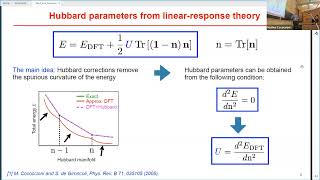
First-Principles Calculation of Hubbard Parameters Using Linear-Response Theory - QE School 2023
Explore first-principles calculation of Hubbard parameters using linear-response theory in advanced Quantum ESPRESSO applications for materials science.